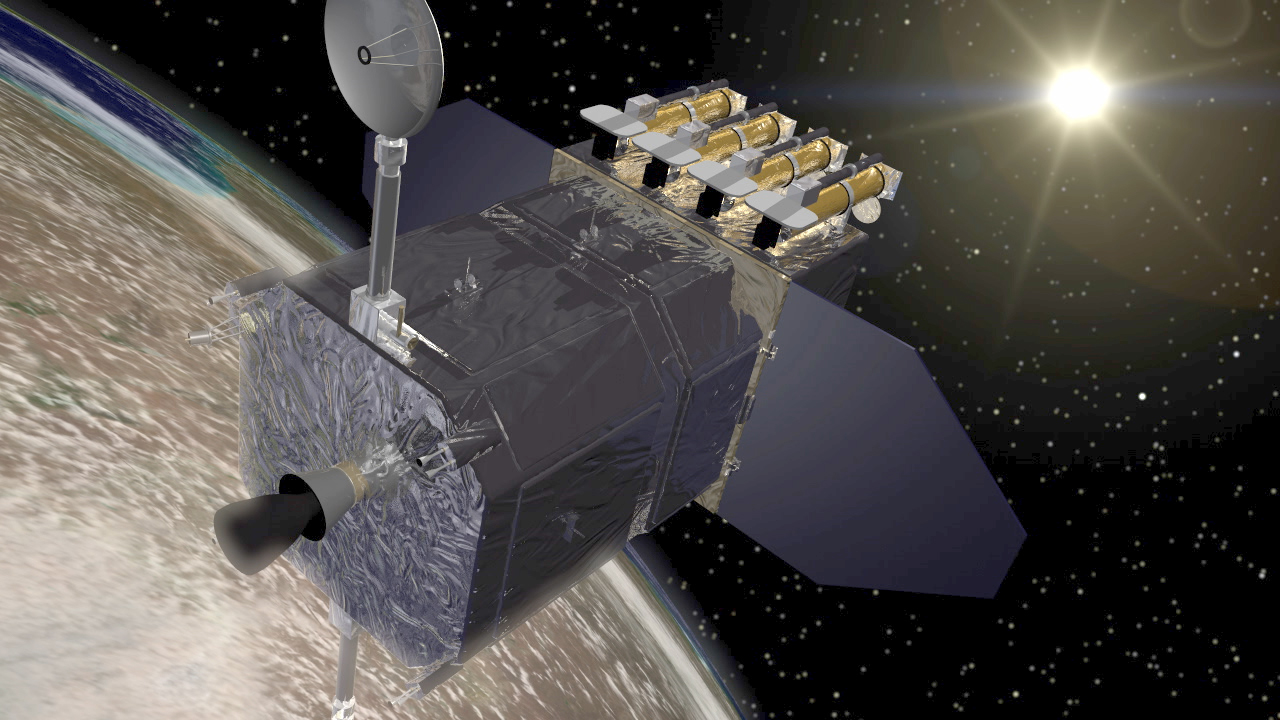
Solar Dynamics Observatory
SpacecraftWikipedia
5
MENTIONS
4
EPISODES
4
PODCASTS
Search complete. 5 mentions across 4 episodes found for "Solar Dynamics Observatory".
Oct 8, 2026

Cleo AbramHOST
We already passed around 40 satellites orbiting Earth studying the sun, and now we're speeding past a very special one.
Cleo AbramHOST
This is the Solar Dynamics Observatory.
Cleo AbramHOST
It's snapping pictures of the sun in all these different wavelengths.
speaker_1SOUNDBITE_SPEAKER
It's one of the biggest data sets that we have at NASA, and it's frankly the beating heart of watching the sun every day and its activity and its changes.

Alex Zaharov-ReuttCORRESPONDENT
In late 2024, Kravova and colleagues were able to show that super flares occur roughly once a century on stars that resemble our sun in key characteristics, such as similar metallicity, luminosity, and mass.
Alex Zaharov-ReuttCORRESPONDENT
So the authors analyzed data collected by NASA's Solar Dynamics Observatory spacecraft between 2010 and 2016.
Alex Zaharov-ReuttCORRESPONDENT
They correlated the amount of energy released by the 300 strongest solar flares during this period and compared that with the size of the corresponding active region the flares came from on the sun's visible surface.
Alex Zaharov-ReuttCORRESPONDENT
Active regions are areas on the sun's surface where the magnetic field is especially strong and complex in structure.

Stuart GaryHOST
In late 2024, Kruvova and colleagues were able to show that super flares occur roughly once a century on stars that resemble our sun in key characteristics, such as similar metallicity, luminosity, and mass.
Stuart GaryHOST
So the authors analyzed data collected by NASA's Solar Dynamics Observatory spacecraft between 2010 and 2016.
Stuart GaryHOST
They correlated the amount of energy released by the 300 strongest solar flares during this period and compared that with the size of the corresponding active region the flares came from on the sun's visible surface.
Stuart GaryHOST
Active regions are areas on the sun's surface where the magnetic field is especially strong and complex in structure.

speaker_2SOUNDBITE_SPEAKER
Its main objective is to investigate the physics behind how the sun works.
Dean RegasHOST
And the Solar Dynamics Observatory can observe the sun twenty-four hours a day.
Dean RegasHOST
SOHO, for instance, sits almost one million miles from us, and closer to the sun, too.
Dean RegasHOST
Okay, it's still, like, ninety-two million miles from the sun, but SOHO has been watching the sun steadily since its launch in 1995, making it one of the longest-lasting missions ever.
16 MINS LATER
Dean RegasHOST
You'll go blind.
Dean RegasHOST
So yeah, don't stare at the sun.
Dean RegasHOST
Instead, check out all the cool solar observatories websites, browse SOHO, STEREO, Solar Dynamics Observatory, and of course, the Parker Solar Probe.
Dean RegasHOST
We'll link to them in the show notes, too.