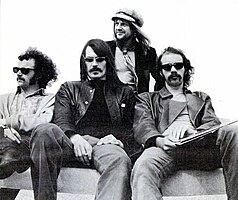
Soft Machine
Rock bandWikipedia
50
MENTIONS
17
EPISODES
12
PODCASTS
Search complete. 50 mentions across 17 episodes found for "Soft Machine".
Sep 12, 2026

Guy PrattHOST
I'm s-
Gary KempHOST
They're sort of Soft Machine gone even weirder
Guy PrattHOST
...
Guy PrattHOST
Traffic, Jethro Tull, um-
Gary KempHOST
But, I mean, if you call yourself Warm Dust, you're not really hoping on being a massive band, are you?
Paul CarrackGUEST
[laughs] Who kn- who kn- back then, who knows?
Gary KempHOST
Uh, Soft Machine, I suppose.
Gary KempHOST
Yeah, yeah, yeah.

Markus ReuterHOST
I mean, relatively speaking.
Markus ReuterHOST
And then, like, and this is, like, Carl Jenkins and Mike Radlich, both of Soft Machine.
Tobias FischerHOST
Yeah.
Markus ReuterHOST
Right? So they have pretty much the jazz rock, experimental jazz rock, and are tied, closely tied up with Mike's work, early work, before he did Tubular Bells.
Markus ReuterHOST
Because, you know, like, Originally, David Allen, Robert Wyatt, Kevin Ayers were the Soft Machine.
Markus ReuterHOST
And the Soft Machine was an experimental pop band, let's say, or rock band initially, then turned into some sort of jazz rock.
Markus ReuterHOST
And Carl Jenkins joined, I guess, sometime in the early 70s.
Markus ReuterHOST
Yeah.

Wesley StaceGUEST
The Canterbury scene of progressive rock music, which was a very, not like Yes, not like Genesis, a little bit more like early Pink Floyd, but a very strange little subsection of British prog.
Wesley StaceGUEST
That included the great band Soft Machine, for which Kevin Ayres was the lead singer originally, and then Kevin Ayres left and Robert Wyatt took over as the lead singer.
Wesley StaceGUEST
And also another of my favourite bands, the band Caravan, and then many other bands, Egg, Gilgamesh, National Health, so many incredible, Wildflowers, another early version of Soft Machine, so many great bands out of that scene.
Wesley StaceGUEST
But that was dead by the time I, I mean, I'm sure that some of the musicians lived there, but basically the scene of it was completely dead by the time I got there.
Wesley StaceGUEST
So I was there and I was in Canterbury and there had been a Canterbury scene, but it wasn't when I was there, you know, because obviously in those years, punk and new wave were the dominant, even chart forms of music, you know, like everybody was listening to the Buzzcocks and the Damned and the Jam.
Wesley StaceGUEST
And certainly in Canterbury, no one was listening or I knew was listening to Soft Machine.
Wesley StaceGUEST
Here's what happened.
Wesley StaceGUEST
There was a great shop record store in Canterbury, and it's still there, run by the same guy called Canterbury Rock.

Nick SolomonHOST
That's what I can tell you about them.
Nick SolomonHOST
So who have we got now? This is, yeah, when the Soft Machine had their first breakup, which was after, I think, Soft Machine 4.
Nick SolomonHOST
They'd done four albums and Robert Wyatt, their drummer, decided to depart and do his solo stuff afterwards.
Nick SolomonHOST
And he'd always liked singing as well, which he did.
Nick SolomonHOST
And it's a lovely single.
Nick SolomonHOST
And it came out on CBS Records in 1972.
Nick SolomonHOST
And Matching Mole was a play on words, really, because it was the French for soft machine is machine moule.
Nick SolomonHOST
And they just kind of anglicised it and called it Matching Mole.

Jimmy WaldoGUEST
So those are the keyboard players that influenced me.
Jimmy WaldoGUEST
And Mike Ratledge, I don't know if you remember a band called The Soft Machine.
Jimmy WaldoGUEST
Well, the English band, more of a proggy, proggy kind of a jazz thing.
Jimmy WaldoGUEST
I didn't care for their songs, but that's...

Farmer JohnHOST
Super Sister recorded four albums between 1970 and 1973.
Farmer JohnHOST
They were highly influenced by Soft Machine, using very little vocals, with long instrumental passages that often incorporated unusual time signatures.
Farmer JohnHOST
This is the type of music that doesn't usually result in hits, but this band lucked out when a pirate radio station picked up their first single, which helped open the door for them to record full albums.
speaker_6SOUNDBITE_SPEAKER
The song She Was Naked was born that way, and from then it went really fast.

Farmer JohnHOST
Super Sister recorded four albums between 1970 and 1973.
Farmer JohnHOST
They were highly influenced by Soft Machine, using very little vocals, with long instrumental passages that often incorporated unusual time signatures.
Farmer JohnHOST
This is the type of music that doesn't usually result in hits, but this band lucked out when a pirate radio station picked up their first single, which helped open the door for them to record full albums.
speaker_4SOUNDBITE_SPEAKER
The song She Was Naked was born that way, and from then it went really fast.
Nick SolomonHOST
That's the sound of Kevin Ayres and the whole world doing a track called Lunatics Lament.
Nick SolomonHOST
And that comes off, well, Kevin Ayres' second solo album after leaving the Soft Machine.
Nick SolomonHOST
And it is called Shooting at the Moon.
Nick SolomonHOST
And it came out on Harvest in 1970.

speaker_0HOST
He is considered to be Norway's most influential swing era jazz trumpet player.
speaker_0HOST
John Stanley Marshall was born in 1941, British jazz rock fusion drummer who gained fame as a founding member of the group Nucleus and also for his work with the prog rock band Soft Machine.
speaker_0HOST
Cheryl Porter was born in 1972, classically trained opera and jazz singer who achieved global fame as a vocal coach and also an educational creator on social media platforms.
speaker_0HOST
Cécile McLorin Salvant was born in 1989, multi-Grammy Award-winning French-American jazz vocalist.

Tony DavenportHOST
Followed by another sort of classic old connection, the Stan Tracy Quartet, often played, of course, at Ronnie Scott's, one of the resident bands there, and from the Under Milk Wood album in 1965, and the title track from that album.
Tony DavenportHOST
Now then, I'm moving on to a slightly different sound, a more sort of jazz fusion-y sound, firstly with Chick Corea, then Soft Machine.
Tony DavenportHOST
Soft Machine Bye.
Tony DavenportHOST
? ? ? ? ? ?
speaker_0UNKNOWN
? ? ? ? Thank you.
7 MINS LATER
speaker_0UNKNOWN
No, it's just a Thank you.
Tony DavenportHOST
musings from the edge of jazz there.
Tony DavenportHOST
Firstly Chick Corea from the definitive Chick Corea on Stretch and Concord 2009 compilation and his track Quartet No. 1 followed by Soft Machine from Volume 2 in 1969 and the very quirky and fun Dada Was Here.
7 more episodes mention Soft Machine.
Create an account to see the whole feed, search across every transcript, and follow the entities you care about.