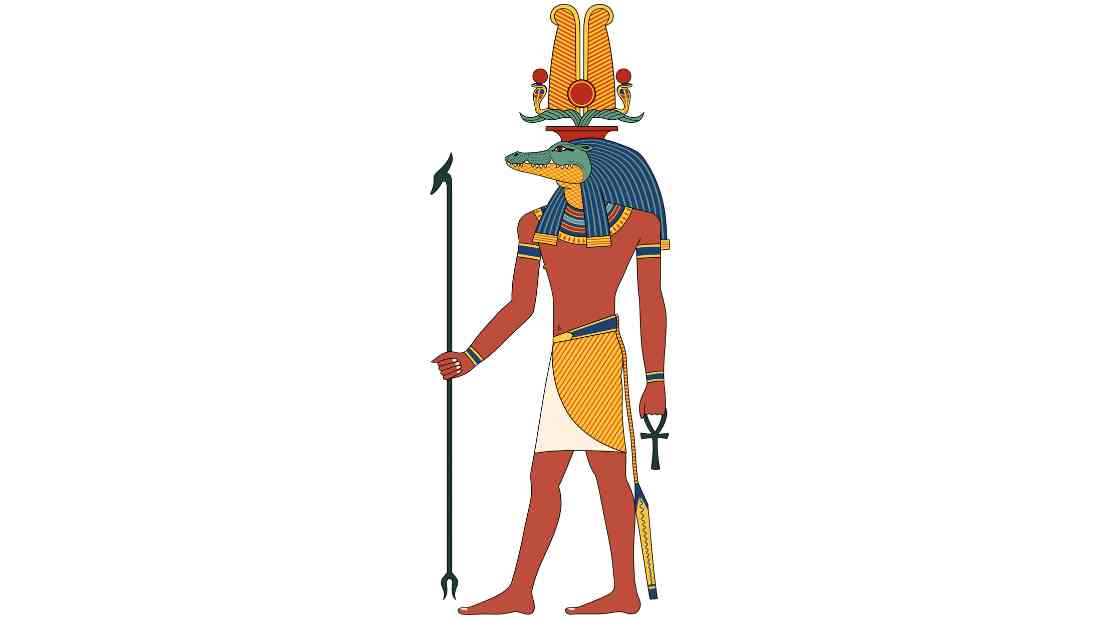
Sobek
DeityWikipedia
56
MENTIONS
13
EPISODES
13
PODCASTS
Search complete. 56 mentions across 13 episodes found for "Sobek".
Sep 11, 2026

EmilyHOST
And the reasons those cities are where they are has kind of ceased to be relevant.
EmilyHOST
And then I just wrote Sobek exclamation point.
PhoebeHOST
Because of the son of Sobek or because you were excited to see him for other reasons?
EmilyHOST
Because of the son of Sobek.
EmilyHOST
I do think Horace and Carter's head during this encounter with Sobek is really funny.
EmilyHOST
Mm-hmm.
EmilyHOST
And be like, yes, this is good.
StevenHOST
And I was like, yes, Carter.

J. Vernon McGeeSOUNDBITE_SPEAKER
They didn't miss an animal, of course, and this animal occupied a very large place in the worship and the religion of Egypt.
J. Vernon McGeeSOUNDBITE_SPEAKER
The god Sebek, S-E-B-E-K, was said to be incarnated in crocodiles.
J. Vernon McGeeSOUNDBITE_SPEAKER
And Apep, A-P-E-P, was the perpetual arch enemy of all the solar gods appeared in the form of a crocodile.
J. Vernon McGeeSOUNDBITE_SPEAKER
Now, they had, for instance, a magical ritual that they went through in the temple of Amun-Ra at Thebes.

Matt MattsonNARRATOR
Thoth Makhshava hunched over clay tablets, elongated skull pulsing with pharmacia-enhanced intellect, as his femur stylus scratched furiously.
Matt MattsonNARRATOR
Sobek the Flesh Eater clacked his massive crocodile jaws repeatedly, spraying blood-flecked saliva onto the railing as he feasted voraciously on platters of forbidden meat and still warm human blood.
Matt MattsonNARRATOR
The runt's favorite still stands, but he frays at the seams, Sobek roared, his laughter booming across the arena like profane thunder that drowned out even the crowd.
Matt MattsonNARRATOR
The blue flame dog has tasted royal blood and found it sweeter than honey.
Matt MattsonNARRATOR
Watch how flesh fails its own bloodline so exquisitely, so inevitably.
12 MINS LATER
Matt MattsonNARRATOR
The dog falters at last.
Matt MattsonNARRATOR
Flesh fails even the most stubborn.
Matt MattsonNARRATOR
Sobek clacked his jaws in delight.

speaker_0NARRATOR
The sacred bird of Thoth stacked floor to ceiling in clay jars.
speaker_0NARRATOR
Mummified crocodiles were associated with the god Sobek.
speaker_0NARRATOR
Mummified baboons, mummified hawks, mummified fish, mummified scarab beetles, each species connected to a deity, each offering a channel of communication between the human and divine worlds.
speaker_0NARRATOR
the scale of it is staggering some of the animal mummies when scanned turned out to be empty or to contain only fragments of bone suggesting that demand for votive mummies so outstripped supply that the priests began producing fakes it was a religion but it was also an industry and where there is industry there is always someone cutting corners to grasp how long this civilization lasted requires a deliberate act of mental recalibration here is the fact that recalibrates most people cleopatra the seventh the last pharaoh of egypt lived closer in time to the moon landing than to the building of the Great Pyramid.

speaker_0NARRATOR
The Nile gave life, but it could also take it without warning.
speaker_0NARRATOR
Egyptians respected crocodiles enough to worship the crocodile god Sobek in many places.
speaker_0NARRATOR
But respect is not the same as affection.
speaker_0NARRATOR
You can honour something precisely because you know what it is capable of doing.
47 MINS LATER
speaker_0NARRATOR
Then, in the Egyptian imagination, the opener of ways stepped forward.
speaker_0NARRATOR
Not to explain what waited at the end, only to make sure the road continued.
speaker_0NARRATOR
Number six, Sobek, the crocodile god.
speaker_0NARRATOR
Wepwet waited at the edge of the road, where the known world gave way to wilderness.

Danny JonesHOST
Whoa.
Louis De CordierGUEST
It was the, the culture of Sobek, and we, we also know that the labyrinth is, was there because of the, the vincity, vinci- vincinity of, uh, of the Crocodilopolis, the, the city of the crocodiles.
Danny JonesHOST
Oh, shit.
Louis De CordierGUEST
Yeah.

speaker_5NARRATOR
It was also worshipped at Onufis, and at Nupti or Ombos it was identified with Seth and held sacred.
speaker_5NARRATOR
Beside the name of Sebek or Sokos in Fayum, it was there identified with Osiris as the western god of the dead.
speaker_5NARRATOR
The frog was an emblem of the goddess Hekt, but was not worshipped.
speaker_5NARRATOR
the cobra serpent was sacred from the earliest times to the present day it was never identified with any of the great deities but three goddesses appear in serpent form uazet the delta goddess of buto mertseger the lover of silence the goddess of the theban necropolis and randut the harvest goddess the memory of great pythons of the prehistoric days appears in the serpent-necked monsters on the slate pallets at the beginning of the monarchy and the immense serpent apop of the underworld in the later mythology the serpent has however been a popular object of worship apart from specific gods we have already noted it on prehistoric amulets and coiled round the hearths of the early dynasties serpents were mummified and when we reach the full evidence of popular worship in the terra-cotta figures and jewellery of later times the serpent is very prominent there were usually two represented together one often with the head of serapis the other of isis so therefore male and female down to modern times a serpent is worshipped at sheikh heridi and miraculous cures attributed to it various fishes were sacred as the oxyrhynchos phagros lepidotos latos and others but they were not identified with gods and we do not know of their being worshipped the scorpion was the emblem of the goddess selk and is found in prehistoric amulets but it is not known to have been adored and most usually it represents evil where horus is shown overcoming noxious creatures It will be observed that nearly all of the animals which were worshipped had qualities for which they were noted, and in connection with which they were venerated.

Megan KennyHOST
So I have some.
Megan KennyHOST
So when Hector has his encounter with the crocodile, he says, oh, holy Sobek, which is a reference to an ancient Egyptian god, Sobek, who people will have seen, I'm sure, on things.
Megan KennyHOST
He's got a crocodile head.
Megan KennyHOST
And he had, actually, there was a cult city called Crocodile, crocodilopolis croc that's a hard one crocodilopolis um that was purely devoted to worship of sobek as well as towerette who was the goddess of childbirth and fertility who had the back and tail of a crocodile so together they make a perfect pair really i suppose And there's also a shrine, a jukun tribe in the Wakari Federation in Nigeria that's dedicated to crocodiles in thanks for their aid during migration.
Megan KennyHOST
Always hungry, every giant on its body was adorned with an extra mouth, which sounds very terrifying.
Megan KennyHOST
But yeah, so Aztec society really worshipped the crocodile as sort of the beginning of all things.
Megan KennyHOST
And in ancient Egypt, as I've mentioned, there's the god Sobek who had this really complex position in ideology.
Megan KennyHOST
So feared as a predator and worshipped as a deity.

JimmyHOST
He built a pyramid at Hawara out of mud brick faced with limestone, and just south of it, he raised something stranger and far larger.
JimmyHOST
The Egyptians knew the wider region for its devotion to Sobek, the crocodile god, and the marshes around the lake were thick with the real animals.
JimmyHOST
The lake wasn't entirely natural either, and ancient writers believed the pharaohs had shaped it into a reservoir for the Nile's floodwater.
JimmyHOST
The nearby capital was so bound to the animal that the Greeks simply called it the City of Crocodiles, where priests kept a jewel-wearing crocodile and fed it by hand.
JimmyHOST
We don't really know what the complex was for, and the best guess is that it did several jobs at once.
JimmyHOST
It was probably a mortuary temple tied to the pharaoh's burial, and also a sort of national gathering place where the administrative districts of Egypt sent their priests to perform rites.
JimmyHOST
Amenemhat's daughter Sobekneferu, who'd later become Egypt's first confirmed female pharaoh, seems to have added her own decorations to it.
JimmyHOST
By the time Greek writers arrived, the building already had a reputation, and Herodotus gave it its most famous description, as was the style at the time.

speaker_1HOST
Right.
speaker_1HOST
Stone was strictly reserved for the gods and the dead.
speaker_1HOST
Stone represented eternity.
DavidHOST
Okay, so what did they use?
8 MINS LATER
speaker_1HOST
Not at all.
speaker_1HOST
Because of the labor and skill involved, honey wasn't something a laborer casually stirred into their morning porridge.
speaker_1HOST
It was an expensive commodity used to sweeten cakes for religious festivals, offered directly to the gods and, as we'll see later, used extensively in medical treatments.
DavidHOST
So we have this picture of a people dealing with gritty, pungent food in cramped, hot, dusty courtyards.
3 more episodes mention Sobek.
Create an account to see the whole feed, search across every transcript, and follow the entities you care about.