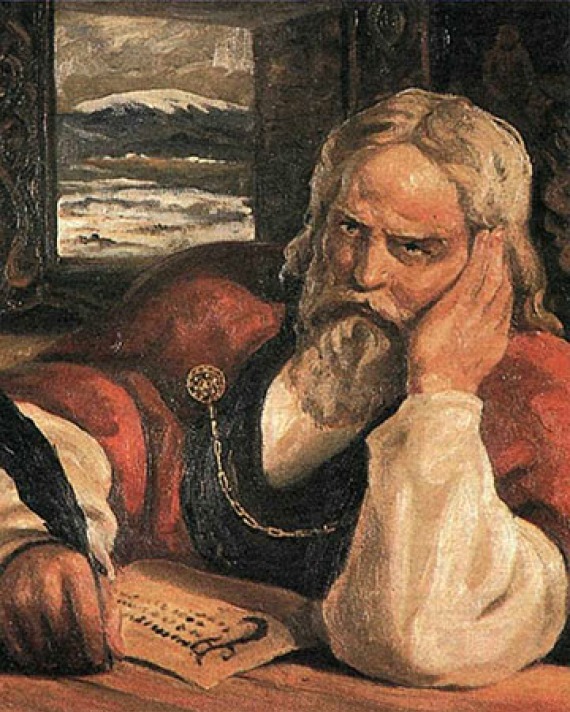
Snorri Sturluson
Icelandic historian and poetWikipedia
40
MENTIONS
23
EPISODES
21
PODCASTS
Search complete. 40 mentions across 23 episodes found for "Snorri Sturluson".
Oct 8, 2026

Einar BlackthornHOST
I have been a heathen all my life, and my 43rd great-grandfather is Rollo, and I am a direct descendant of Ragnar Lothbrok.
Einar BlackthornHOST
I am also Snorri Sturluson's 38th great-grandson.
Einar BlackthornHOST
Not believing in my claims of descent from nobility is a crime tantamount to heresy, and I will not stand for it.
Einar BlackthornHOST
I will challenge you to a Holmgang, and so long as my mom says it's okay, and you can Cash App me for my flight and hotel, we can make it happen.
MattHOST
I always like to put this little note in there.
MattHOST
The Prose Edda was compiled by an Icelandic scholar named Snorri Sturluson around 1200 CE, roughly 200 years after Iceland's conversion to Christianity.
MattHOST
It is our most detailed source for Norse mythology, but it was written by a Christian author attempting to preserve and systemize the older oral tradition of these people.
MattHOST
This context does not invalidate the sources.

Adam GidwitzHOST
It's awesome.
Adam GidwitzHOST
Um, also, how do these two relate to Snorri Sturluson, who the listeners may have heard about in another Norse tale that I told that I called Snorri And The Norn?
Jonah DraganGUEST
They lived quite a long time after Snorri Sturluson, but they would likely have been familiar with the, with the sagas that he wrote down hundreds of years earlier.
Adam GidwitzHOST
So they were living around the same time as the Brothers Grimm, or a little later?
Jonah DraganGUEST
Y- around the same time, and a- as in many countries in Europe, they read the Brothers Grimm stories and thought, first of all, amazing.

Mads HøjmarkGUEST
There are several Which goes for most of, of the ancient mythologies.
Mads HøjmarkGUEST
But the most elaborate one is one, uh, told by, uh, the Icelander Snorri-
James EllisHOST
Mm.
Mads HøjmarkGUEST
Uh, who was originally from Norway, I believe.

Ryan SmithHOST
Like, it only looks bad if you assume that Valhalla is a reward rather than an outcome of leading a particular kind of life.
Ryan SmithHOST
This is also not helped by that this whole reward-punishment frame that exists in larger society has in many ways been read into the Nordic source material, and particularly is quite present in Snorri Sturluson's Prose Edda, which also gives us some of the best direct descriptions of Helheim and the Goddess Hel.
Ryan SmithHOST
That said, we do have evidence that whatever it is that Snorri is describing here is not fully and all-encompassing, because we do see references to hell as well as similar root words that trace back to the Old Norse word for the grave that pop up in many different places.
Ryan SmithHOST
In short, what seems to be the pattern that exists also in grave goods and other material is tends to be more one that suggests rest and preparation for a different kind of existence, rather than expecting reward or punishment upon arrival.
Ryan SmithHOST
So let's talk Helheim for a minute.
Ryan SmithHOST
Helheim itself sits across that river Gjol, and crossing the river requires first confronting the great giant Mogud, who stands guard over the bridge and can either grant passage or deny it to any who seek it.
Ryan SmithHOST
Once one crosses Mogud's bridge, they come upon Helgrind, the great gates of Helheim, which then stand open before all those who come and seek its shelter.
Ryan SmithHOST
Here Snorri gives a bunch of interesting details about Helheim, although I think that these particulars may be more reflections on the way one reaches the realm of Hel, rather than necessarily this is what awaits one in the realm of Hel.

Joe SummerfieldHOST
Today's story comes from Norse mythology, the tales of the gods of the Viking world.
Joe SummerfieldHOST
It was written down in 13th century Iceland by Snorri Sturluson in the collection that we now know as the Prose Edda, drawing on older poems and oral tradition.
Joe SummerfieldHOST
Two small details come from elsewhere in the same tradition.
Joe SummerfieldHOST
Tyr's title, Fosterer of the Wolf, from the part of Snorri's Edda written as a guide for poets, and Tyr's reply to Loki from an older poem called Lokasenna, found in the Poetic Edda.

speaker_0NARRATOR
Unfortunately, very little recorded evidence concerning his early life is extant.
speaker_0NARRATOR
One of the most important sources for his adult life are the writings of Snorri Sturluson, the greatest Norse poet and chronicler of medieval times, who lived in Iceland in the late 12th and early 13th centuries.
speaker_0NARRATOR
He composed a work called the Heimskringla, which transliterates as The Circle of the World.
speaker_0NARRATOR
It was a history of the Norse kings of Norway and Sweden, and Harald features prominently in some sections.
speaker_0NARRATOR
Adam’s life substantially overlapped with that of Hardrada, whom he referred to as The Thunderbolt of the North.
speaker_0NARRATOR
[instrumental music] Little verifiable information exists with which to reconstruct the details of Harald’s childhood.
speaker_0NARRATOR
He was described by the 13th century Icelandic poet Snorri Sturluson as being larger and taller than other men from a young age, with light-colored hair, a substantial beard, and mustache.
speaker_0NARRATOR
The Vikings or Norse people of Scandinavia at the height of the Norse migrations in the 8th, 9th, and 10th centuries did not have a system of formal education.

MattHOST
Before we get into the story, I want to name where it comes from, because it matters.
MattHOST
Most of what we know about Mimir comes from two collections, the Prose Edda, written by Snorri Sturluson, an Icelandic Christian in the 13th century, and the Poetic Edda, which is a collection of older poems that were written down around the same period, also in Christian Iceland, though the poems themselves preserve much older oral material.
MattHOST
That does not make any of these stories false, less valid.
MattHOST
It means we are reading pre-Christian belief through a Christian era lens, written down generations after the tradition that it describes was actively practiced.

JimmyHOST
It was, in essence, historical fiction about a great Viking leader added onto previous historical fiction established by Dudo as, quote-unquote, "historical fact." Interestingly, it seems like the idea of a powerful Viking leader faking his own death was a common motif in Scandinavian culture.
JimmyHOST
Snorri Sturluson, the Icelandic historian, tells the same feigned death trick of Harald Hardrada in Sicily, and Saxo Grammaticus tells it about a legendary Danish king.
JimmyHOST
It's a folk motif that got pinned on whichever Northmen a given author most wanted to portray as a Norse Odysseus.
JimmyHOST
The question that still remains is whether all the references to Hastein are actually to the same legendary Viking leader.

James TurnerGUEST
No, no, it very much is.
James TurnerGUEST
I think it's worth touching at the Heimskringla, Snorri Sturluson's Icelandic saga, I think has a lot to...
James TurnerGUEST
Iceland has just been subjugated by 13th century kings of Norway.
James TurnerGUEST
So I think on the surface it's, like, showing their own side and celebrating their shared legacy.
13 more episodes mention Snorri Sturluson.
Create an account to see the whole feed, search across every transcript, and follow the entities you care about.