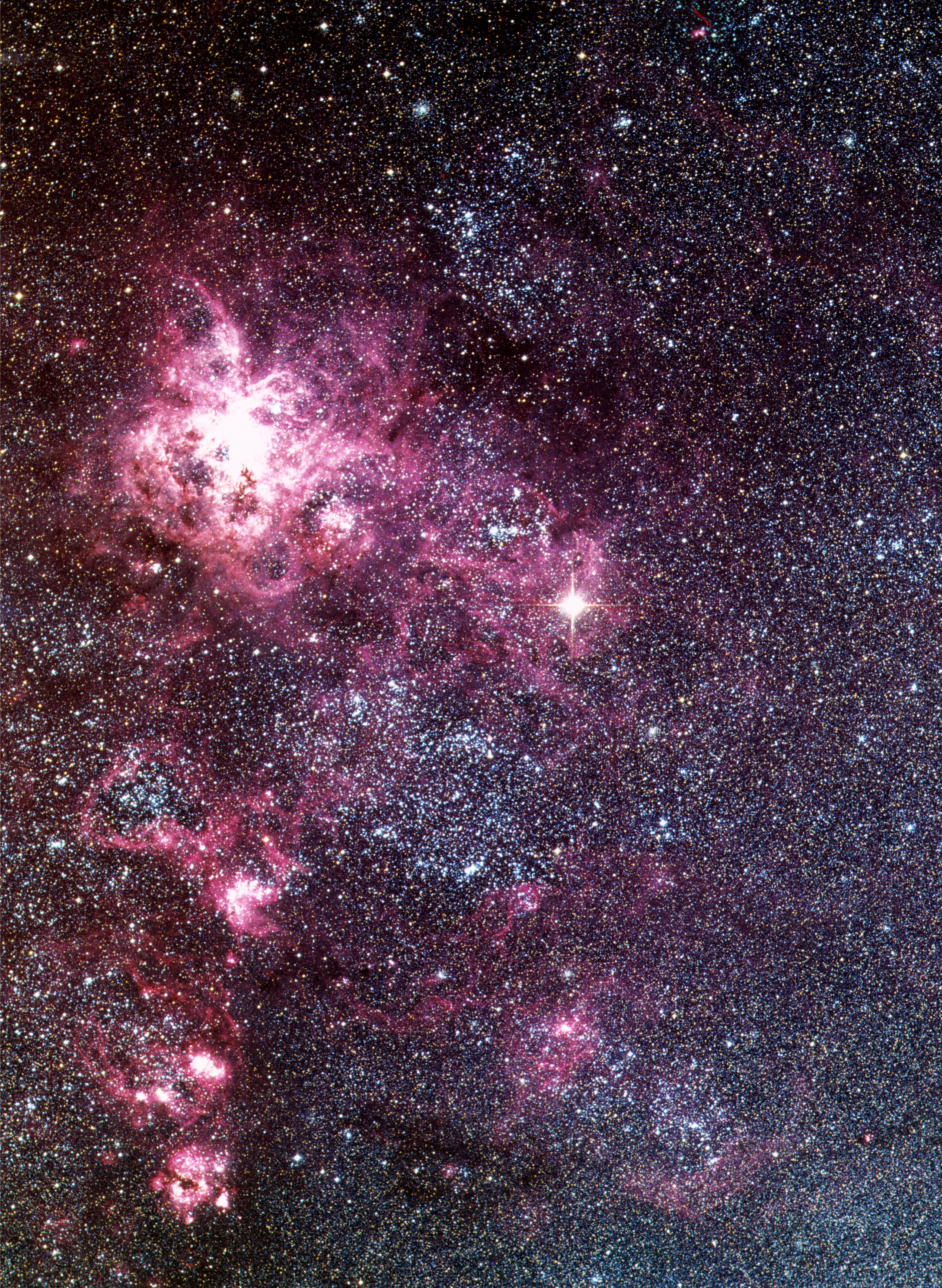
SN 1987A
SupernovaWikipedia
29
MENTIONS
9
EPISODES
7
PODCASTS
Search complete. 29 mentions across 9 episodes found for "SN 1987A".
Oct 9, 2026

AveryHOST
It also fits a lineage.
AveryHOST
Raymond Davis and Masatoshi Koshiba shared a Nobel in 2002 for catching neutrinos from the sun, and from Supernova 1987A, the explosion in the Large Magellanic Cloud we talked about just a few weeks ago, still the only supernova whose neutrinos we've ever detected.
AveryHOST
In 2015, it was Takaaki Kajita and Arthur McDonald for showing neutrinos change flavor.
AnnaHOST
The next step is bigger ice.

AveryHOST
It also fits a lineage.
AveryHOST
Raymond Davis and Masatoshi Koshiba shared a Nobel in 2002 for catching neutrinos from the sun and from Supernova 1987A, the explosion in the Large Magellanic Cloud we talked about just a few weeks ago, still the only supernova whose neutrinos we've ever detected.
AveryHOST
In 2015, it was Takaaki Kajita and Arthur McDonald for showing neutrinos change flavor.
AnnaHOST
The next step is bigger ice.

Kirsty DuffyGUEST
[laughs] The problem with that, though, is, uh, it's happened once, 1987.
Kirsty DuffyGUEST
There was a supernova 1987A, and I think worldwide we saw something like 11 neutrinos.
Kirsty DuffyGUEST
[laughs] So, uh, we only expect a supernova of that size in our galaxy to happen once every 100 years, um, so everyone really wants to be prepared [laughs] the next time.
Hamish JohnstonHOST
Yeah.

LeonHOST
Oh, good question.
LeonHOST
Yes and no, in the sense that the data we got from Supernova 1987A suggests that the action happened over a period of just several seconds, like the core collapse and then the rebound and all of that.
LeonHOST
But because the star, by the time these stars explode, they're... hundreds of millions of kilometres wide because they've swollen up in their old age, the time it takes for the shockwave to travel out and for all of the actual chaos to take place is of order several weeks.
AliciaHOST
Right, okay.

SharnaHOST
Mm-hmm
LeonHOST
Uh, so the Supernova 1987A, as it was called-
SharnaHOST
Catchy name
LeonHOST
Yep

LeonHOST
And that happened inside the Milky Way galaxy.
LeonHOST
So the supernova 1987A, as it was called, happened inside the Large Magellanic Cloud.
LeonHOST
So it wasn't inside the Milky Way, but it was close enough, and it was the closest one astronomers had seen.
LeonHOST
And, of course, in 1987, you have to remember, compared to today where we have automated computers that will scan the sky every night looking at distant galaxies, to find a supernova back then was still pretty exciting news, and let alone to find one that was right next door.

JoshHOST
The Montreal Protocol was signed on September 16th, creating an international agreement to phase out chemicals responsible for damaging the ozone layer.
JoshHOST
Supernova SN 1987A was discovered in February in the Large Magellanic Cloud, becoming the brightest supernova visible from Earth in centuries.
DaveHOST
Hmm.
Baba LouieHOST
Very exciting.
AnnaHOST
Bi Li put the scale plainly.
AnnaHOST
Those one hundred and eighteen bubbles correspond to thousands of supernova explosions over the past forty million years.
AnnaHOST
Then the actual test.
AnnaHOST
From the bubbles, they calculated the rate at which supernovae are injecting kinetic energy between ten to the forty-ninth to ten to the fifty-one and a half ergs per cubic kiloparsec per million years.
AnnaHOST
Separately, and this is the part that makes the paper work, they derived the rate at which turbulence is dissipating energy from the same data using the observed motions of the gas.
AnnaHOST
Two independent numbers.
AnnaHOST
In magnitude, and this is the stronger claim, in spatial distribution.
AnnaHOST
It's not just that the galaxy-wide totals happen to agree, which could be coincidence between two quantities that both scale with how many stars a galaxy has.
AnnaHOST
All of these are real.
AnnaHOST
The question was never whether supernovae contribute.
AnnaHOST
It was whether they are enough on their own to pay the whole bill.
AveryHOST
And to answer that, you need to do something nobody had managed.
AveryHOST
Super bubbles are the fingerprints.
AveryHOST
Each one carries in its size and its expansion speed a record of how much energy went into it and roughly when.
AnnaHOST
So a complete dynamically resolved census of super bubbles across an entire galaxy would let you add up the energy supernovae have actually delivered and then compare it against how fast the turbulence in that same galaxy is bleeding energy away.
AnnaHOST
If the two numbers match, you have your answer.