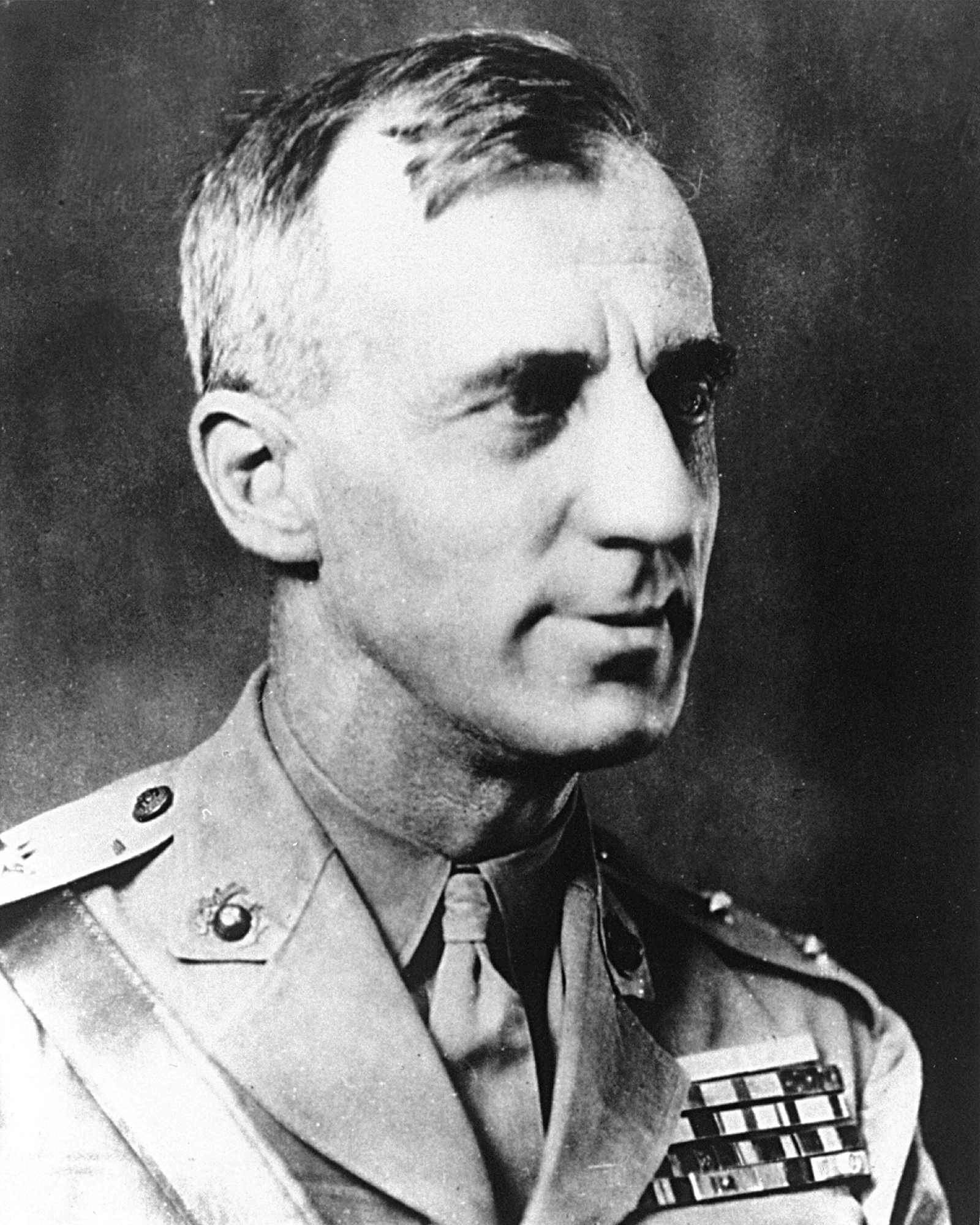
Smedley Butler
WriterWikipedia
84
MENTIONS
45
EPISODES
39
PODCASTS
Search complete. 84 mentions across 45 episodes found for "Smedley Butler".
Sep 18, 2026

Mel KHOST
What they do care about is who's going to reconstruct after the war, because that's where the money is made.
Mel KHOST
Smedley Butler told us after World War I, it's very clear after World War II, with the United Nations and the black holes of the World Bank and the IMF and all of the 63 development banks that have total immunity and the growth of the UN, trillions of U.S. taxpayer dollars missing.
Mel KHOST
Trillions since then and to this day, and nobody's been held accountable.
Mel KHOST
So keep that in mind.

Ken HarbaughHOST
This isn't exactly new.
Ken HarbaughHOST
In 1935, General Smedley Butler wrote, War is a racket, arguing that too often America wages war for the profit of arms makers and financiers, not for national defense.
Ken HarbaughHOST
Butler was a decorated Marine general who came to see his own decades of interventions abroad as protecting corporate interests rather than protecting the country.
Ken HarbaughHOST
He stood up for the veteran bonus marchers in 1932, and in 1934 exposed an attempt by America's wealthiest businessmen to overthrow FDR's government.
Ken HarbaughHOST
Chris, welcome to the show.
Ken HarbaughHOST
You are part of the re-release of this podcast.
Ken HarbaughHOST
incredible book, historic book, Smedley Butler's War is a Racket, which couldn't have been written by a more authoritative voice on this question.
Ken HarbaughHOST
Smedley Butler, a general with an incredible record of service in foreign wars from Mexico to beyond and saw the light when conspirators asked him to lead a coup against the democratically elected government.

Jonathan KatzGUEST
It's called The Big Truck That Went By, How the World Came to Save Haiti and Left Behind a Disaster.
Jonathan KatzGUEST
And then the second book, which is very much on topic for the podcast, is Gangsters of Capitalism, Smedley Butler, The Marines, and the Making and Breaking of America's Empire.
Jonathan KatzGUEST
which is about sort of the rise of America's overseas empire in the early 20th century, but also its echoes and legacies in our own time.
Jonathan KatzGUEST
So there's a very brief mention of the thing that we're going to be talking about today, although it doesn't primarily deal with that moment.
33 MINS LATER
Jonathan KatzGUEST
That means a ton.
Jonathan KatzGUEST
And, you know, there's a lot of like, there's a lot of like big names that show up at various points along the way.
Jonathan KatzGUEST
Like Herbert Hoover shows up as a young man in China and gets Smedley Butler, who's effectively the main character of the book, gets shot in the Battle of Tianjin.
Jonathan KatzGUEST
Teddy Roosevelt shows up before he's, you know, a major international figure.

Kit CabelloGUEST
Wait.
Kit CabelloGUEST
Be- better yet, better yet, let's, let's let us not forget the greatest, and in my opinion, I'm gonna say this, Smedley Butler, okay?
Garland NixonHOST
Yes.
Garland NixonHOST
Yes, yes.
Garland NixonHOST
They called him a communist, and why? Because he was doing things for poor people.
Garland NixonHOST
He was electrifying areas, he had Tennessee Valley Authority.
Garland NixonHOST
He was giving boots to people and giving them a job and all that stuff, and so these titans of industry all decided, "We're gonna overthrow him, and Smedley Butler is gonna be our point man." So they got to Smedley Butler and he says, "We're gonna overthrow FDR, and we're gonna have a coup, and you, sir, are gonna run it." And Smedley Butler, who was a true patriot, ratted them out and said, "Oh, no.
Garland NixonHOST
Not, not...

KubaGUEST
I've known plenty of people who are former, uh, US intelligence or, uh, former service men and women that join with a relatively normie, vaguely patriotic sense of, um, national service.
KubaGUEST
Then once they see what it means to operate in this space, you know, they go full Smedley Butler and recognize that they were just, um, stooges for, for capital.
KubaGUEST
For me, what's important, as much as the i-ideological shift, is the knowledge base that they bring with them.
KubaGUEST
Wherever there's been a successful so-- uh, socialist revolution, one fundamental issue is: how do we keep doing all of the technical stuff that the old state was doing without any of the new-- without any of the old state personnel? And what happens time and again is that first you try to do it with your own cadres.

David FeldmanHOST
Yes, we'll finance Hitler and maybe stage a coup, but that didn't work.
David FeldmanHOST
Smedley Butler.
David FeldmanHOST
Although I've been told that wasn't really a coup.
David FeldmanHOST
Anyway, the Republicans kind of were embarrassed.

Aaron BennettNARRATOR
Vandergriff would spend the greater part of the next decade in Haiti, where he fought Keiko bandits and served as an inspector of constabulary with the Gendarmerie de Haiti.
Aaron BennettNARRATOR
It was in Haiti that he met and was befriended by Marine Colonel Smedley D. Butler, who called him Sonny Jim.
Aaron BennettNARRATOR
The lessons of these formative years fighting an elusive enemy in a hostile jungle environment were not lost upon the young Marine officer.
Aaron BennettNARRATOR
He spent the next 18 years in various posts and stations in the United States, along with two tours of China duty at Peiping and Tientsin.

KubaPANELIST
I've known plenty of people who are former, um, US intelligence or, uh, former service men and women that join with a relatively normie, vaguely patriotic sense of, um, national service.
KubaPANELIST
Then once they see what it means to operate in this space, you know, they go full Smedley Butler and recognize that they were just, um, stooges for, for capital.
KubaPANELIST
For me, what's important as much as the i- ideological shift is the knowledge base that they bring with them.
KubaPANELIST
Wherever there's been a successful so-- uh, socialist revolution, one fundamental issue is how do we keep doing all of the technical stuff that the old state was doing without any of the new... without any of the old state personnel? And what happens time and again is that first you try to do it with your own cadres.
Mel KHOST
And of course, that happened right after that.
Mel KHOST
But we have to remember endless war for profit, uh, was warned to us, uh, by Smedley Butler after the First World War when he said, "All wars are racket.
Mel KHOST
All wars are bankers' wars." We've heard it all.
Mel KHOST
Uh, but we do have to start to be honest and look in the mirror and, uh, I think, pray and then, you know, repent and all that good stuff this, uh, at this time.

VyzygothHOST
They weren't jumping the Atlantic Ocean.
VyzygothHOST
And when I think about what Smedley Butler had to say about it, he's absolutely right.
VyzygothHOST
He goes, yeah, good luck with setting up a beachhead, you know, in Asbury Park.
VyzygothHOST
But anyway, again, to me, war is all manipulated.
35 more episodes mention Smedley Butler.
Create an account to see the whole feed, search across every transcript, and follow the entities you care about.