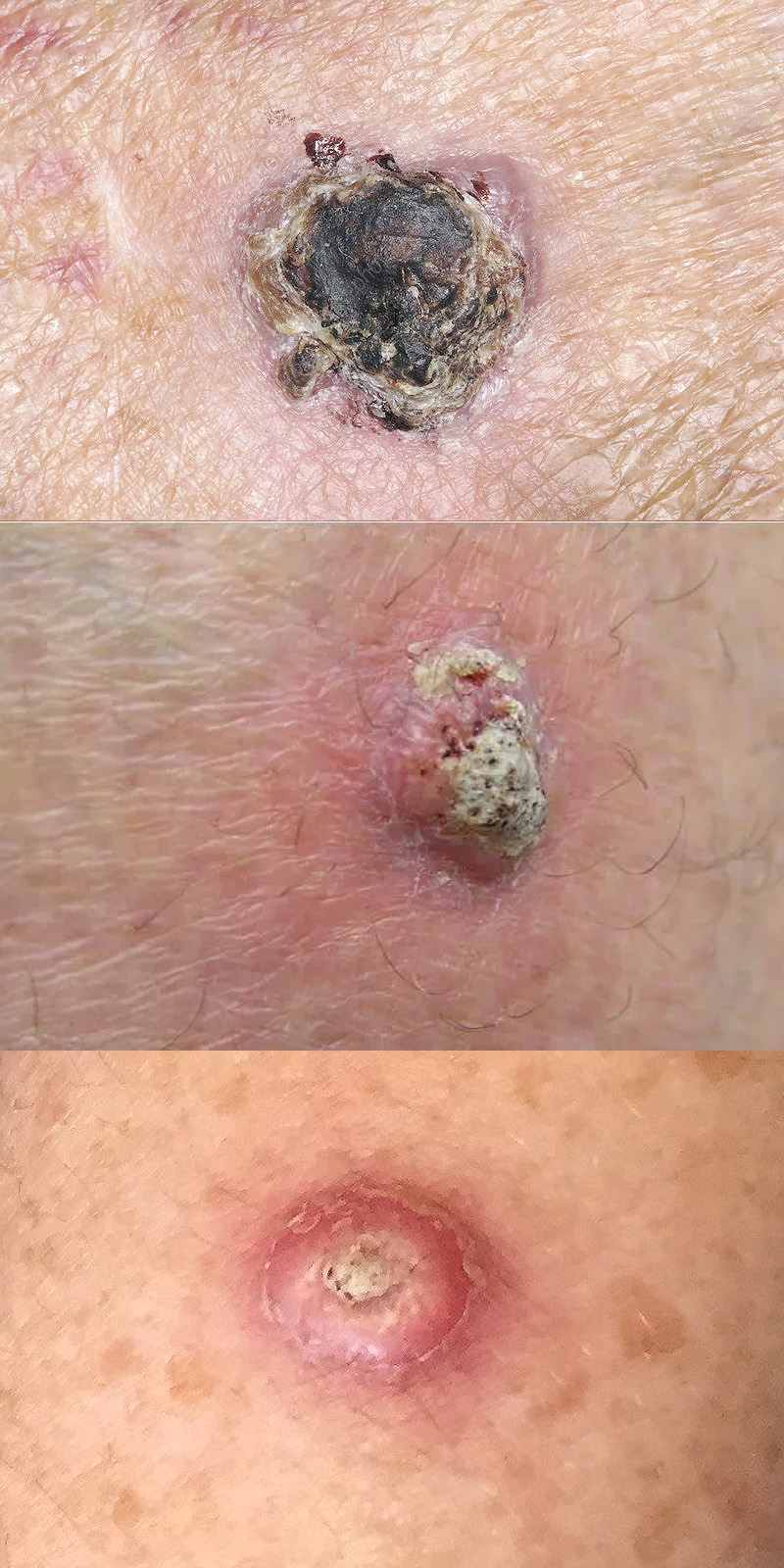
Skin Squamous Cell Carcinoma
DiseaseWikipedia
53
MENTIONS
6
EPISODES
6
PODCASTS
Search complete. 53 mentions across 6 episodes found for "Skin Squamous Cell Carcinoma".
Oct 21, 2026

FergusonHOST
Reapplication every two hours outdoors matters more than the SPF number.
JiyadHOST
Finally, the European CSCC Guideline Update, Part 1, Diagnostics and Prevention.
JiyadHOST
Stratigos et al., European Journal of Cancer.
JiyadHOST
This is a big one for skin cancer clinics.
FergusonHOST
It classifies common primary CSCC as low risk or higher risk.
FergusonHOST
Advanced CSCC is locally advanced, locoregional metastatic, or distant metastatic.
FergusonHOST
And there's a new five-group difficult-to-treat classification.
FergusonHOST
The nine risk factors are listed.

Anna Olsen-BrownHOST
But in the adjuvant setting, the question is, can we reduce the risk of malignancies recurring? Now, don't get me wrong, it is important in every cancer that we can try and do that.
Anna Olsen-BrownHOST
But I think whenever I think about the potential benefit of adjuvant treatment in cutaneous SCC, what I think about is the hugely significant impact on quality of life that we see in patients that have got recurrent SCC.
Anna Olsen-BrownHOST
And also because they tend to occur on the skin, patients tend to have often recurrent and sometimes incredibly morbidity-inducing surgeries, and more and more of them in through their life.
Anna Olsen-BrownHOST
And I will see patients that are coming to my clinic who've had 10, 15 surgeries for squamous cell carcinoma over their life.

speaker_0NARRATOR
[gentle music] The following podcast is part of a certified educational activity titled "The Next Act of Immunotherapy in CSCC: Upgrading the Risk Adapted Management of Resectable Disease." Access the entire activity and complete the post-test at peerview.com/DAP860.
speaker_0NARRATOR
Downloadable slides and practice aids are also available.
Nikhil KhushalaniHOST
Hello, my name is Nikhil Khushalani.
Nikhil KhushalaniHOST
Our discussion today will center on the next act of immunotherapy in cutaneous squamous cell carcinoma, upgrading the risk adaptive management of resectable disease.
Nikhil KhushalaniHOST
Here are our objectives today.
Nikhil KhushalaniHOST
We will learn that the multimodal management of resectable CSCC has evolved to include the adjuvant use of immune checkpoint inhibitors for patients considered high risk for recurrence.
Nikhil KhushalaniHOST
There's growing evidence and practice guidelines that increasingly support a role for both neoadjuvant and perioperative immunotherapy as part of response adaptive protocols, and these developments carry implications for cross-specialty collaboration on treatment planning, care coordination, dosing, and safety management.
Nikhil KhushalaniHOST
So let's understand the disease in two thousand and twenty-six first.

Nikhil KhushalaniHOST
Here are our objectives today.
Nikhil KhushalaniHOST
We will learn that the multimodal management of resectable CSCC has evolved to include the adjuvant use of immune checkpoint inhibitors for patients considered high risk for recurrence.
Nikhil KhushalaniHOST
There's growing evidence and practice guidelines that increasingly support a role for both neoadjuvant and perioperative immunotherapy as part of response adaptive protocols, and these developments carry implications for cross-specialty collaboration on treatment planning, care coordination, dosing, and safety management.
Nikhil KhushalaniHOST
So let's understand the disease in two thousand and twenty-six first.
Nikhil KhushalaniHOST
What has been quite remarkable over the last ten years or so has been therapeutic progress in this disorder, particularly in the locally advanced as well as metastatic setting, and then more recently that has transcended into perioperative management as well.
Nikhil KhushalaniHOST
In the pre-two thousands, this was predominantly a surgical disease with the addition of radiotherapy in the adjuvant setting or in selected cases as definitive management for unresectable disease.
Nikhil KhushalaniHOST
Then came along cemiplimab, uh, the first anti-PD-1 antibody approved for CSCC, locally advanced and metastatic setting back in two thousand and eighteen.
Nikhil KhushalaniHOST
And since then, we've had two additional approvals, pembrolizumab in twenty twenty and more recently cosicinib, which is an anti-PD-L1 antibody in twenty twenty-four.

Nikhil I. KhushalaniHOST
Here are our objectives today.
Nikhil I. KhushalaniHOST
We will learn that the multimodal management of resectable CSCC has evolved to include the adjuvant use of immune checkpoint inhibitors for patients considered high risk for recurrence.
Nikhil I. KhushalaniHOST
There's growing evidence and practice guidelines that increasingly support a role for both neoadjuvant and perioperative immunotherapy as part of response adaptive protocols, and these developments carry implications for cross-specialty collaboration on treatment planning, care coordination, dosing, and safety management.
Nikhil I. KhushalaniHOST
So let's understand the disease in two thousand and twenty-six first.
Nikhil I. KhushalaniHOST
What has been quite remarkable over the last ten years or so has been therapeutic progress in this disorder, particularly in the locally advanced as well as metastatic setting, and then more recently that has transcended into perioperative management as well.
Nikhil I. KhushalaniHOST
In the pre-two thousands, this was predominantly a surgical disease with the addition of radiotherapy in the adjuvant setting or in selected cases as definitive management for unresectable disease.
Nikhil I. KhushalaniHOST
Then came along cemiplimab, uh, the first anti-PD-1 antibody approved for CSCC, locally advanced and metastatic setting back in two thousand and eighteen.
Nikhil I. KhushalaniHOST
And since then, we've had two additional approvals, pembrolizumab in twenty twenty and more recently cosicimab, which is an anti-PD-L1 antibody in twenty twenty-four.

Nikhil KhushalaniHOST
Here are our objectives today.
Nikhil KhushalaniHOST
We will learn that the multimodal management of resectable CSCC has evolved to include the adjuvant use of immune checkpoint inhibitors for patients considered high risk for recurrence.
Nikhil KhushalaniHOST
There's growing evidence and practice guidelines that increasingly support a role for both neoadjuvant and perioperative immunotherapy as part of response adaptive protocols, and these developments carry implications for cross-specialty collaboration on treatment planning, care coordination, dosing, and safety management.
Nikhil KhushalaniHOST
So let's understand the disease in two thousand and twenty-six first.
Nikhil KhushalaniHOST
What has been quite remarkable over the last ten years or so has been therapeutic progress in this disorder, particularly in the locally advanced as well as metastatic setting, and then more recently that has transcended into perioperative management as well.
Nikhil KhushalaniHOST
In the pre-two thousands, this was predominantly a surgical disease with the addition of radiotherapy in the adjuvant setting or in selected cases as definitive management for unresectable disease.
Nikhil KhushalaniHOST
Then came along cemiplimab, uh, the first anti-PD-1 antibody approved for CSCC, locally advanced and metastatic setting back in two thousand and eighteen.
Nikhil KhushalaniHOST
And since then, we've had two additional approvals, pembrolizumab in twenty-twenty and more recently cosicimab, which is an anti-PD-L1 antibody in twenty-twenty four.