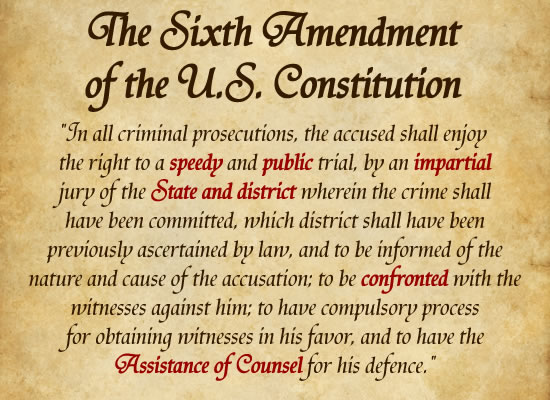
Sixth Amendment to the United States Constitution
Constitutional amendmentWikipedia
187
MENTIONS
123
EPISODES
77
PODCASTS
Search complete. 187 mentions across 123 episodes found for "Sixth Amendment to the United States Constitution".
Sep 15, 2026

Bobby CapucciHOST
We have to be able, as the public, to take a look at what's going on, to evaluate what's going on, and to make sure things aren't going south.
Bobby CapucciHOST
Still, Mueller wrote, the balancing act between the First Amendment protections afforded to the press and the Sixth Amendment fair trial rights promised to the defendant has become increasingly difficult with the advent of the Internet and social media.
Bobby CapucciHOST
He's not wrong about that.
Bobby CapucciHOST
It's very difficult these days to keep people sterile.

speaker_4HOST
Right.
speaker_5HOST
And every defendant has a constitutional right under the Sixth Amendment to represent themselves.
speaker_5HOST
But any judge will tell you it is usually a spectacularly bad idea.
speaker_4HOST
I can imagine.

Victor Davis HansonGUEST
So we're going to tax them, start out at 1%, see how they like it.
Victor Davis HansonGUEST
We're going to enforce the First Amendment, and we're going to enforce the Fourth, Fifth, and Sixth Amendment on campus.
Victor Davis HansonGUEST
We're going to go after their anti-Semitism.
Victor Davis HansonGUEST
We're going to go after their 40% federal grant gouging.

speaker_1GUEST
Though we know that death-qualifying juries introduces these biases that we do not want.
speaker_1GUEST
And as a result, the process has been challenged under the Sixth Amendment, the Eighth Amendment, the Fourteenth Amendment.
speaker_1GUEST
So far, these challenges have been relatively unsuccessful.
speaker_1GUEST
Most notably, the Supreme Court in 1986, Lockhart v. McCree, ruled that a death-qualified jury's disproportionate likelihood to inflict the death penalty didn't constitute a deprivation of a representative jury, as guaranteed by the Sixth and the Fourteenth Amendment.
speaker_1GUEST
Though we know that death-qualifying juries introduces these biases that we do not want.
speaker_1GUEST
And as a result, the process has been challenged under the Sixth Amendment, the Eighth Amendment, the Fourteenth Amendment.
speaker_1GUEST
So far, these challenges have been relatively unsuccessful.
speaker_1GUEST
Most notably, the Supreme Court in 1986, Lockhart v. McCree, ruled that a death-qualified jury's disproportionate likelihood to inflict the death penalty didn't constitute a deprivation of a representative jury, as guaranteed by the Sixth and the Fourteenth Amendment.

Robert BarnesGUEST
And as a whole, it's problematic if the government ever tries to do like what the government can do is say we're going to have notice to the court of a potential conflict because otherwise the government is trying to deliberately interfere.
Robert BarnesGUEST
with his constitutional right to choose his own counsel uh and that's a sixth amendment right and they love to play games with this and it wouldn't surprise me if this prosecutor has gone past that line but the that that's a limit and this isn't a conflict anyway normally this comes up when a lawyer is representing co-defendants in a case um but if they're married if there's other agreements arrangements usually that's not a problem they have to show a plausible ground for a conflict of interest legal interest between the two.
Robert BarnesGUEST
And sometimes there can be a finger-pointing defense, things of that nature.
Robert BarnesGUEST
But even then, because of the Sixth Amendment right, they have to do this long soliloquy because there's aspects of it you can't waive, but most aspects you can.
Robert BarnesGUEST
But it's utterly frivolous, frankly, to suggest there's a conflict of interest because they're representing someone who is aligned with the interest of Brian Cole, not adverse to the interest of Brian Cole.
David FreiheitHOST
Oh, yeah, that's right.
14 MINS LATER
Robert BarnesGUEST
While she excluded all the compelling impeachment evidence against the government's witnesses and even the chief judge in the center of the panel, the African-American woman, you know, said at the end, you know, isn't it kind of bad when it's like everything appears to have been one sided? Like literally every ruling against him was made and every ruling for him was denied.
David FreiheitHOST
that's because that's because he was really really really wrong robert i mean

Victor Davis HansonGUEST
Why, why do these universities with multi-billion dollar tax-free endowments when they're not disinterested? They're partisan hacks, so we're gonna tax them, start out at 1%, see how they like it.
Victor Davis HansonGUEST
We're gonna enforce the First Amendment, and we're gonna enforce the Fourth, Fifth, and Sixth Amendment on campus.
Victor Davis HansonGUEST
We're gonna go after their antisemitism.
Victor Davis HansonGUEST
We're gonna go after their 40% federal grant gouging." And then e-even into the, the mile, we're gonna re-restore neoclassical architecture We're gonna promote a World War I monument that actually looks like real people in the classical tradition.

Caleb GrangerGUEST
Trial counsel did not retain a ballistics or forensic expert to demonstrate that there wasn't any physical evidence tying him to the murder weapon, nor did he call any witnesses to testify during the guilt phase of the trial.
Caleb GrangerGUEST
So one could argue that he did not receive his Sixth Amendment right to the effective assistance of counsel.
Caleb GrangerGUEST
And then when it came to the jury selection in his case, potential black jurors were systematically excluded from the jury pool, and this is something you see in a lot of cases.
Caleb GrangerGUEST
In Kershon's case, all the potential black jurors were excluded without much meaningful opposition.

RobinHOST
In Pena Rodriguez v. Colorado back in 2017, Kennedy writing, after a conviction, two jurors came forward saying that a third juror had made explicit statements showing racial animus toward the Hispanic defendant.
RobinHOST
The court held that where a juror makes a clear statement indicating reliance on racial stereotypes or animus, the Sixth Amendment requires the no impeachment rule to give way.
RobinHOST
Kennedy wrote that blatant racial prejudice is antithetical to the functioning of the jury system and must be confronted in especially egregious cases.
RobinHOST
The threshold is overt racial bias.

Jeff BellSOUNDBITE_SPEAKER
Okay.
Jeff BellSOUNDBITE_SPEAKER
And he found also that you are competent to understand your Sixth Amendment rights.
Jeff BellSOUNDBITE_SPEAKER
That's the right to assistance of counsel.
Jeff BellSOUNDBITE_SPEAKER
And that he found that you would be able to make a knowing, intelligent waiver of those Sixth Amendment rights to have counsel present.
Jeff BellSOUNDBITE_SPEAKER
And even to go ahead and represent yourself if that was your choice.
Israel KeyesSOUNDBITE_SPEAKER
Right.
113 more episodes mention Sixth Amendment to the United States Constitution.
Create an account to see the whole feed, search across every transcript, and follow the entities you care about.