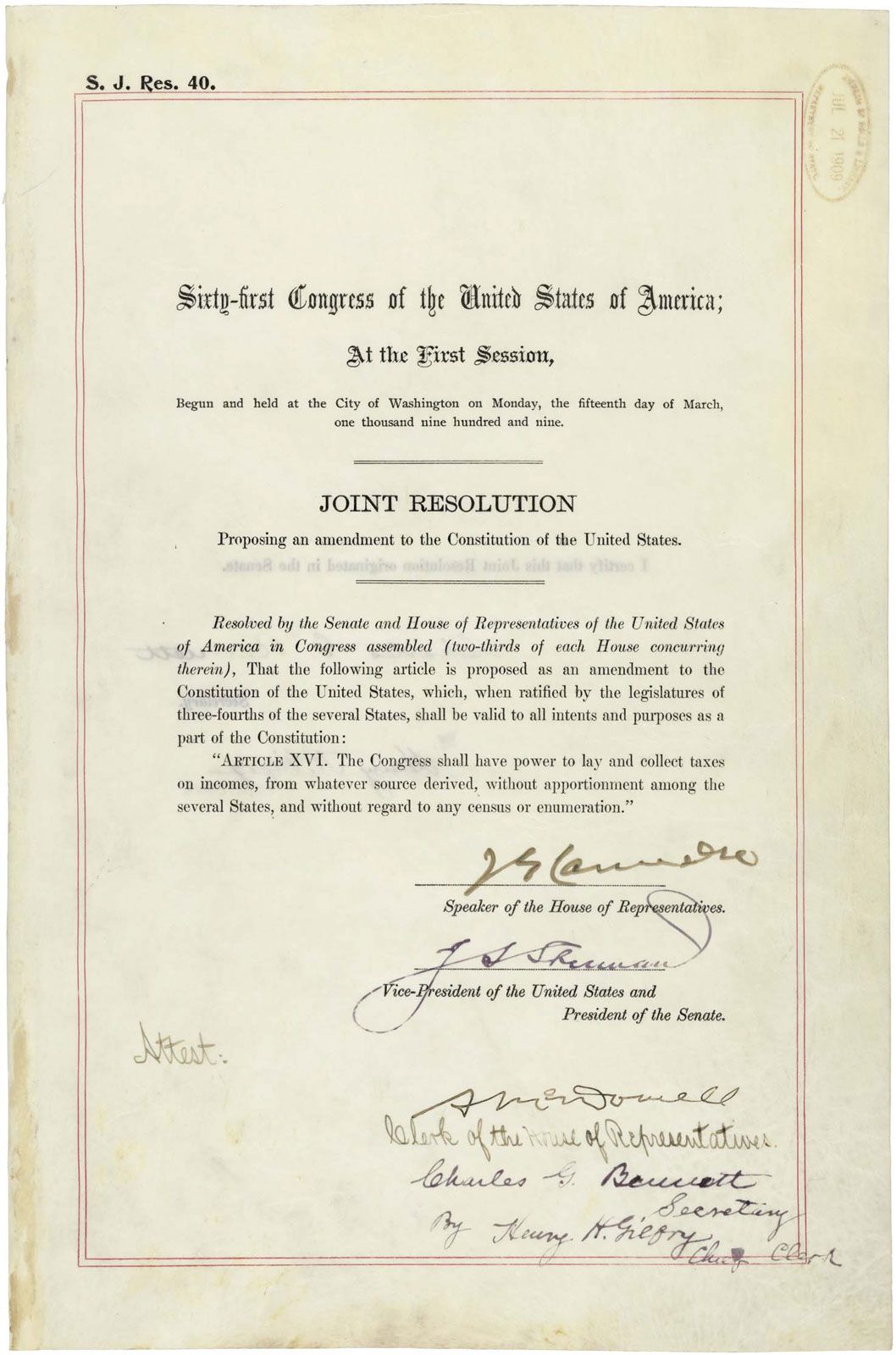
Sixteenth Amendment to the United States Constitution
Constitutional amendmentWikipedia
27
MENTIONS
16
EPISODES
14
PODCASTS
Search complete. 27 mentions across 16 episodes found for "Sixteenth Amendment to the United States Constitution".
Sep 14, 2026

Ann VandersteelGUEST
And that was pretty important in the development of government of Washington.
Ann VandersteelGUEST
But the really big powder, the powder, the brow, as they say, was 1913, the 16th amendment.
Ann VandersteelGUEST
And that is where I think When I look at the destruction of the family unit, I lay this right at the steps of the 16th.
Ann VandersteelGUEST
And Woodrow Wilson made a cataclysmic mistake.

Ran ChenHOST
A common exam question might describe a client who claims that wages are not income.
Ran ChenHOST
that the 16th Amendment was never ratified or that paying taxes is purely voluntary.
Ran ChenHOST
These are classic frivolous arguments that the IRS and courts have repeatedly rejected.
Ran ChenHOST
As a practitioner, your duty under Circular 230 is clear.

Carson CarpenterGUEST
They did it in a horrible manner.
Carson CarpenterGUEST
They cited the 14th, 15th, 16th Amendment, yet that was made for runaway slaves back in the Civil War.
Carson CarpenterGUEST
It wasn't made for unchecked balance with illegal immigration at the border.
Adam MocklerHOST
I disagree with some of the Supreme Court's rulings as well, but I wouldn't go so far as to say the politicians that I like are failing only because of the Supreme Court.
Joe ThomasHOST
This is why I say to me the only form of transparent taxation is if I receive an invoice from the state and the city that I live in and the federal government once, it doesn't even have to be once a month, once a quarter saying here is your contribution to the federal government based on this.
Joe ThomasHOST
Because I think the 16th Amendment violates the 5th on its face.
Joe ThomasHOST
nobody wants to take that case up um you know i don't have a problem with the government needing taxes to do its business it just like the fifth amendment says in order for me to give up my property my money um i need due process you need to tell me what you need this for um and let me in you know get through the process of figuring out whether i want to give it to you or not
AndyAUDIENCE
you're exactly right and it's um you know that i've been thinking about like spending some time in kentucky but the the the rules are or the laws up there are so like anti really tennessee and anti florida oh yeah it's good now it's crazy they have um they have a lot of these unions that are still involved.

Tom LuongoSOUNDBITE_SPEAKER
No, then they just started buying our politicians, and then they got Woodrow Wilson elected in 1912.
Tom LuongoSOUNDBITE_SPEAKER
And then miraculously, we got, you know, direct election of senators, the Federal Reserve and the 16th Amendment and the income tax the very next year.
Tom LuongoSOUNDBITE_SPEAKER
And somehow we wound up fighting two world wars to bail the British and the French out of their frigging bullshit.
Tom LuongoSOUNDBITE_SPEAKER
And after both of those world wars, the price of gold was reset to the pre-war value.

Joe BanisterGUEST
And in the Pollitt case, the Supreme Court ruled that income tax is unconstitutional.
Joe BanisterGUEST
So the people that, you know, the powers that wanted an income tax went back to the drawing board and crafted what became the 16th Amendment.
Joe BanisterGUEST
And the 16th Amendment is basically the income tax amendment that ushered in what we know today as the income tax.
Joe BanisterGUEST
That was in 1913, the same year as the Federal Reserve Act, which is not a coincidence.
Lara LoganHOST
Yes, 1913 was a very active year for the banking cabal.
Lara LoganHOST
Okay, so 1913, very bad year for the American people.
Joe BanisterGUEST
Yes, and apparently the income tax supporters thought that the Supreme Court would go along, but they didn't.
Joe BanisterGUEST
In 1916, there was a case called Bruchaber, B-R-U-S-H-H-A-B-E-R, and many other cases that ruled that the 16th Amendment did not expand federal taxing power.

Joe ThomasHOST
And they've got a thing called Crossfire Hurricane just to show you that we can interfere with American elections just as well as we interfere with Ukrainian elections.
Joe ThomasHOST
So we have to look at the federal government as a dangerous precedent because 16th Amendment says if you don't pay your taxes, you go to jail.
Joe ThomasHOST
Huh.
Joe ThomasHOST
That means the government's going to have my money no matter what.
Joe ThomasHOST
I still maintain that I could see how a case could get before the Supreme Court, maybe not John Roberts, but the rest of the Supreme Court justices would hear the fact that the 16th Amendment violates the 5th, therefore...
Joe ThomasHOST
And we don't have time to go into why I think the 16th amendment violates the fifth, but if you violate one of the core tenants of this country, AKA the fifth amendment, it should be illegal.
Joe ThomasHOST
Not illegal, like building the East wing ballroom because you had to renovate the bunker underneath the East wing anyway.
Joe ThomasHOST
And we'll get into John Roberts' rulings on the White House ballroom if necessary.

speaker_32NARRATOR
Thus spoke Woodrow Wilson during his campaign for election.
speaker_32NARRATOR
In this spirit, as president, he gave the signal for work by summoning Congress in a special session on April 7, 1913. he invited the cooperation of all forward-looking men and indicated that he would assume the role of leadership as an evidence of his resolve he appeared before congress in person to read his first message reviving the old custom of washington and adams then he let it be known that he would not give his party any rest until it fulfilled its pledges to the country when democratic senators balked at tariff reductions they were sharply informed that the party had plighted its word and that no excuses or delays would be tolerated domestic legislation financial measures under this spirited leadership congress went to work passing first the underwood tariff act of nineteen thirteen which made a downward revision in the rates of duty fixing them on the average about twenty six per cent lower than the figures of nineteen o seven the protective principle was retained but an effort was made to permit a moderate element of foreign competition as a part of the revenue act congress levied a tax on incomes as authorized by the sixteenth amendment to the constitution the tax which aroused such party passions twenty years before was now accepted as a matter of course having disposed of the tariff congress took up the old and vexatious currency question and offered a new solution in the form of the federal reserve law of december nineteen thirteen this measure one of the most interesting in the history of federal finance embraced four leading features in the first place it continued the prohibition on the issuance of notes by state banks and provided for a national currency in the second place it put the new banking system under the control of a federal reserve board composed entirely of government officials to prevent the growth of a central money power it provided in the third place for the creation of twelve federal reserve banks one in each of twelve great districts into which the country is divided all local national banks were required and certain other banks permitted to become members of the new system and share in its control finally with a view to expanding the currency a step which the democrats had long urged upon the country the issuance of paper money under definite safeguards was authorized mindful of the agricultural interest ever dear to the heart of jefferson's followers the democrats supplemented the reserve law by the farm loan act of nineteen sixteen creating federal agencies to lend money on farm mortgages at moderate rates of interest Within a year, 20 million had been lent to farmers, the heaviest borrowing being in nine western and southern states, with Texas in the lead.
speaker_32NARRATOR
anti-trust legislation the tariff and currency laws were followed by three significant measures relative to trusts rejecting utterly the progressive doctrine of government regulation president wilson announced that it was the purpose of the democrats to destroy monopoly and maintain competition as the only effective instrument of business liberty the first step in this direction the clayton anti-trust act carried into great detail the sherman law of eighteen ninety forbidding and penalizing combinations in restraint of interstate and foreign trade in every line it revealed a determined effort to tear apart the great trusts and to put all business on a competitive basis its terms were reinforced in the same year by a law creating a federal trade commission empowered to inquire into the methods of corporations and lodge complaints against concerns using any unfair method of competition in only one respect was the severity of the democratic policy relaxed an act of nineteen eighteen provided that the sherman law should not apply to companies engaged in export trade the purpose being to encourage large corporations to enter foreign commerce the effect of this whole body of antitrust legislation in spite of much labor on it remained problematical very few combinations were dissolved as a result of it startling investigations were made into alleged abuses on the part of trusts but it could hardly be said that huge business concerns had lost any of their predominance in american industry labor legislation By no mere coincidence, the Clayton Antitrust Law of 1914 made many concessions to organized labor.
speaker_32NARRATOR
It declared that the labor of a human being is not a commodity or an article of commerce, and it exempted unions from prosecution as combinations in restraint of trade.

Scott ReischHOST
How about a little history, legal history? This date, August 27th, 1894, the Wilson-Gorman Tariff Act became the law and included a federal income tax.
Scott ReischHOST
The Supreme Court later struck down major portions of that tax and And then in the Pollock versus Farmers Loan and Trust Company, a constitutional fight that ultimately helped lead to the adoption of the 16th Amendment and the modern federal income tax.
Scott ReischHOST
Remember, ladies and gentlemen, when this country started, we had no income tax, federal income tax.
Scott ReischHOST
until 1916.
Joe ThomasHOST
These days, I am on, well, there's a couple of things regarding the Bill of Rights that I'm particularly nerdy about.
Joe ThomasHOST
First is that the 16th Amendment violates the Fifth Amendment.
Joe ThomasHOST
in taking my property without due process and or just compensation, property being the monies that I've earned that they take from my employer in withholding taxes.
Joe ThomasHOST
I've already earned that money.
6 more episodes mention Sixteenth Amendment to the United States Constitution.
Create an account to see the whole feed, search across every transcript, and follow the entities you care about.