Six-party talks
EventWikipedia
6
MENTIONS
4
EPISODES
4
PODCASTS
Search complete. 6 mentions across 4 episodes found for "Six-party talks".
Sep 29, 2026

Mike GreenHOST
And so they used to just vote in the studio, but then they had a national vote where you could get on a QR code and vote, and seventy-five million Chinese voted, and they shut the show down [laughs].
Mike GreenHOST
And I, I had breakfast a day or two later with a Chinese ambassador and asked him about it, and he sort of hesitated, and he said, "Eh, turns out the Chinese do like to vote." [laughs] North Korea, during the six-party talks, one of the North Korean envoys, as we were looking at ways to give a negative security assurance or otherwise, to your point, without violating our principles or pretending we're happy with a Stalinist brutal regime, looking for ways to signal that we were not pursuing active near-term regime change, and we were floating different ideas, and the North Korean negotiator said, "Those are all poisoned carrots.
Mike GreenHOST
We're not interested."
Sheena Chestnut GreitensGUEST
Hmm.
Mike GreenHOST
One view was, well, it reassures them, so it's a good way to lubricate trade and other agreements.
Mike GreenHOST
The other view, which would have been my view, and I actually had a chance to meet Secretary Kerry and tell him this, and then he showed me the door, is that no, you're playing into China's narrative.
Mike GreenHOST
And Xi Jinping's personal narrative about China's greatness and so on and so forth, and we had similar things in the six-party talks and have repeatedly with North Korea.
Mike GreenHOST
So how do you, how would you recommend diplomats, or even President Trump, address this in summits with a Kim Jong Un or a Xi Jinping? Should America be steering clear of in any way dignifying the nature of these regimes, or is there a sort of non-ideological way to do it? Because i- it's almost impossible to thread that needle.

Victor ChaHOST
He served as the National Intelligence Officer for North Korea on the NIC, the National Intelligence Council.
Victor ChaHOST
You had all these positions, but you were most notably Special Envoy for Six-Party Talks and Director for Korea on the National Security Council.
Victor ChaHOST
So one of the few folks from the government who has operated both on the intel side as well as on the policy side.
Victor ChaHOST
Also joining us today is Bonny Lin.
32 MINS LATER
Bonny LinGUEST
It doesn't logically follow that China would be happy that North Korea has its nuclear program.
Bonny LinGUEST
But the question is, what can China manage at this point, given that Kim seems pretty set on its nuclear program? And I think right now the Chinese are willing to accept it if it could come at the cost of much more improved China-North Korea relations, which is, I think, what President Xi is trying to do, improve relations at the highest levels, kind of actually similar to what he's trying to do with President Trump, have him and these high-level meetings really set the tone for a positive relationship.
Victor ChaHOST
So would it be fair to say now that deep the chinese talking about denuclearization will become a signpost of how unhappy they are with their relationship with north korea i mean in other words it was sort of standard talking point like they would just adopt it like the u.s like all the members of the six-party talks adopted it right but now that it's kind of fallen off as we look to the future if they start talking about it again that's a sign that they're unhappy with north korean actions like belligerent actions or their unhappy with the bilateral relationship is that is that fair to say
Bonny LinGUEST
I think so and the other thing to add to that is whether if with China starts talking about if it's also a sign of unhappiness towards the United States we've seen some more we've seen a a scholar on China-North Korea relations, Xu Xinluo, she wrote a piece recently that argues that historically you've seen more Chinese willingness to put pressure on North Korea when the U.S. has provided more reassurances to China on Taiwan.

Edward HowellGUEST
When North Korea began to develop nuclear weapons and after it conducted its first nuclear test, which was very unsuccessful, but still, in October 2006, China began to get irritated with a nuclear neighbour.
Edward HowellGUEST
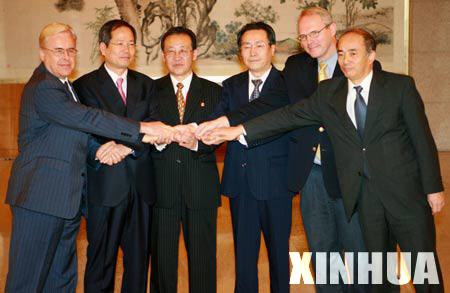
China hosted what was called the Six Party Talks from 2003 to 2009, involving six countries, South Korea, China, Japan, Russia, the United States, and obviously North Korea.
Edward HowellGUEST
And the aim was to get North Korea to give up its nuclear weapons.
Edward HowellGUEST
But North Korea was not willing to play ball.

Susan ThorntonGUEST
And, you know, there are a lot of issues on the Korean Peninsula that make them pay very close attention to what's happening there, most having to do with the U.S. and the U.S.-South Korean alliance and regional security issues.
Susan ThorntonGUEST
Of course, the Chinese hosted the Six-Party Talks back in the 2000s when we were working along the same kind of line toward working on the nuclear program.
Susan ThorntonGUEST
But since then, I mean, the North Koreans have really flipped the script on the Chinese with the outreach to Russia and the incredible, you know, kind of dramatic really move to support Russia's war in Ukraine and open up a lot more ties to Russia than we're used to seeing in the sort of previous efforts by the U.S. to, you know, work on the nuclear issue with the Chinese.
Susan ThorntonGUEST
The Russians were kind of an afterthought, really, not seen as a particularly... crucial to the outcome player.