Situation, Task, Action, Result
26
MENTIONS
10
EPISODES
9
PODCASTS
Search complete. 26 mentions across 10 episodes found for "Situation, Task, Action, Result".
Sep 8, 2026

Caroline Diarte EdwardsHOST
You'll get asked behavioral questions.
Caroline Diarte EdwardsHOST
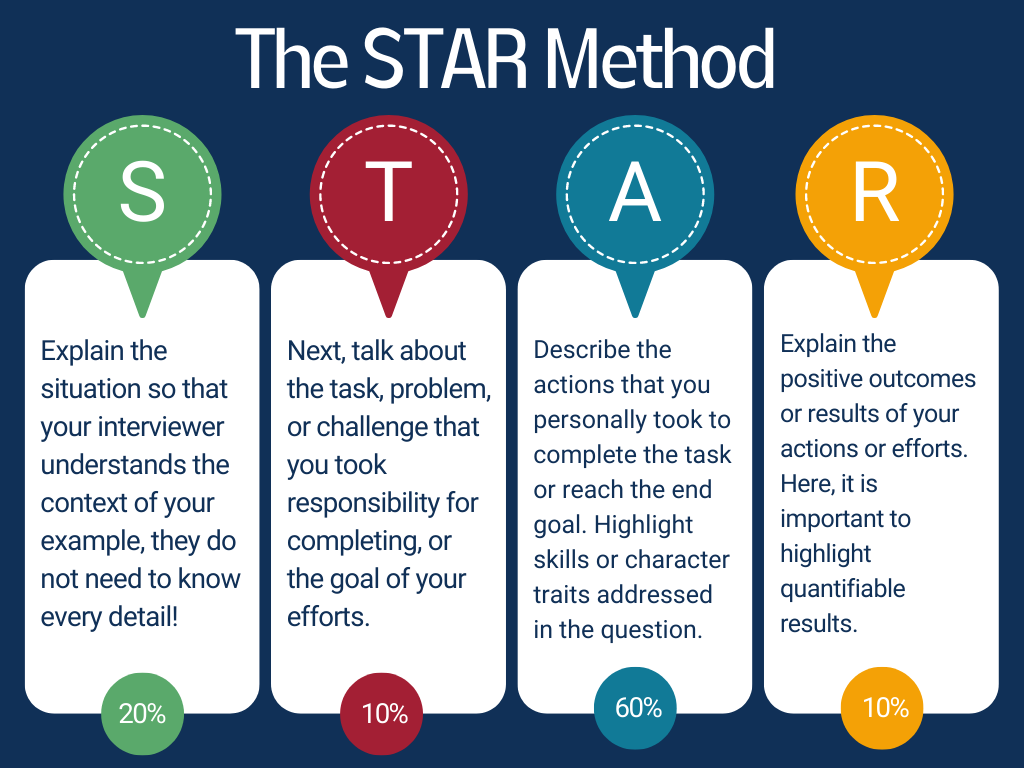
And a typical structure for responding to those behavioral questions is the STAR framework, right? So explaining the situation, the task that you are faced with, and then responding the action that you took and the result that that had.
Caroline Diarte EdwardsHOST
So that is a great structure for, you can use that framework for conveying your achievements and the impact that you've had and demonstrating the evidence that speaks to the qualities that you bring.
Caroline Diarte EdwardsHOST
So that's important to keep in mind in what you say in your application, but also, of course, what recommenders say about you, because that can sometimes be an issue with recommendations where they will talk about the strengths that they've observed.

Ryan SheppardGUEST
Because when we place people, we can't really talk about it.
Ryan SheppardGUEST
But I wanted to put my knowledge and my expertise into something because I love coaching candidates through interview prep, helping them develop their STAR method stories.
Ryan SheppardGUEST
And then I realized that, wait a second, my candidates are really appreciating what I'm teaching them, but I'm saying the same thing over and over again.
Ryan SheppardGUEST
How can I put that into a resource? So started as a course.
22 MINS LATER
Ryan SheppardGUEST
I wasn't getting tangible stories.
Ryan SheppardGUEST
And all it is is situation, task, action, result.
Ryan SheppardGUEST
So I was repeating, teaching the STAR method over and over and over and over and over again.
Ryan SheppardGUEST
Yet, when I would meet presidents of my clients, particularly big pharmaceutical companies, because obviously they're the top of thousands of personal organizations, super crisp, super articulate, they're always throwing out examples.

ElenaHOST
And it's something that we have observed in our Job Accelerator program that, and I think you can elaborate on this a little bit, but basically as an introduction, what we've realized is when the PhDs who work with us send us their resumes and We realize there is a lot of important detail and skills missing and you look for a way to pull that out.
ElenaHOST
And what is one way or method that you use for the PhDs in our program to pull that detail and these skills that they often think as like they're common or it's clear that you applied this skill in order to get there? How do you do that?
Angela PriestGUEST
Yeah, I think it's really important to recognize that the things that make you stand out are the unique ways that you have combined your skills to get outcomes.
Angela PriestGUEST
So oftentimes, because these people don't know you, it's important to remember that the people looking at your resume don't know you and they are not going to connect the dots.
Angela PriestGUEST
if you don't spell it out for them they're not going to interpret that to say oh you have this skill if it doesn't appear in your resume so you've got to have it there because you're just skimming through so one of the things that we have done with the folks in our program is to use the star method which is usually used for interviews so you kind of get a twofer out of this where you can work on your resume but you can also prepare for interviews at the same time So the STAR method is a good way of pulling out stories.
Angela PriestGUEST
So your resume should tell a story and the bullet points in your professional experience should be the supporting evidence in your story.
Angela PriestGUEST
And so what the STAR method does is it allows you to get to an appropriate level of detail so then you can take that and you can boil it down and you can summarize.
Angela PriestGUEST
So STAR stands for Situation, Task, Action, Result.

NamanHOST
Yeah.
Aishwarya RaghavanGUEST
So I think everyone's familiar with the STAR framework and many of the well-known frameworks.
Aishwarya RaghavanGUEST
But I think what people end up doing in an interview, again, because it's a very nervous experience going through an interview, is you just go through it as a checklist.
Aishwarya RaghavanGUEST
But instead, if you can kind of put yourself in the shoes of the listener or the hiring manager or your interviewer, They are asking you that question because they have a specific problem in mind.

speaker_1HOST
Yeah, that's a good way to put it.
speaker_0HOST
Like, it stands for Situation, Task, Action, Result.
speaker_0HOST
And you use this for the behavioral questions, right?
speaker_1HOST
Right.
speaker_0HOST
Okay.
speaker_1HOST
So the first is STAR.
speaker_1HOST
You know, situation, task, action, and result.
speaker_1HOST
You, you deploy this for behavioral questions.
6 MINS LATER
speaker_0HOST
You know, the prove it phase.
speaker_1HOST
Yes.
speaker_0HOST
This is where our STAR method does the heavy lifting, right?
speaker_1HOST
This is where they test how you handle friction.

Elizabeth WillettsHOST
And then you need to quantify it.
Elizabeth WillettsHOST
So, you know, how much have you saved? And, you know, how did you do that? And how much did you save? What then was the monetary value of that ideally? Um, sales it's a little bit easier how much money have you made your employer in the past even like account manager roles which aren't direct sales there has to be some sort of impact that you can demonstrate because employers are nervous at the moment they want to feel they're taking on a safe pair of hands somebody that can add value to their business pretty quickly when writing about your achievements you want to be following the star technique so I always include a key achievement when I'm writing CVs for my clients in every single most recent job, actually, that they've done, because that really shows the uniqueness of your experience and really brings it to life.
Elizabeth WillettsHOST
So when writing about your achievements, you want to be following the STAR technique.
Elizabeth WillettsHOST
So the STAR technique stands for Situation, Task, Action, Result.
Elizabeth WillettsHOST
So think about the situation.
Elizabeth WillettsHOST
So share some context around the challenges faced, the task.
22 MINS LATER
Elizabeth WillettsHOST
Have your answers ready.
Elizabeth WillettsHOST
So I mean, obviously these are really common, but tell me about yourself.

Lisa LeongGUEST
So I think ultimately is to know that in the process, you are trying to show a fit for the job and a fit for the culture.
Lisa LeongGUEST
So at its most basic level, you are going back to every time you get asked a question, you are thinking about, well, why am I the best person? And in very clear terms, so you use the STAR.
Lisa LeongGUEST
You know, you've heard of the STAR framework.
Lisa LeongGUEST
So it's, what is the situation? What was the task I was asked to do? What was the action? And then what was the result? So that stays the same.
Lisa LeongGUEST
The same way you prepared for your interview before, you wanna actually prepare for your A- possible AI interview.

Rudy CrousGUEST
Hit the key criteria in it.
Rudy CrousGUEST
My advice is always keep the answer quite simple, you know, 90 to 120 seconds, and use the STAR methodology, right? So give an example, measure, provide measurements in terms of, um, um, how you can prove the evidence of what you've achieved.
Rudy CrousGUEST
So keep, uh, thinking about how someone would objectively evaluate you.
Lisa LeongHOST
So people are still using the STAR framework, situation, task, action, and result for these interviews as well, Rudy?
Rudy CrousGUEST
For sure.
Rudy CrousGUEST
I mean, that's how you measure what's the story someone's telling.