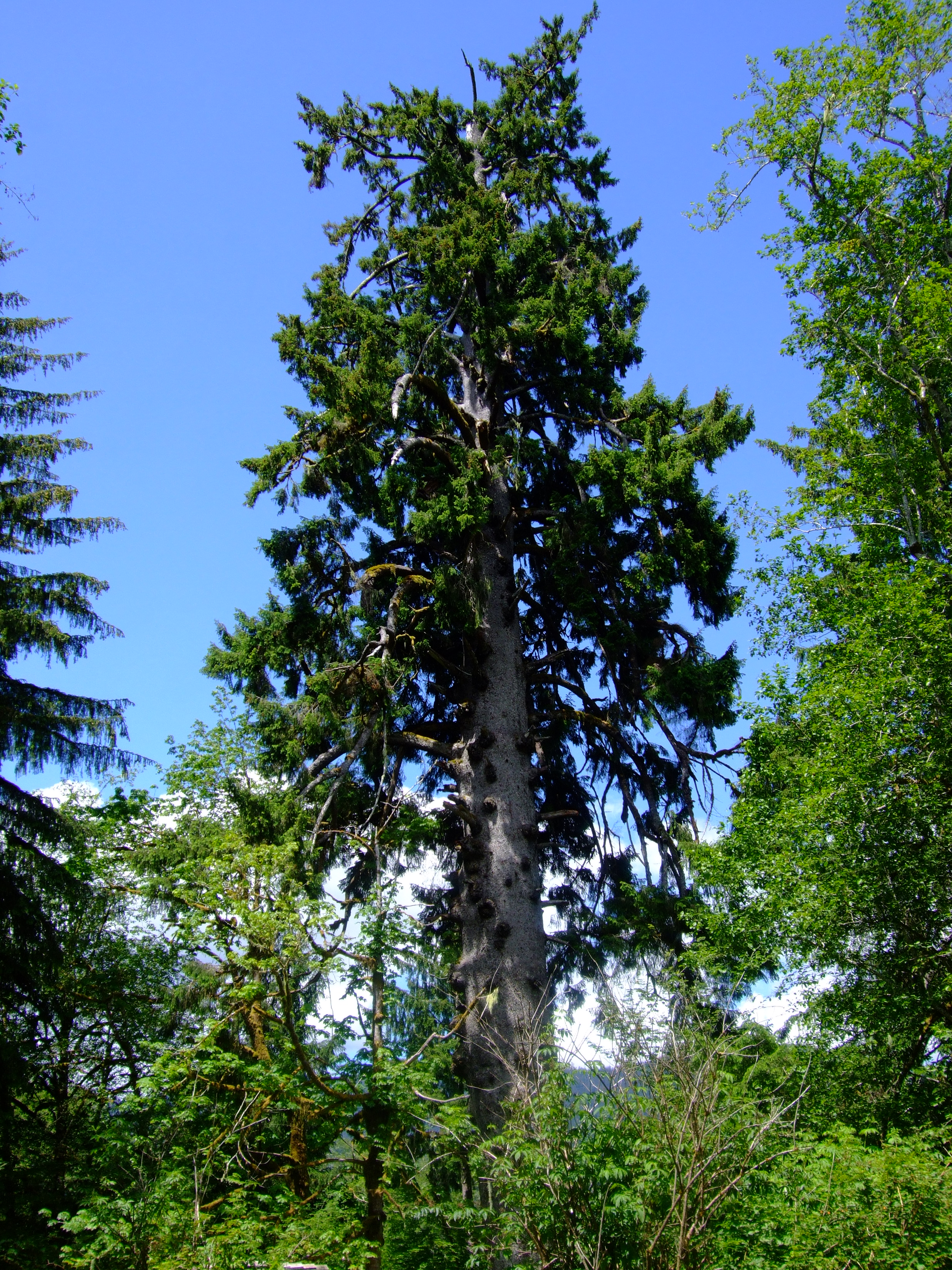
Sitka spruce
PlantWikipedia
31
MENTIONS
12
EPISODES
11
PODCASTS
Search complete. 31 mentions across 12 episodes found for "Sitka spruce".
Sep 26, 2026

Anna MacleodGUEST
There's nowhere to go.
Anna MacleodGUEST
Again, it's not just the loss of farming land to the Sitka spruce plantations, but it's the fact that they're owned by hedge companies.
Anna MacleodGUEST
I'm sure, you know, the Teachers Union in Canada, that was one of the hedge funds, I'm sure they thought they were investing in forestry in Ireland and they had no idea the type of forestry or the type of setup that it was.
Anna MacleodGUEST
I think there was a Danish teachers' union as well involved in one of the hedge funds.

Laurence JuberGUEST
Um, at least it was for me.
Laurence JuberGUEST
But, you know, that was the point where I had realized that, that, uh, that Adirondack spruce was more arti- more articulate and better suited to what I was looking for than Sitka spruce.
Laurence JuberGUEST
And, um, as a result, you know, that was why I, I ordered this with an Adirondack spruce top.
Laurence JuberGUEST
Um, and it, it kind of, then it became an experiment in, um, in, you know, the different body woods.
13 MINS LATER
Jimmy LeslieHOST
Now you get-
Laurence JuberGUEST
Yeah, because they did use alpine spruce, too
Jimmy LeslieHOST
... now you get Sitka.
Jimmy LeslieHOST
That's what's available mostly.

Daniel BessnerGUEST
He leaves him this land in Grays Harbor, and Boeing comes out to Grays Harbor in 1906 and he founds a, uh, timber company called the Boeing and McCrimmon Lumber Company, which later becomes the Greenwood Timber Company, and he, he makes a lot of money a- and he begins to expand operations in Hoquiam, then he moves to Aberdeen, and then of course, he also moves to Seattle where he eventually headquarters his timber company.
Daniel BessnerGUEST
But Boeing really makes hi- a significant amount of money in the teens for several reasons, mo- maybe most important for the story we're telling, in World War I, the US government needs a lot of Sitka spruce, which is a spruce that is native to the Pacific Northwest, and which is a, a lot of the timber that Boeing and under, uh, other timber barons mined.
Daniel BessnerGUEST
Um, so this makes his money.
Daniel BessnerGUEST
But the important thing is that Boeing is very interested in aviation.
Daniel BessnerGUEST
He becomes entranced with it, as many Americans did.
Daniel BessnerGUEST
And he basically uses the Sitka spruce to help found what would become Boeing Airplane Company.
Daniel BessnerGUEST
And, and, and again, World War I is crucial to this because they, the US government needed planes, and Boeing helped provide those planes.
Daniel BessnerGUEST
So, so eventually there's a long story of antitrust, but just to get to Kurt Cobain, so eventually Boeing's timber company closes in the late 1930s, but his real legacy is Boeing Aviation, uh, the Boeing Airplane Company rather, uh, and it becomes one of the largest defense contractors in the United States, and it really becomes a foundation of the, uh, Seattle economy-

Colm GilheaneyGUEST
There's a standard on any ground.
Colm GilheaneyGUEST
So Sitka spruce is the benchmark, even if you're planting a native woodland.
Colm GilheaneyGUEST
What I mean by that is you have to be able to achieve yield class 14 of Sitka spruce on any site to make it plantable effectively.
Colm GilheaneyGUEST
So if you planted some higher elevation sites, particularly in the West, like a lot of them would grow native woodlands.
Colm GilheaneyGUEST
A lot of them were probably traditionally native woodlands in the past.

Eoghan DaltunGUEST
If you go to Wild Nephin, so, so-called Wild Nephin, it's just, you know, you see barely any native trees.
Eoghan DaltunGUEST
It's, it's full of, of Sitka spruce and lodgepole pine and other exotic trees, you know, vast dead zone plantations, and then a huge amount of rhododendron, which is a, an invasive-
Oliver CallanHOST
Right.
Oliver CallanHOST
It's over
Marina ConwayGUEST
And then basically an opinion has to be made if there is any effect of the forestry operation which you're proposing.
Marina ConwayGUEST
So if you're proposing whether it's to plant two acres of native woodland or whether it's to plant 70 acres of Sitka spruce, this all goes through the exact same screening process.
Marina ConwayGUEST
So all of our forest types, be it commercial conifers and broadleaves, be it agroforestry, emergent woodlands, native woodlands, forest for water, everything goes through the exact same
Dermot McNallyHOST
screening process.
29 MINS LATER
Marina ConwayGUEST
So it's 150 euro a hectare for seven years, but it can be up to 650 a hectare for the native woodland in insensitive areas per hectare per year for seven years as well.
Marina ConwayGUEST
But then also you might decide that, you know, I'm not interested in any of these schemes.
Marina ConwayGUEST
I just want to go back in with my Sitka spruce.
Marina ConwayGUEST
And what's happening a little bit to the frustration of landowners that, yes, I agree that when we, you know, replant these areas, if there is sensitivities on the sites like streams or like houses or like roads and we want to encourage a little bit more diversity into it, that the landowner should be supported to do that.

Keith FryerHOST
Yeah, and
Mike JeffreyHOST
the book is called Sitka Spruce, The Amazing Timber Tree.
Mike JeffreyHOST
And it's all about sort of how...
Mike JeffreyHOST
The spruce tree is grown in the forest.
Gary NewmanGUEST
I'm here.
Mike JeffreyHOST
Right, so maybe we can kick off perhaps with a question for Jenny.
Mike JeffreyHOST
Sitka Spruce, The Amazing Timber Tree.
Mike JeffreyHOST
I mean, what was your inspiration for the book? Was it suggested to you by the timber sector or did it come from your personal inspiration?

Hayes GriffinHOST
Like, typically, I, I go for the, the forward shifted X brace, Adirondack spruce top.
Hayes GriffinHOST
You know, Adirondack spruce is a, is a stiffer version of spruce than Sitka, what you see.
Eli GilbertHOST
Mm-hmm.
Hayes GriffinHOST
So people say that it has a little bit more punch and volume to it than the Sitka, naturally.
Hayes GriffinHOST
Um, but what's funny is...
Hayes GriffinHOST
So, like, my, my Collings CW, that's my main axe that I've got behind me, the one that I won at Winfield two years ago.
Hayes GriffinHOST
And then this one that I have is a Collings D1.
Hayes GriffinHOST
They call it a prototype because they, they, um, braced it differently.

Finn J.D. JohnHOST
After experimenting with lots of different types, early aviators quickly figured out that there was one type of wood that was head and shoulders above the rest, old-growth spruce.
Finn J.D. JohnHOST
And of all the different types of spruces, the variety known as Sitka spruce was among the very best.
Finn J.D. JohnHOST
It was certainly the biggest.
Finn J.D. JohnHOST
Sitka spruce trees can get over 200 feet tall with trunks over 10 feet in diameter.
Finn J.D. JohnHOST
One 500-year-old Sitka spruce tree can provide enough straight, clear spruce to build about 150 Newport 28s.
Finn J.D. JohnHOST
The wood is extremely rigid and lightweight.
Finn J.D. JohnHOST
Furthermore, as it turned out, it wouldn't shatter when hit with a rifle bullet.
Finn J.D. JohnHOST
But the Allies, as it turned out, had a secret weapon.

speaker_0NARRATOR
Rainfall that feeds a forest so dense, so layered, so overwhelmingly alive that it takes the word forest and stretches it into something the word was never quite designed to contain.
speaker_0NARRATOR
The trees are Sitka spruce, western red cedar, and Douglas fir, some of them over 60 metres tall and several hundred years old, their trunks wider than a car.
speaker_0NARRATOR
their bark furrowed into ridges deep enough to hide your hand the under story is a wall sword fern grows in clusters that reach chest height each frond unfurling from a central crown with the mathematical precision of a fractal Salal, an evergreen shrub with thick waxy leaves, fills in every gap the ferns miss.
speaker_0NARRATOR
And covering everything, the living trees, the dead trees, the fallen trees, the rocks, the ground, the hanging branches, the nurse logs, is moss.
2 more episodes mention Sitka spruce.
Create an account to see the whole feed, search across every transcript, and follow the entities you care about.