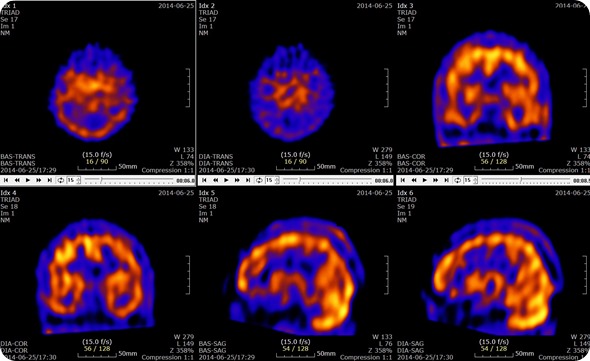
Single-photon emission computed tomography
Medical imagingWikipedia
65
MENTIONS
23
EPISODES
23
PODCASTS
Search complete. 65 mentions across 23 episodes found for "Single-photon emission computed tomography".
Oct 30, 2026

Christian BosselmannGUEST
So you need technical expertise to actually get them to run, to provide reasonable results for the data you want to give them.
Christian BosselmannGUEST
And having these sort of different tools united and robust and reliable at your fingertips, that is, at the bedside, is where clinical decision support systems, CDSS, come into play, where you have a shared interface where you can address problems like data from the surgical evaluation, integrating MRI, PET scans, SPECT, EEG, and doing that quickly and easily enough to be actually usable in the sort of high throughput, busy clinical work we all know too well.
Alina IvaniukHOST
The second part of the question,
Christian BosselmannGUEST
are there any problems that are not solvable by machine learning? I'd rather flip that question around.

Marley JonesHOST
So we're exploring what Dr. Daniel Amen, double board certified psychiatrist, has done for many years.
Marley JonesHOST
And he does SPECT imaging and within his SPECT imaging has determined that there are actually seven proposed subtypes of ADHD or what he calls seven ADHD patterns.
Marley JonesHOST
and what scientists know about the brain systems involved so that we can now help parents ask better questions when their child is struggling.
Marley JonesHOST
We also want to discuss today neuro training and allow for ourselves opportunity for eligible student families who are interested in what we have now as the student recognition program, where you can take advantage of quite a savings having the NeurOptimal Neurofeedback system that you can purchase for home use.
Marley JonesHOST
Now, when it comes to Dr. Amen's seven proposed ADHD patterns, let's talk about that.
Marley JonesHOST
Dr. Daniel Amen, he's the founder of Amen Clinics.
Marley JonesHOST
There are about a dozen Amen Clinics nationwide, and they use SPECT imaging.
Marley JonesHOST
And what that does is it takes a radioactive tracer dye, goes into the bloodstream, and they look at what is going on in the brain by being able to detect blood flow they also take clinical histories as part of this approach to their brain health and the SPECT does what it measures the regional blood flow patterns using that tracer, and it provides information about brain activity.

Michelle KittlesonGUEST
which gets us to polling question number two.
Michelle KittlesonGUEST
An older man with heart failure symptoms and preserved EF on echo with a remote history of carpal tunnel syndrome is found to have perigene grade two uptake on technetium pyrophosphate with SPECT scan.
Michelle KittlesonGUEST
What's the next best F? Okay, so that's an imaging test that can be used as part of the diagnostic algorithm from ATTR amyloidosis.
Michelle KittlesonGUEST
So it's positive.
Michelle KittlesonGUEST
So you do not want to miss that diagnosis.
Michelle KittlesonGUEST
So if your monoclonal protein screen is abnormal, it behooves you to check a biopsy and the biopsy gold standard, the organ of interest, like a heart biopsy to exclude AL.
Michelle KittlesonGUEST
But if your monoclonal protein screen is negative, you can breathe a deep sigh of relief on behalf of the patient and turn your attention towards radionuclide scintigraphy with SPECT.
Michelle KittlesonGUEST
Most commonly, this will be a technetium pyrophosphate scan, which if it's positive is 99% accurate or 100% accurate really for ATTR cardiac amyloidosis.

Michelle KittlesonGUEST
which gets us to polling question number two.
Michelle KittlesonGUEST
An older man with heart failure symptoms and preserved EF on echo with a remote history of carpal tunnel syndrome is found to have perigene grade two uptake on technetium pyrophosphate with SPECT scan.
Michelle KittlesonGUEST
What's the next best F? Okay, so that's an imaging test that can be used as part of the diagnostic algorithm from ATTR amyloidosis.
Michelle KittlesonGUEST
So it's positive.
Michelle KittlesonGUEST
So you do not want to miss that diagnosis.
Michelle KittlesonGUEST
So if your monoclonal protein screen is abnormal, it behooves you to check a biopsy and the biopsy gold standard, the organ of interest, like a heart biopsy to exclude AL.
Michelle KittlesonGUEST
But if your monoclonal protein screen is negative, you can breathe a deep sigh of relief on behalf of the patient and turn your attention towards radionuclide scintigraphy with SPECT.
Michelle KittlesonGUEST
Most commonly, this will be a technetium pyrophosphate scan, which if it's positive is 99% accurate or 100% accurate really for ATTR cardiac amyloidosis.

Michelle KittlesonHOST
which gets us to polling question number two.
Michelle KittlesonHOST
An older man with heart failure symptoms and preserved EF on echo with a remote history of carpal tunnel syndrome is found to have perigene grade two uptake on technetium pyrophosphate with SPECT scan.
Michelle KittlesonHOST
What's the next best F? Okay, so that's an imaging test that can be used as part of the diagnostic algorithm from ATTR amyloidosis.
Michelle KittlesonHOST
So it's positive.
Michelle KittlesonHOST
So you do not want to miss that diagnosis.
Michelle KittlesonHOST
So if your monoclonal protein screen is abnormal, it behooves you to check a biopsy and the biopsy gold standard, the organ of interest, like a heart biopsy to exclude AL.
Michelle KittlesonHOST
But if your monoclonal protein screen is negative, you can breathe a deep sigh of relief on behalf of the patient and turn your attention towards radionuclide scintigraphy with SPECT.
Michelle KittlesonHOST
Most commonly, this will be a technetium pyrophosphate scan, which if it's positive is 99% accurate or 100% accurate really for ATTR cardiac amyloidosis.

Leonardo LopezGUEST
There's evidence that disruptions in GABA transmission have something to do with catatonia, which will not be surprising to people when we get to treatments later.
Leonardo LopezGUEST
For example, there are SPECT studies that show reduced GABA-A receptor density in the somatosensory cortex.
Leonardo LopezGUEST
So there are a variety of brain regions implicated.
Leonardo LopezGUEST
I think the most strongly implicated are the supplementary motor area and the M1 motor cortex.

Cameron AllenGUEST
I love Daniel Amen's work and I think that he's done so much to bring an incredible amount of awareness to how much our brain is kind of defining our life, what's happening in our brain.
Cameron AllenGUEST
The way that a SPECT scan works is that you have a radioactive isotope put in your body, and then the scan is actually looking at where that binds with the oxygen in the brain.
Cameron AllenGUEST
When your brain has more activation, you're consuming more oxygen and glucose, and then it lights up or it doesn't light up depending on where the activation is.
Cameron AllenGUEST
It gives you a really good indication of a snapshot in time of what's happening in your brain.
Cameron AllenGUEST
And it looks at the structures.
Cameron AllenGUEST
So you can see, are the structures of the brain actually getting smaller? Are they growing over time with tests and retests? And so I've done a lot with SPECT.
Cameron AllenGUEST
I've done some with PET.
Cameron AllenGUEST
I've done a lot with MRI, fMRI.

Peter ScireHOST
They're not done, hey, you're going to just walk right in now.
Peter ScireHOST
Obviously, Dan Amons made a name for himself all these years using SPECT technology, but I know as you brought up before is that when you're just measuring blood flow, how are you measuring whether it's increased blood flow or less blood flow? Is it less blood flow because it's more efficient, or is it elevated blood flow because it's metabolically super active? But how does that relate to the inhibition and the excitation circuitry? Right.
Robert MelilloHOST
And so you can't really see that yet.
Robert MelilloHOST
And even when you're looking at advanced imaging, like where you can look at functional connectivity or you can look at connectivity where you're looking at white matter connections versus gray matter, even there, you know, the brain initially grows.

Stephen BarrettHOST
So I wanted to see what's going on from a CNS san- standpoint.
Stephen BarrettHOST
So we were fortunate enough to get a few patients in for SPECT imaging at-
Michael BagnellGUEST
Mm-hmm
Stephen BarrettHOST
... a couple of the Amen Centers, and it's phenomenal when you see some of these SPECT images, these holes in these people's brains where there's just no activity going on at all.
Stephen BarrettHOST
... and I think they marry that up to the qEEG, uh, as well.
Stephen BarrettHOST
They kind of...
Stephen BarrettHOST
And then does that give them a better picture of things, or? And I realize SPECT imaging's very expensive.
Stephen BarrettHOST
It's not in the mainstream for-
13 more episodes mention Single-photon emission computed tomography.
Create an account to see the whole feed, search across every transcript, and follow the entities you care about.