Sine and cosine
18
MENTIONS
11
EPISODES
7
PODCASTS
Search complete. 18 mentions across 11 episodes found for "Sine and cosine".
Nov 22, 2026

David CloughHOST
I'm going to say import the math module.
David CloughHOST
And then I will say print math.sin, S-I-N, sin of x.
David CloughHOST
And I will try to run that.
David CloughHOST
And it doesn't like it because The functions in the math module do not accommodate array operations.

Shini SomaraHOST
Trigonometry, which we use to calculate the angles and sides of triangles, is going to come up a lot in physics, because we'll be using right-angled triangles all the time.
Shini SomaraHOST
So it's a good idea to know how to find the derivatives of sine x and cosine x.
Shini SomaraHOST
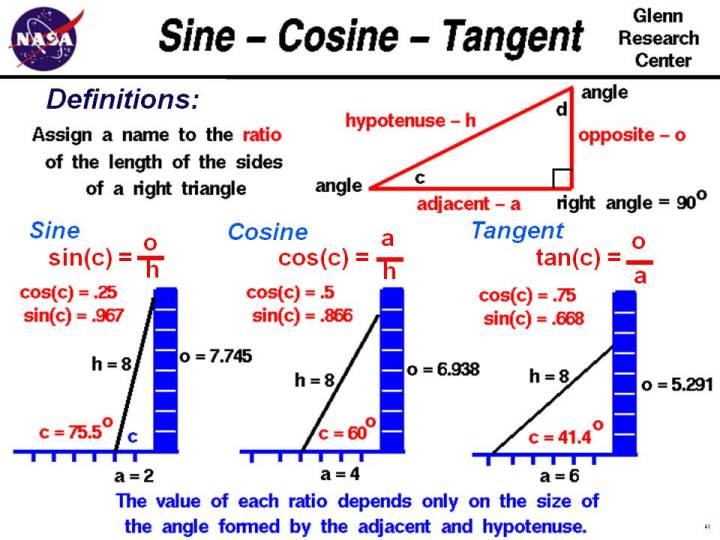
Sine tells you that if you have a right-angled triangle, and x is the angle in that triangle, then sine x will be the length of the side opposite that angle, divided by the hypotenuse.
Shini SomaraHOST
Cosine does the same thing, just with the side next to the angle, divided by the hypotenuse.
Shini SomaraHOST
So their graphs will tell you what those ratios will be depending on the angle.

Ben FuchsHOST
And if you can remember from your – I don't want to get too wonky here, but that looks like a snake mathematically.
Ben FuchsHOST
It's called a sine wave.
Ben FuchsHOST
Sine actually means snake.
Ben FuchsHOST
That's why a snake – one of the reasons, I guess, why snakes have been worshipped and have been deified.
Ben FuchsHOST
and have been feared also, because they represent reality, the sine wave, the up and the down.

Dave FarinaHOST
Then we just use the definitions of the trig functions to find the lengths of the legs of this triangle.
Dave FarinaHOST
The sine of one third pi is equal to the opposite side over two.
Dave FarinaHOST
Sine of one third pi is root three over two, times two is root three, so this side has a length of root three.
Dave FarinaHOST
Cosine of one third pi is equal to the adjacent side over two.
Dave FarinaHOST
Cosine of one third pi is one half, times two is one, so this side has a length of one.
Dave FarinaHOST
How could we take an equation like X plus Y equals three, and turn this into one with Rs and thetas? It's not too difficult, if we realize that when we look at one of the triangles we constructed earlier, we can write in X, Y, R, and theta.
Dave FarinaHOST
What is X in terms of R and theta? Well, cosine theta is X over R, so X is R cosine theta.
Dave FarinaHOST
What is Y in terms of R and theta? Sine theta is Y over R, so Y is R sine theta.

Grant SandersonHOST
That's the same thing as 30 degrees.
Grant SandersonHOST
And then the y is going to be the sine of that.
Grant SandersonHOST
Sine of math.pi over six.
Grant SandersonHOST
Great.
Grant SandersonHOST
So if we look at its components, the real part is around 0.866 and the imaginary part should be exactly one half, but you know, often you get a little numerical error because computers, they can't get all the real numbers perfectly.
9 MINS LATER
Grant SandersonHOST
So the real component is the cosine of 30 degrees.
Grant SandersonHOST
And then the imaginary component, the vertical component here, is the sine of 30 degrees, which looks like it's the smaller leg of a 30-60-90 triangle, which is going to be one half, but we'll work out the numbers in just a moment.
Grant SandersonHOST
Sine of 30 degrees times i.
Grant SandersonHOST
Let's go back to black, good old friendly black.
Grant SandersonHOST
Cosine squared of x, using the dum-dum convention, is one plus cosine of two x, so it's kind of oscillating more quickly, all divided by two, okay? So now I'm gonna ask you a trickier question, which is gonna be, what is the cosine of pi 12ths, okay? And for those of you keeping track, pi twelfths is the same as 15 degrees.
Grant SandersonHOST
So if we were doing this with a unit circle, what you might think is, okay, a 30-degree angle sits looking like this.
Grant SandersonHOST
That's 30 degrees.
18 MINS LATER
Grant SandersonHOST
So it's divided by the cosine of theta, which means cosine squared of theta, dumb convention, is equal to the answer that we want.
Grant SandersonHOST
Let me just write it down in a different color to really emphasize.
Grant SandersonHOST
Cosine squared of theta.
Grant SandersonHOST
And let me emphasize, this is not using the Pythagorean Theorem in any way.
speaker_3ADVERTISER
Consult a healthcare professional if symptoms persist.
Dave FarinaHOST
original substitution for X, what will these sides be? Well, if X was equal to three sine theta, then sine theta must be equal to X over three.
Dave FarinaHOST
Sine theta is opposite over hypotenuse, so according to our own substitution, this vertical leg must be equal to X, and the hypotenuse must be equal to three.
Dave FarinaHOST
By the Pythagorean theorem, we can also get this other leg, as this leg squared, plus x squared, must equal nine, so we subtract to get nine minus x squared, and then take the square root to get root nine minus x squared.
Dave FarinaHOST
Now with all of these sides labeled, we can express terms with theta in terms of x instead.
Dave FarinaHOST
We have this angle, 35 degrees, and we have the hypotenuse, as the string length is always equal to two meters.
Dave FarinaHOST
We want to know this opposite side, which we can get by using sine.
Dave FarinaHOST
Sine theta is opposite over hypotenuse, so sine of 35 equals this distance x over two.
Dave FarinaHOST
We evaluate the sign, multiply by two, and we get 1.15 meters.
Dave FarinaHOST
Now that we have this distance, it is easy to get the height from the lowest point, because when vertical, this length is two meters.
1 more episode mentions Sine and cosine.
Create an account to see the whole feed, search across every transcript, and follow the entities you care about.