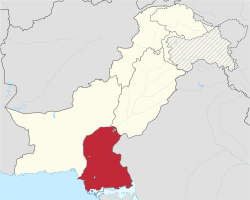
Sindh
68
MENTIONS
27
EPISODES
27
PODCASTS
Search complete. 68 mentions across 27 episodes found for "Sindh".
Sep 13, 2026

VijayHOST
It's like maybe a few feet wide.
VijayHOST
But by the time you get to what is today called Sindh, which is a province in Pakistan, and Sindh is... derived from the Sanskrit word for the Indus, Sindhu.
VijayHOST
So Sindh is the province and essentially it's like kilometers wide by the time it gets closer to the Indian Ocean.
VijayHOST
So it becomes a huge river.
VijayHOST
And of course, one of the things that feeds this river, which is very important, is the cyclical monsoons that happen in the Indian subcontinent.
12 MINS LATER
VijayHOST
And the two major sites that they found was a site called Harappa, which is why sometimes the Indus Valley civilization is also called the Harappan civilization.
VijayHOST
It is closer to what is today Punjab.
VijayHOST
And second was a place called Mohinjodaro, which is closer to what is today Sindh.

Beowulf RocklinHOST
The dolphins have seen large declines in the amount of river it's able to access as Pakistan's economic growth drove river infrastructure projects like dams and irrigation canals.
Beowulf RocklinHOST
With the Punjab government's creation of the Punjnad Indus River Dolphin Sanctuary, it not only safeguards the heart of the dolphins' habitat in the Punjab, but connects it with the existing protected area in neighboring Sindh province.
Beowulf RocklinHOST
creating roughly 249 miles, about the length of New York State, of connected habitat under legal protection, according to World Wildlife Foundation Pakistan.
Beowulf RocklinHOST
The WWF chapter will work closely with the governments in Islamabad and Punjab to develop a management plan for the sanctuary to ensure the dolphins therein can thrive, not merely survive.

speaker_1NARRATOR
book.
speaker_1NARRATOR
Journey of Ibn Battuta Volume 2 A Gift to Those Who Contemplate the Wonders of the Nations and the Marvels of Travel Ibn Battuta D-779H Volume 2 Account of Arriving at the Valley of Sindh in the name of allah the most gracious the most merciful may the blessings of allah be upon our master mohammed his family and his companions the sheikh abu abdullah mohammed ibn abdullah ibn mohammed ibn ibrahim al lawati al tanji known as ibn batuda may allah have mercy on him said on the first day of the month of muharram at the beginning of the year seven hundred and thirty-four we arrived at the sind valley known as punjab meaning the five waters This valley is one of the greatest in the world, overflowing during the hot season.
speaker_1NARRATOR
The people of these lands cultivate their crops on its overflow, just as the people of Egypt do with the Nile.
speaker_1NARRATOR
This valley is the first territory of the great Sultan Muhammad Shah, the King of India and Sindh.
speaker_1NARRATOR
Upon reaching this river, we were greeted by the informants assigned to this duty, and they sent news of our arrival to Qutb al-Mulk, the governor of the city of Multan.
speaker_1NARRATOR
The principal emir of Sindh at that time was a Mamluk of the Sultan named Sartiz.
speaker_1NARRATOR
He was one of the notable Mamluks before whom the Sultan's armies would parade.
speaker_1NARRATOR
His name means sharp-headed, as Sar with an open S and a silent R means head, and Tiz with a T and a Z means sharp.

Jasbir G. SinghGUEST
It should be done.
Jasbir G. SinghGUEST
Even now, after 100 years of partition, if it doesn't happen, then where will it happen? But the question is again, where are the Sikhs standing? What is happening? In Sindh, there are many gurudwaras.
Jasbir G. SinghGUEST
In Sindh, there is a lot of Sikh propaganda.
Jasbir G. SinghGUEST
In Punjab, there are many Sikhs.
Jasbir G. SinghGUEST
In KPK, there are 14,000-18,000 Sikhs living there.
Jasbir G. SinghGUEST
It is happening . . . . . . . . . I know that when you say it, the outside world only knows that Shri Nankana Sahib taught.
Jasbir G. SinghGUEST
Today, tell your channel that he taught in the whole of Pakistan.
Jasbir G. SinghGUEST
He taught in KPK, in Sindh.

Omendra RatnuGUEST
There are still one crore Hindus in
Sanjay DixitHOST
Sindh.
Sanjay DixitHOST
Hindus will live in their hearts today.
Sanjay DixitHOST
Okay,
Omendra RatnuGUEST
okay.
Omendra RatnuGUEST
So many… Even today, about 800,000 Hindus live in Sindh even after the terrible war.
Omendra RatnuGUEST
This is the blessing of our Gods and our Hindu
Sanjay DixitHOST
resilience.

DukeHOST
644 to 650, Muslim crusaders conquer Cyprus and Tripoli.
DukeHOST
644 to 650, Muslim crusaders establish Islamic rule in Iran, Afghanistan, and the Sindh.
DukeHOST
710 to 713.
DukeHOST
We're not even a hundred years out from Muslims and Islam and Muhammad.

Benjamin BosterHOST
The earliest evidence of the use of cotton in the Old World in the form of a few fibers of mineralized cotton thread was found in a string of eight copper beads at the Neolithic site of Mehrgarh at the foot of the Bolan Pass, Balochistan, Pakistan.
Benjamin BosterHOST
Fragments of cotton textiles and spindle whorls dated to the third millennium BCE have also been found at Mohenjo-daro in Sindh, Pakistan, and other sites of the Bronze Age Indus Valley Civilization, which is likely site for the first cultivation of Gossypium arboreum, and cotton may have been an important export from it.
Benjamin BosterHOST
Microremains of cotton fibers, some dyed, have been found at Tell Tsaf in the Jordan Valley, dated 5200 BCE.
Benjamin BosterHOST
They may be the remnants of ancient clothing, fabric containers, or cordage.

Ayesha SiddiqaGUEST
And that wasn't going to happen.
Ayesha SiddiqaGUEST
I mean, yes, there were Muslims in Bengal, there were Muslims in Punjab, in Kalat, which was later turned into Balochistan, in Sindh, in whatever became part of Pakistan.
Ayesha SiddiqaGUEST
Yet, That went hand in hand.
Ayesha SiddiqaGUEST
There was a parallel identity.
6 MINS LATER
Ayesha SiddiqaGUEST
But it was effectively as a party, it always remained a very elite party.
Ayesha SiddiqaGUEST
It didn't have an outreach.
Ayesha SiddiqaGUEST
In fact, if you look at Pakistan's history, India Act 1935 and the elections which happened as a result after India Act 1935, Muslim League lost in Punjab and Sindh.
Ayesha SiddiqaGUEST
And in those areas, which then later became Pakistan.

Scott AlexanderHOST
Grants were won, aid projects implemented, success declared.
Scott AlexanderHOST
But, as Barno relates, Oxfam soon discovered an unexpected dark side to its capacity-building work in Sindh province.
Scott AlexanderHOST
It had trained six locally prominent welfare organisations in strategic planning and proposal writing, and got them started on implementation by giving them $1,000 to work with.
Scott AlexanderHOST
The VOs largely met their explicit project targets, and seemed ready to engage with international development funds on a scale much greater than they'd handled before.
Scott AlexanderHOST
In reality, aid-funded groups tend to operate rather more like corporate and or government contractors, paid service providers with comfortably salaried staff, focused on the goals of faraway clients, whose main unifying clause is, whatever helpful thing they pay us to do.
Scott AlexanderHOST
And as it turns out, that model severely demotivates volunteers.
Scott AlexanderHOST
Oxfam's capacity-built, in quotes, Sindhi organisations were certainly non-governmental, but they were no longer voluntary.
Scott AlexanderHOST
NGOs, but not VOs.

speaker_4SOUNDBITE_SPEAKER
Huzoor, how can we improve this way of thinking and become more obedient towards our parents?
Mirza Masroor AhmadSOUNDBITE_SPEAKER
Basma Jidran, are you from Sindh?
speaker_4SOUNDBITE_SPEAKER
Yes.
speaker_4SOUNDBITE_SPEAKER
Are
17 more episodes mention Sindh.
Create an account to see the whole feed, search across every transcript, and follow the entities you care about.