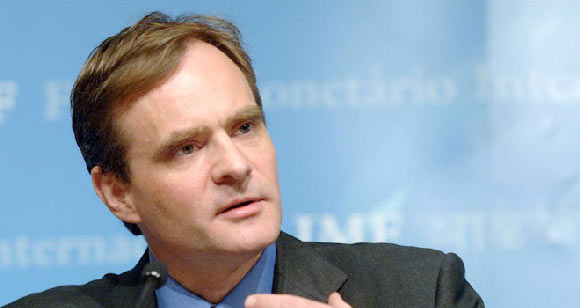
Simon Johnson
British-American economistWikipedia
70
MENTIONS
22
EPISODES
17
PODCASTS
Search complete. 70 mentions across 22 episodes found for "Simon Johnson".
Nov 2, 2026

Simon JohnsonHOST
Hello, everyone, and welcome to Power and Consequences.
Simon JohnsonHOST
My name is Simon Johnson.
Simon JohnsonHOST
I'm Gary Gensler.
Simon JohnsonHOST
And we're talking today about the midterm elections in the United States.
Gary GenslerHOST
It does.
Gary GenslerHOST
Let me say that there's two core congressional functions.
Gary GenslerHOST
It's oversight and It's written right into the constitution that you carry around in that pocket constitution of yours, Simon.
Gary GenslerHOST
And that's oversight not only of the executive branch, Our founders thought that that was important to think about how spending goes and oversight of the executive, but also oversight for legislative purposes.

Shamubeel EaqubHOST
This is where the Zombie Town story connects to a much bigger argument in economics.
Shamubeel EaqubHOST
In 2024, the Nobel Prize in Economics went to three economists, Darren Achimoglu, Simon Johnson, and James Robinson.
Shamubeel EaqubHOST
Their argument is that culture and institutions are what determine whether a country prospers or doesn't.
Shamubeel EaqubHOST
Not just capital, not just labor, not even just technology.

George HahnNARRATOR
It's a chilling scene that captures the moment a man stops believing in the rule of law and starts believing in gangsterism.
George HahnNARRATOR
When nations make the same choice, their economies stagnate, according to economists Doron Asimoglu and James Robinson, who shared the 2024 Nobel Prize with Simon Johnson.
George HahnNARRATOR
In their 2012 book, Why Nations Fail, Asimoglu and Robinson wrote, countries differ in their economic success because of their different institutions, the rules influencing how the economy works, and the incentives that motivate people.
George HahnNARRATOR
Inclusive systems, they argue, protect property, enforce contracts, and allow everyone to compete.

Tom KeeneHOST
That's a school up in Boston, if you didn't know that, Owen.
Tom KeeneHOST
Simon Johnson says, shut up and read it.
Tom KeeneHOST
And the giant...
Tom KeeneHOST
I dearly miss him every day.

Tom KeeneHOST
That's a school up in Boston.
Tom KeeneHOST
If you didn't know that on Simon Johnson says, shut up and read it in the giant one.
Tom KeeneHOST
I dearly miss him every day.
Tom KeeneHOST
Angus Deaton says a vitally important book.

James HardingHOST
good people for that?
Ben ZarankoGUEST
They've got a Nobel Prize winner chairing the AI Economics Institute, Simon Johnson.
Ben ZarankoGUEST
So there's got good people.
Ben ZarankoGUEST
And the AI Security Institute is very heavily praised internationally, including by some of the frontier US labs.

Samuel MaddenGUEST
It's a very nice way to think about it, right? Yeah, because I think we do, as faculty, you do feel a lot of pressure to, I mean, most faculty don't want to ruin their students' lives or whatever it is students feel like is happening when they get a bad grade, right? Some people don't have qualms about this, but...
Matthew RascoffHOST
So let's talk about their lives, because you quote in the report, your colleagues, Doron Ejemolu, David Otter, Simon Johnson, on this idea of pro-worker AI.
Matthew RascoffHOST
And it sort of leads us to this concept of pro-learner AI.
Matthew RascoffHOST
And I wonder, you've talked a little bit about the classroom structure and what that looks like from the faculty perspective, but maybe you can talk about the learner side of this.
Tom KeeneHOST
Mr. Gensler's here, the former chairman of the Securities Exchange Commission.
Tom KeeneHOST
The Nobel laureate Simon Johnson has the privilege of working with him up at MIT.
Tom KeeneHOST
How's that going? How's this wonderful experiment of Gensler and Johnson, Johnson and Gensler going?
Gary GenslerGUEST
We're having a lot of fun.

Tom KeeneHOST
Mr. Gensler's here, the former chairman of the Securities Exchange Commission.
Tom KeeneHOST
The Nobel laureate Simon Johnson has the privilege of working with him up at MIT.
Tom KeeneHOST
How's that going? How's this wonderful experiment of Gensler and Johnson, Johnson and Gensler going?
Gary GenslerGUEST
We're having a lot of fun.
12 MINS LATER
Gary GenslerGUEST
And then the Federal Reserve has to decide, well, do we raise rates again in December? Do we raise rates again in March? I think they might pause after December.
Tom KeeneHOST
What's the pixie dust? Come on.
Tom KeeneHOST
Simon Johnson finally won a Nobel Prize.
Tom KeeneHOST
His book, 13 Bankers, was brilliant on the crass, a short monograph.
Simon JohnsonHOST
Hello, everyone, and welcome to Power and Consequences.
Simon JohnsonHOST
My name is Simon Johnson.
Simon JohnsonHOST
And I'm Gary Gensler.
Simon JohnsonHOST
And we're talking today about what will the Fed, the Federal Reserve, do next?
16 MINS LATER
Gary GenslerHOST
So if I were in those meetings, I would say, we can wait till December.
Gary GenslerHOST
Will one be viewed as less political? And two, we might have a better sense of this.
Gary GenslerHOST
Are we getting near the top of some of these issues on the artificial intelligence boom, the European debt challenges, energy shocks, and more? But what about you, Simon? Well, I'm not
Simon JohnsonHOST
very good at predictions, Gary.
12 more episodes mention Simon Johnson.
Create an account to see the whole feed, search across every transcript, and follow the entities you care about.