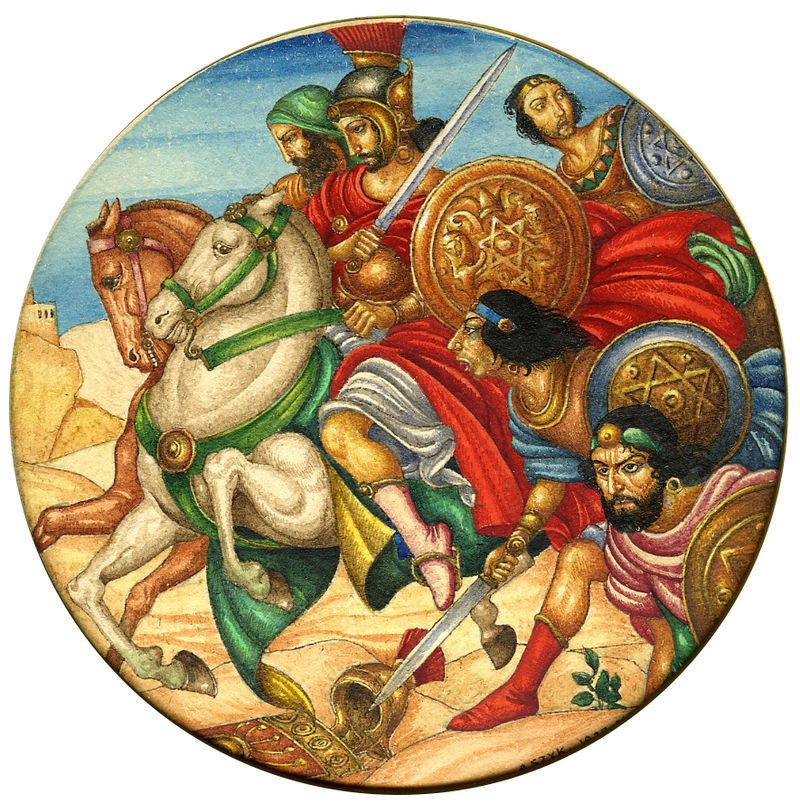
Simon bar Kokhba
Military leaderWikipedia
161
MENTIONS
74
EPISODES
60
PODCASTS
Search complete. 161 mentions across 74 episodes found for "Simon bar Kokhba".
Oct 30, 2026

Ray BrownGUEST
And with some justification, the Jews rebelled in 65 AD, ended in the destruction of the temple in 70 AD by the Roman 10th Legion.
Ray BrownGUEST
And what a lot of people don't know is just 60 or 70 years later, Bar Kochba rebelled against the Romans again and was destroyed.
Ray BrownGUEST
And this is when Jerusalem was just totally destroyed.
Ray BrownGUEST
And the Jews that were left alive from the first rebellion were were carted up and scattered among the Roman Empire, and the Jews were no more in the Palestinian area until 1948.
Austin GarrettHOST
I didn't even realize there was that second one.
Austin GarrettHOST
Bar Kochba.
Austin GarrettHOST
After Titus.
Austin GarrettHOST
It

MarkHOST
And I'm going to murder the pronunciation of this again.
MarkHOST
His name is Simon Bar Kokhba.
MarkHOST
And he rises up in 132 AD.
MarkHOST
AD.
MarkHOST
And the most prominent rabbi, so this is the time of the rabbis because the temple has been destroyed, as you recall, was this guy called Akiva ben Joseph.
MarkHOST
Very charismatic, rabble-rousing kind of rabbi.
MarkHOST
He called Simon Bar Kokhba, the Messiah.
MarkHOST
He said, this is it.

Dan SnowNARRATOR
There are no statues or images of the man.
Dan SnowNARRATOR
Historians even disagree on his name, but most call him Bar Kokhba.
Dan SnowNARRATOR
He needed fighters who believed that mighty Rome could be defeated.
Dan SnowNARRATOR
And so he recruited believers, students from Jewish religious schools.
Dan SnowNARRATOR
The Romans had weapons and armor that Bar Kokhba could not match.
Dan SnowNARRATOR
So he gave his men something else.
Dan SnowNARRATOR
A lethal, ancient Hebrew fighting technique
Dan SnowNARRATOR
engage in skirmishes or terrorist attacks, but patiently built his army till it numbered in the thousands.

GlennHOST
This was not the holy place, and the end did not occur 1290 days later, like Daniel 12 predicts.
GlennHOST
Romans warring with the Jews continued off and on for another 55 years until 135 AD with the Bar Kokhba revolt that the Romans put down.
GlennHOST
Therefore, when verse 15 says the abomination of desolation must be standing in the holy place, the temple had to still be standing The Romans had laid siege to Jerusalem and took five months to finally kill or capture the Jewish population.
GlennHOST
The siege started in Passover, in April.
7 MINS LATER
GlennHOST
The Romans destroyed Jerusalem, but they did not destroy all the Jews, nor did they run all the Jews from all of Israel.
GlennHOST
After 70 AD, there were still enough Jews to try more revolts against Rome.
GlennHOST
The Kittos War in 115 was a war between the Jews and the Romans, and the Bar Kokhba Revolt in 132 AD that lasted for a couple of three years.
GlennHOST
Therefore, while the temple was destroyed in 70 AD, the Jews did not stop fighting Rome for another 55 years.

N.T. WrightGUEST
And that actually goes on into the second century AD.
N.T. WrightGUEST
when the last great Jewish revolutionary, Ben Kozibar, a.k.a. Bar Kokhba, when he sets up his flag and says, it's time for God to become king, some of the rabbis say, oh, no, no, you're much too early, because they are calculating it again from 70 AD when Jerusalem fell.
N.T. WrightGUEST
There's going to be another great thing.
N.T. WrightGUEST
But many, many, many people in Judea at the time had done their sums and had figured out that Daniel 9 was going to be fulfilled roughly in the period that we would say 10 BC to 20 AD, around then.

David Patrick HarryHOST
So now moving into the Middle Ages, divergent civilizations, Jewish diaspora and identity.
David Patrick HarryHOST
Following 70 AD, the Bar Kokhba revolt, 135 AD, Jews were dispersed across the Roman Empire.
David Patrick HarryHOST
Jew now designates both a religious community and an ethnos, often maintaining identity through endogamy, so marrying within the community.
David Patrick HarryHOST
observance of Torah and Sabbath, circumcision and dietary laws, right? Notice all of those are ended in the council of Jerusalem.

Joel RichardsonHOST
So historically, you can look at...
Joel RichardsonHOST
the Bar Kokhba rebellion at the end of the first going into the second century, where the majority of the people of Israel sort of hitched their wagons to this false Messiah and him they received.
Joel RichardsonHOST
But there's a difference between saying there's been a propensity down throughout Israel's history where the majority rejected the Messiah and the majority accept alternative false messiahs.
Joel RichardsonHOST
Obviously, he was not the messiah.

Eva MroczekGUEST
And this idea of like being worried about whether the text will survive is very, very old as well.
Eva MroczekGUEST
And you asked about the Bar Kokhba letters.
Eva MroczekGUEST
So around the same time, a little bit later, after the first set of Dead Sea Scrolls were discovered in the same region, there was a cache of letters connected to the messianic figure Bar Kokhba, who led a Jewish revolt against the Romans in the first part of the second century of the Common Era.
Eva MroczekGUEST
And a bunch of his letters... were found in caves near the Dead Sea as well in the same region.
Eva MroczekGUEST
And one of the main reports that describes the finding of these manuscripts connects them to a really dirty work that they were found in caves that had long been inhabited by rodents, by bats and rats.

Michael MotiaHOST
And you talk about a move from decaying to preserved.
Michael MotiaHOST
And one of the examples you give is the Bar Kokhba letters and that kind of story around them.
Michael MotiaHOST
So can you tell us about these letters and that kind of decaying to preserved aspect of the story?
Eva MroczekGUEST
This is one of my favorite parts of the book because connecting these precious ancient manuscripts, many of which are, you know, deeply connected to kind of the most the most sacred texts of Judaism and Christianity.
Eva MroczekGUEST
And so many of them are adjacent to garbage and they're at risk of becoming garbage, right? Because texts are preserved and travel through time because they're inscribed on organic material.
Eva MroczekGUEST
And this idea of like being worried about whether the text will survive is very, very old as well.
Eva MroczekGUEST
And you asked about the Bar Kokhba letters.
Eva MroczekGUEST
So around the same time, a little bit later, after the first set of Dead Sea Scrolls were discovered in the same region, there was a cache of letters connected to the messianic figure Bar Kokhba, who led a Jewish revolt against the Romans in the first part of the second century of the Common Era.

Tom SchusterHOST
What it did not survive was the Second War.
Tom SchusterHOST
In 132, Judea rose again under Bar Kokhba with an even worse outcome than the first time.
Tom SchusterHOST
Hadrian had already re-founded Jerusalem as a Roman colony, Hylia Capitolina, before the rising.
Tom SchusterHOST
Most think that that is what caused it.
64 more episodes mention Simon bar Kokhba.
Create an account to see the whole feed, search across every transcript, and follow the entities you care about.