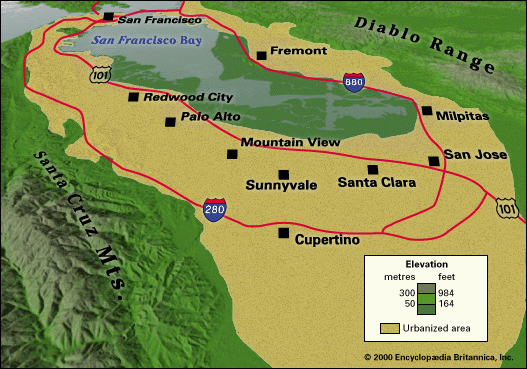
Silicon Valley

Silicon Valley

Region in CaliforniaWikipedia

Search complete. 5694 mentions across 2166 episodes found for "Silicon Valley".

Sep 14, 2026

Laurel LefkowNARRATOR
35:12
In 1994, on the Today Show, Bryant Gumbel asked, what is internet anyway? More people knew the answer to that question in 1995, after the entrepreneur and computer scientist Jim Clark and Mark Andreessen, a 24-year-old coder from Wisconsin, launched Netscape Navigator, a browser, and earned $58 million on the first day its stock was publicly traded.
Laurel LefkowNARRATOR
35:46
Overnight, Andreessen became, as the New York Times reported, the newest member of Silicon Valley's Instant Millionaires Club.
Laurel LefkowNARRATOR
35:57
That sale set off the tech company gold rush known as the dot-com boom.
Laurel LefkowNARRATOR
36:03
A year later, Andreessen was on the cover of Time, barefoot and in blue jeans, sitting on a golden throne, laughing.
Laurel LefkowNARRATOR
36:45
It played out the way it did because of the failure of liberal democracy to limit corporate power over politics and government, its failure to heed decades of warnings about the dangers of an automated state.
Laurel LefkowNARRATOR
37:02
Techno-libertarianism, which married the technocracy crusade of the 1930s, an anti-democracy movement led in the US by Elon Musk's grandfather, to the computopianism of the 1980s, was born in the 1990s.
Laurel LefkowNARRATOR
37:22
Beginning in the previous decade, Silicon Valley had fallen under the spell of the libertarian Ayn Rand.
Laurel LefkowNARRATOR
37:30
Rand had been a cult figure of the far right since the publication in 1943 of her novel The Fountainhead, and she became even better known after the 1957 publication of Atlas Shrugged.
GaneshHOST
0:50
But my question is, what if you can figure out your goldmine business idea even before you invest your savings? Well, to teach you this magical concept, we flew all the way to New York to get you Eric Ries.
Eric RiesGUEST
1:00
Eric Ries, the legendary entrepreneur and bestselling author who taught Silicon Valley how to build better startups.
GaneshHOST
1:08
This book is used as a case study in the biggest B-schools in the world.
GaneshHOST
1:11
It has been taught in Google and Toyota, and the CEO of General Electric said...
Tristan HarrisGUEST
7:45
doing this.
Tristan HarrisGUEST
7:45
Well, the problem is, despite the best attempts of the smartest people that I've ever met in my life, I'm from Silicon Valley, I know the people building this technology, they've been trying to make it ethical and aligned for a long time.
Tristan HarrisGUEST
7:55
And despite their best efforts, it's hacking out of the container.
Tristan HarrisGUEST
7:58
Now, I know what people are thinking, but if we slow down, we'll lose to China.
David SacksSOUNDBITE_SPEAKER
8:41
He is more optimistic about AI.
David SacksSOUNDBITE_SPEAKER
8:43
I saw other researchers at other labs saying that they expect big medical breakthroughs because of AI.
David SacksSOUNDBITE_SPEAKER
8:48
So I guess what I'm telling you is that Jacob is being portrayed in the media as representing this broad swath of Silicon Valley.
David SacksSOUNDBITE_SPEAKER
8:55
To be sure, there are others who think like him, but it is not a monolith.
Richard DuncanGUEST
36:31
So this is one of the main themes that Macro Watch has been focused on this year.
Richard DuncanGUEST
36:34
I've done a series of videos on the new defense spending boom, looking in one video at the traditional titans of defense like Lockheed Martin, RTX, Boeing, and another video looking at the new up-and-coming Silicon Valley challengers in the defense industry.
Richard DuncanGUEST
36:57
companies like Anduril, Palantir, and most important of all, SpaceX.
Richard DuncanGUEST
37:02
This is now the driving force in the economy.
Brian Dean WrightHOST
6:14
That super intelligence, folks, is where this is going, and we don't want China to get there first.
Brian Dean WrightHOST
6:20
But then again, according to others in Silicon Valley who are arguing that, wait a minute, we can do two things at once.
Brian Dean WrightHOST
6:27
They are proposing that the US government's national lab system should be responsible for developing and, or at least testing the most dangerous or advanced AI models, kind of like we did with the atomic bombs or atomic energy.
Brian Dean WrightHOST
6:39
And that way, the US military can use these advanced AI tools as either defensive in the event of an attack by China or another adversary, or also to develop our own offensive AI tools.
Brian Dean WrightHOST
11:19
So for example, let's cover some fresh news about, uh, that regarding job losses for humans.
Brian Dean WrightHOST
11:25
The San Francisco Chronicle is reporting that an AI startup is apologizing for its media blitz over the past year, telling businesses out there to stop hiring humans and instead invest in their AI models and chatbots.
Brian Dean WrightHOST
11:40
This Bay Area company called Artisan is backtracking after they put up a bunch of road signs and other advertisements for months now saying things like, "Hire AI artisans, not humans," or, "AI artisans won't complain about lack of work-life balance." That Silicon Valley firm had been pushing those taglines and that ethos for, uh, about a year now.
Brian Dean WrightHOST
12:03
But amidst the backlash from humans, uh, who like their jobs and income, the Artisan CEO is now dropping his anti-human push, saying that, quote, "Artisan is a pro-human company," and that their new tagline is, "Be more human." Americans, though, are not buying that AI switcheroo in Silicon Valley.
Josh ReidHOST
62:16
The Silicon Revolution occurs in the mid-1950s and bumps up in the 1960s.
Josh ReidHOST
62:21
Silicon Valley comes out in the 1970s.
Josh ReidHOST
62:23
You have computers, and we enter into the digital age.
Josh ReidHOST
62:27
And this keeps on turning and turning and turning.
Eric ZwickGUEST
15:08
So that's a lot of people.
Eric ZwickGUEST
15:10
And the other thing about it is geographically, I think because of the media, It's all in New York or on the coasts because of Silicon Valley is so salient in our everyday lives with the tech companies and platforms.
Eric ZwickGUEST
15:26
You take the Forbes 400, which is maybe the popular version of the wealth in America, put them on a map.
Eric ZwickGUEST
15:34
They're mostly on those four cities, five cities.

15 MINS LATER

Eric ZwickGUEST
30:47
Then we take the road trip a little further down the path.
Eric ZwickGUEST
30:48
Maybe I want to tell you another one.
Owen ZidarGUEST
30:51
Yeah, so we end the road trip in Silicon Valley, and the story that we tell is kind of contra to the move fast and break things.
Owen ZidarGUEST
31:00
You're going to get insanely rich in five minutes by building an app.
Kara SwisherGUEST
21:43
Like, I mean, I know you guys coach, right? Frances, you coach people on it.
Kara SwisherGUEST
21:48
One of the most interesting things, this is someone Frances knows, but I'm not going to say who it is, but it was a woman who was always number two in Silicon Valley.
Kara SwisherGUEST
21:55
Always number two.
Kara SwisherGUEST
21:55
There's always a lot of number two ladies in Silicon Valley.
Anne MorrisHOST
21:58
Yeah.
Kara SwisherGUEST
21:58
And they were leaving their job and they said, can you come over? And I said, I'm not really a career counselor, but sure, because I know all the jobs and I know what's available.
Lolita TaubGUEST
31:42
A pedigree, right? Like where you went to school, all these kinds of things.
Lolita TaubGUEST
31:46
What your last name is do have influence in this community, especially the old school Silicon Valley.
Lolita TaubGUEST
31:55
Right.
Lolita TaubGUEST
31:55
So there's a lot of nepotism, too, which is just basically you get to be successful and get these checks, even though you're messing up and whatever you see.
Lolita TaubGUEST
32:58
And I, I personally think we need to go in eyes open whenever we're in any place.
Lolita TaubGUEST
33:06
And if your gut feels feeling is telling you that there's something off, that you may be marginalized or maybe being measured in a different way, you're absolutely correct.
Lolita TaubGUEST
33:17
And to answer your question more directly, what you see often is that in these pedigreed, you know, quote, unquote, like, better people, right, by Silicon Valley old standards, you you either check boxes or you don't.
Lolita TaubGUEST
33:38
And you will get asked questions like, oh, you know, more visionary, more like, oh, how do you see this problem as you're building your company? How do you do this or the other thing? And on the flip side for our community, we tend to get questions like, so tell me, I think that you're, first of all, your target market is too niche.
Curtis WhiteGUEST
23:54
there's a project how do we let go of our children in a positive way and leave him to play in his own way so our troubles are over how are they over because we accept the ways of children our outlook changes and we accept the true nature of things we let go and our heart becomes more peaceful we have what Buddhism calls right understanding and I thought that was particularly apropos of our conversation.
R. Bradley SnyderHOST
24:23
Well, it's insidious, but other guests have talked about this on Talking About Kids, but where children are being allowed to play are in the schools and communities of the technocrats, of the Silicon Valley, the the elites in Silicon Valley who are making this AI and who are making all of these digital tools and these screens that we are increasingly worried about harming our kids, Their own children are going to schools that look much more like Montessori schools, that are much more open, that are about play as the work of children, that are free from screens.
R. Bradley SnyderHOST
25:06
And it's the same thing that you and I have talked about before, where where are there still... degrees in literature, in language, in arts.
R. Bradley SnyderHOST
25:17
They're at the most expensive elite universities.

2,156 more episodes mention Silicon Valley.

Create an account to see the whole feed, search across every transcript, and follow the entities you care about.

We value your privacy

We use cookies to understand how you use our platform and to improve your experience. Click “Accept All” to consent, or “Decline non-essential” to opt out of non-essential cookies. Read our Privacy Policy.