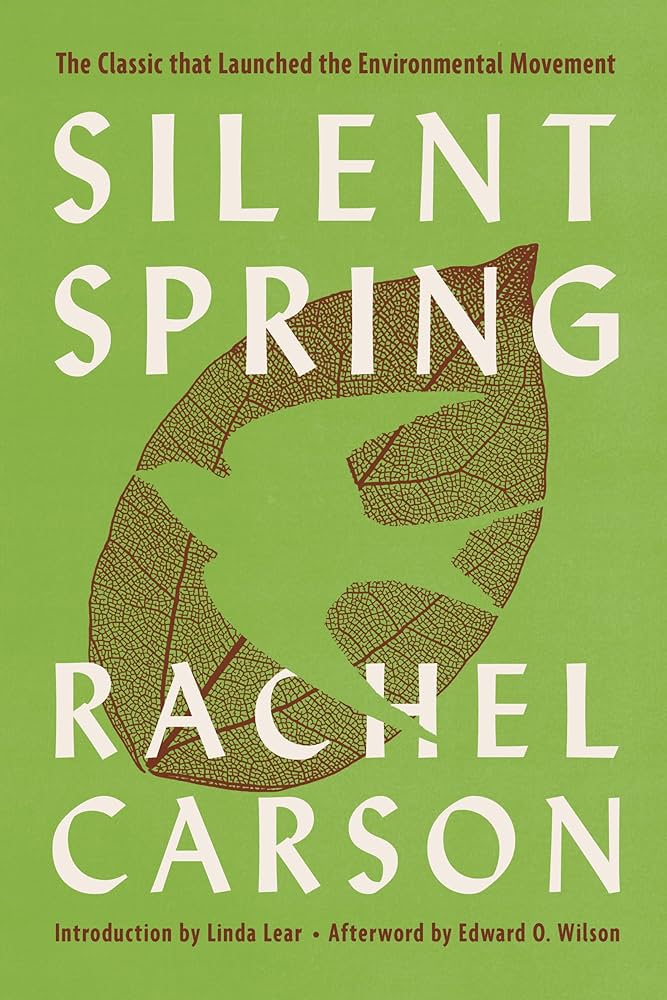
Silent Spring
Book by Rachel CarsonWikipedia
85
MENTIONS
39
EPISODES
38
PODCASTS
Search complete. 85 mentions across 39 episodes found for "Silent Spring".
Oct 30, 2026

Bert LiveranceGUEST
You go back in time to, you're probably too young for this, Jeff, a lady by the name of Rachel Carson.
Bert LiveranceGUEST
She wrote a book called Silent Spring, and she was advocating for preventing the use of DDT.
Bert LiveranceGUEST
And DDT was used quite a bit in the 60s and 70s.
Bert LiveranceGUEST
And they found that it was actually causing large birds' eggs to not mature properly.

Mark SmithGUEST
That's right.
Mark SmithGUEST
And many people say it was all the result of one woman, Rachel Carson, and her book that she produced called Silent Spring.
Mark SmithGUEST
She noticed that none of these birds were coming back for spring migration and kind of started to sound the alarms and The whole story of DDT and how it was banned and the people that did it is quite fascinating.
Mark SmithGUEST
It was a very small group of people that faced challenges everywhere they went for many years and were often laughed out of court, but they just kept going.

Justin StellmanHOST
There's no supplements that were used during that time, during that experiment.
Justin StellmanHOST
so taking something to remove chemicals or finding out how they're getting in is really important because you could do a double whammy right lower your exposure while taking things to help get them out it's a really great quote by rachel carlson or carson in silent spring and she says nothing in nature exists alone and this is true everything in our body works in systems and our detox pathways our organs they all adapt to the environment they work together there's a synergy to all this and when she wrote that silent spring she was talking about the connections and ecosystems and the ecosystem i want to explore in this episode is our internal ecosystem in response to the external ecosystem that's the things we eat the things we store in our bodies how we cook what we breathe in they all intersect in the body that we're living in so this ecosystem both internal and external kind of really just shows us that in nature, nothing exists alone.
Justin StellmanHOST
Everything is connected.
Justin StellmanHOST
And this is one of the things doctors just don't realize is that you can't just be a knee doctor, right? You can, but the human body is connected.

Peter Marcus BachNARRATOR
We reflect on the many out-of-the-box ways our guests have navigated the complexity and intricacies of our environment at the cutting edges of science, engineering, technology, and design.
Peter Marcus BachNARRATOR
On today's show, Josh and I embark on an epic journey across diverse topics, unraveling how his early childhood experiences have shaped his views, from Silent Spring to America's major cultural and political events.
Peter Marcus BachNARRATOR
We discuss how art and science are closer than you think and a powerful means to spark important conversations, how fire and ecology, sewers and oysters, moss and air quality relate, and how ancient wisdom provides a roadmap into the future for those who are willing.
Peter Marcus BachNARRATOR
Visit tgcpodcast.show for detailed information and show notes on this episode.
46 MINS LATER
Joshua HarrisonGUEST
The Club of Rome laid pretty much everything down.
Joshua HarrisonGUEST
out about resource extraction, you know, the fate of the Earth.
Joshua HarrisonGUEST
I mean, not the fate of the Earth, the diet for a small planet was a critical analysis, you know, Silent Spring earlier, even earlier.
Peter Marcus BachHOST
Climate change was mentioned in the early 20th century, even late 19th century as

Gaelin RosenwaksGUEST
way that she connected with the ocean, the way that she wrote about the ocean.
Gaelin RosenwaksGUEST
And then, of course, her seminal work, Silent Spring, which is really such a game changer in the environmental science space and conservation, getting DDT banned.
Gaelin RosenwaksGUEST
So those are the first three that come to mind, you know, and then all of the amazing imagery that, you know, we get to see of the ocean.
Toby UsnikHOST
Absolutely.

Jack GescheidtGUEST
This talks about it from a capitalist point of view, which is money, money, money, money, money.
Jack GescheidtGUEST
And it all goes back to the classic written over six decades ago, Silent Spring by Rachel Carson.
Jack GescheidtGUEST
Everybody knows it.
Jack GescheidtGUEST
Why aren't we paying attention to this brilliant woman who had the balls, if I may say that, to say, hey, let's not put biocides into the atmosphere.

Rupert DarwallGUEST
But what they did is they appropriated the language and the moral absolutism of the civil rights movement and put it in the environmental movement.
Rupert DarwallGUEST
Of course, in 1962 is the publication of what I've said elsewhere is the most important book of the post-war period, which was Rachel Carson's Silent Spring.
Rupert DarwallGUEST
And that was the germ seed of the ideology that was then taken up by these white liberal boomers, which I think explains why your friend got so upset with you when you put a question mark over all of this.
Rupert DarwallGUEST
Then they made a prediction.

Bob NovellaHOST
She was an American world-renowned marine biologist and author and conservationist.
Bob NovellaHOST
Her probably most famous book, Silent Spring, is credited with advancing global environmental movement.
Bob NovellaHOST
So this quote is from 1952, I believe.
Bob NovellaHOST
I really liked how Carson reframes the sentiment on environmentalism and conservation.
Bob NovellaHOST
And that deepening, you know, deepening our genuine curiosity comes, you know, cures that destructive impulse.
Bob NovellaHOST
So this is, it definitely had a, I was reading a lot of quotes saying this one really had a, I had a real reaction to, and that's why I'm using it today.
Steven NovellaHOST
Yeah, but I have to say that some of the things she concludes in her book Silent Spring— Oh, I
Bob NovellaHOST
didn't read it.

Larry FessendenGUEST
And also, I got radicalized by reading books about the environment.
Larry FessendenGUEST
Silent Spring is an important book to me.
Larry FessendenGUEST
It was written in 1963 by Rachel Carson, and she spoke about pesticides and so on.
Larry FessendenGUEST
So sorry to go off the rails here, but you see, it started to tap into my mind.

Stephen ScharperGUEST
So his courage, I think, also is one of his greatest legacies.
Stephen ScharperGUEST
I teach Rachel Carson's Silent Spring, as you know, and I use a documentary that was done for PBS in the States on Rachel Carson's Silent Spring.
Stephen ScharperGUEST
And the documentary shows that Rachel Carson was amazing.
Stephen ScharperGUEST
She was valiant and courageous.
Stephen ScharperGUEST
They went ahead.
Stephen ScharperGUEST
Sitting at home in his living room was Senator Abraham Rybakov of Connecticut, Democrat.
Stephen ScharperGUEST
I don't know if he read Silent Spring.
Stephen ScharperGUEST
I don't know if he read the excerpts in The New Yorker.
29 more episodes mention Silent Spring.
Create an account to see the whole feed, search across every transcript, and follow the entities you care about.