Sieve of Eratosthenes
6
MENTIONS
3
EPISODES
3
PODCASTS
Search complete. 6 mentions across 3 episodes found for "Sieve of Eratosthenes".
Sep 18, 2026

AnnaHOST
Around 240 BC, the Greek mathematician, geographer, and astronomer, Eratosthenes of Cyrene, discovered a way of finding all the prime numbers up to a given limit.
AnnaHOST
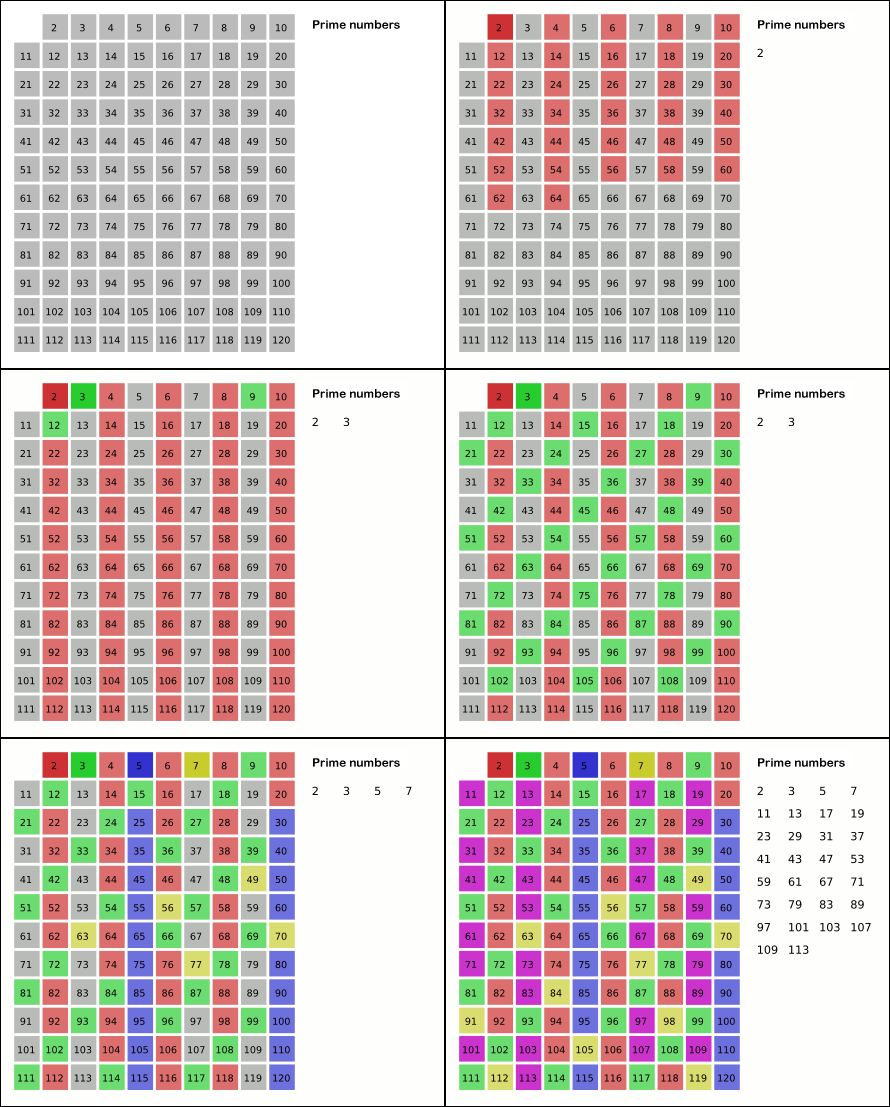
It's called the sieve of Eratosthenes, and it's an ancient algorithm that finds prime numbers.
AnnaHOST
How it works is first you choose the limit up to which you want to explore.
AnnaHOST
Let's say you want to find all the primes up to 100.
AnnaHOST
The root of 100 is 10, so we only need to cross out multiples of 2, 3, 5, and 7. and you'll find that even just these four numbers will eliminate every non-prime up to 100.
AnnaHOST
So there you have it.
AnnaHOST
The sieve of Eratosthenes sieves a whole range of numbers to leave only the primes.
AnnaHOST
This method is intriguing because you're not so much finding the primes as finding what isn't prime, which is very effective because there are more composite numbers in the given range than there are primes.

BrianHOST
The sieve of Eratosthenes is a timeless, elegant method for finding all the prime numbers in a large number set.
BrianHOST
It doesn't involve adding new numbers or creating new shapes.
BrianHOST
Instead, it uses a clever process of subtraction and filtering.

speaker_0NARRATOR
The Pythagoreans considered the even number of which the duad was the prototype to be indefinite and feminine.
speaker_0NARRATOR
The odd numbers are divided by a mathematical contrivance called the Sieve of Eratosthenes into three general classes: incomposite, composite, and incomposite composite.
speaker_0NARRATOR
The incomposite numbers are those which have no divisor other than themselves and unity, such as three, five, seven, eleven, thirteen, seventeen, nineteen, twenty-three, twenty-nine, thirty-one, thirty-seven, forty-one, forty-three, forty-seven, and so forth.
speaker_0NARRATOR
For example, seven is divisible only by seven, which goes into itself once, and unity, which goes into seven seven times.
speaker_0NARRATOR
Thus, every fourth number is evenly odd.
speaker_0NARRATOR
Each of the even odd numbers may be divided once as two, which becomes two ones and cannot be divided further, or six, which becomes two threes and cannot be divided further.
speaker_0NARRATOR
The Sieve of Eratosthenes.
speaker_0NARRATOR
Redrawn from Taylor's Theoretic Arithmetic.