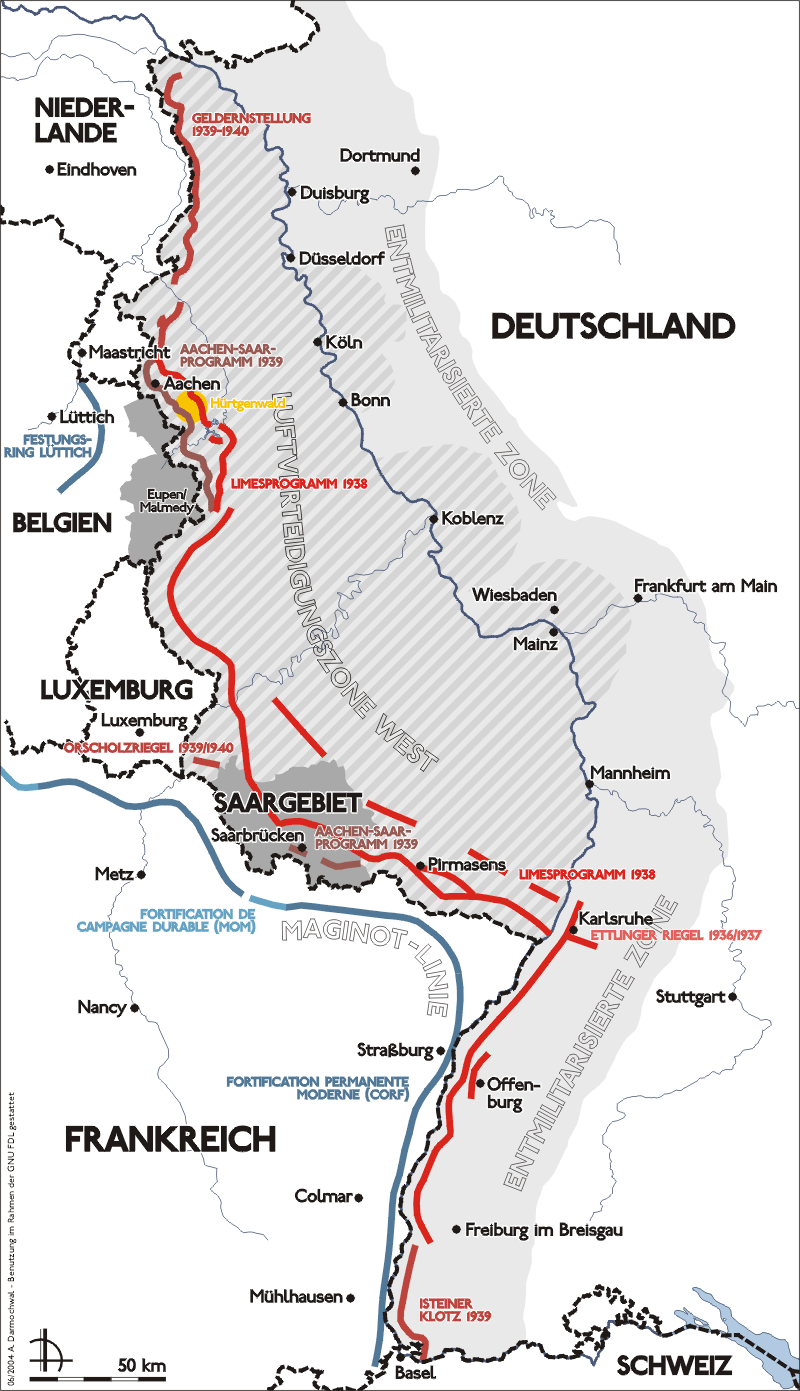
Siegfried Line
20
MENTIONS
5
EPISODES
5
PODCASTS
Search complete. 20 mentions across 5 episodes found for "Siegfried Line".
Oct 17, 2026

Victor Davis HansonGUEST
The Germans were paranoid about it because the usual routes of invasion that were through the flatlands to France were blocked by the Maginot Line.
Victor Davis HansonGUEST
In fact they even tried to copy it with the Siegfried Line.
Victor Davis HansonGUEST
It was a joke.
Victor Davis HansonGUEST
The problem was that Belgium and the North, uh, said to the French, "If you build that across our border, uh, we will be neutral or we'll, we'll, we're not gonna fight." Well, they weren't gonna fight anyway and the French, uh, did not have the money to incorporate all of Belgium behind the Maginot Line.

PatHOST
So cheer up, my lads, bless them all.
PatHOST
We're gonna hang out the washing on the Siegfried Line.
PatHOST
"Have you any dirty washing, mother dear?" We're gonna hang out the washing on the Siegfried Line.
PatHOST
'Cause the washing day is here.
PatHOST
Whether the weather may be wet or fine.
PatHOST
We'll just rub along without a care.
PatHOST
We're gonna hang out the washing on the Siegfried Line.
PatHOST
If the Siegfried Line's still there.

Tom GulleyHOST
The French themselves operated the trains, providing rolling stock and trained personnel to supplement the Third Army.
Tom GulleyHOST
Patton believed his forces were close enough to the Siegfried Line that he remarked to Bradley that with 400,000 gallons of gasoline, he could be in Germany within two days.
Tom GulleyHOST
In late September, a large Panzer counterattack spent, sent expressly to stop the advance of Patton's Third Army was defeated by the U.S. Fourth Armored Division at the Battle of Arracourt.
Tom GulleyHOST
This, the German commanders believed this was because their counterattack had been successful, whatever that means.

Ray Harris JrHOST
But I mean, and you make this point in the book, this comes after a pretty good dash of a couple of weeks where there's been a lot of ground covered.
Ray Harris JrHOST
Having said that, why do the American commanders initially believe that the Siegfried line would be so much easier to overcome than it actually was.
Ray Harris JrHOST
Because, again, I think in your book, there was like 14 weeks of steady progress, something like that.
Craig S. ChapmanGUEST
Well, I think the Allied commanders and the senior officers had some concerns about attacking a fortified line.
Ray Harris JrHOST
However, as it turns out, as Hitler is going to certainly be shocked, the pillboxes in and of themselves are not the end-all, be-all of his magnificent defensive line.
Craig S. ChapmanGUEST
Now, it turns out they ended up being quite vulnerable.
Craig S. ChapmanGUEST
The Siegfried Line was made up of about 5,000 different concrete bunkers.
Craig S. ChapmanGUEST
Now, they're not very elaborate, nothing like the Maginot Line.

Mark PainterHOST
As it was, the delay caused when Market Garden was given priority gave the Germans time to reinforce their defensive positions along the Scheldt, Ultimately, it would be the Canadian Army stuck with the costly job of securing the waterway, which they would not complete until early November.
Mark PainterHOST
Field Marshal Walter Modell, commander of the German Army Group B, had taken a shattered German Army Group and rebuilt it into a formidable defensive force along Westwall, the defensive line Germany had built before the war, the German answer to the Maginot Line.
Mark PainterHOST
As he had already done on the Eastern Front, Model saved the German army from what seemed a catastrophic collapse.
Mark PainterHOST
Defenses were rebuilt, new units and equipment sent to the front, taking full advantage of the slowed advance of the western allies, and of course of the fact that they were now taking up positions in Germany itself, which meant a populace who supported the German army and saw them as protectors rather than loathing the German army as their occupiers.