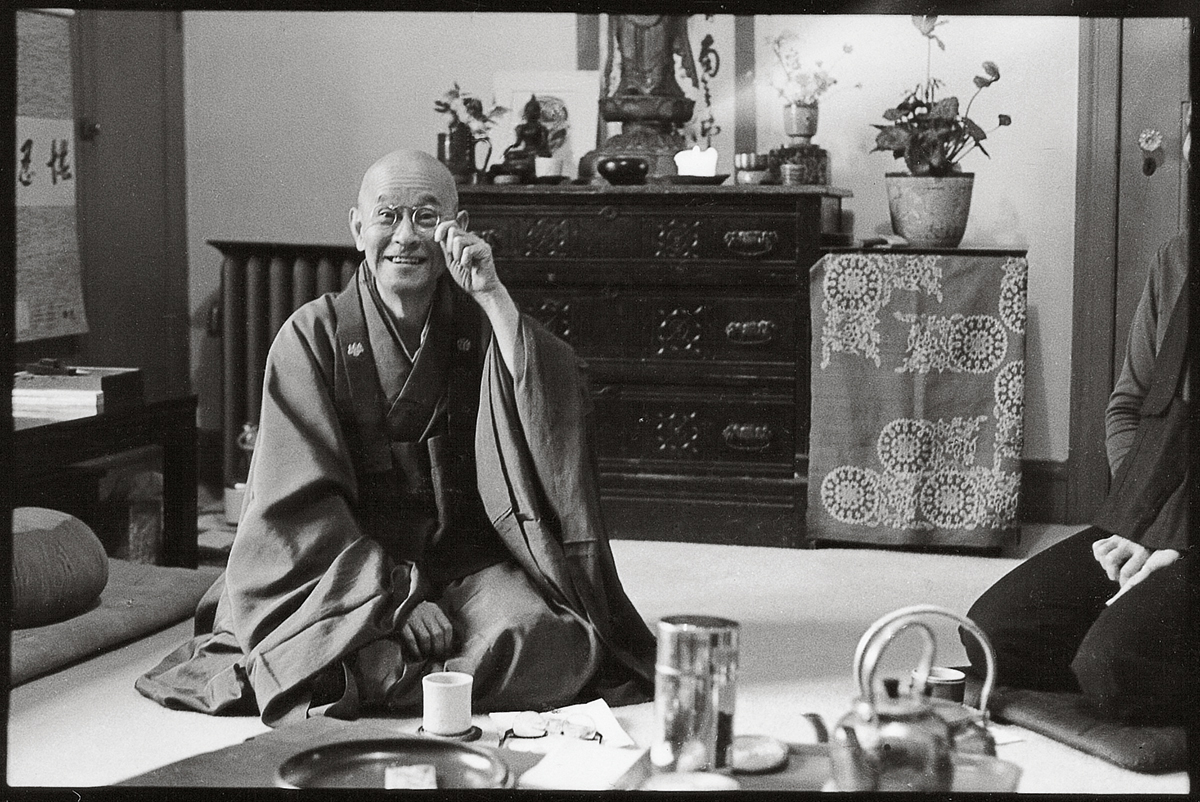
Shunryū Suzuki
Monk and teacherWikipedia
138
MENTIONS
64
EPISODES
48
PODCASTS
Search complete. 138 mentions across 64 episodes found for "Shunryū Suzuki".
Oct 27, 2026

Erik FabianHOST
Bakers, hello! I am happy to be back with you and to be talking today with Edward S.B.
Erik FabianHOST
Brown, a Zen priest, meditation instructor, teacher of vegetarian cooking classes, and the author of a long list of books about food and Zen.
Erik FabianHOST
He was the first head cook at the Tassajara Zen Mountain Center.
Erik FabianHOST
which is now a retreat location for the San Francisco Zen Center.
8 MINS LATER
Edward Espe BrownGUEST
And then we say, this is why awakening is said to be a practice.
Edward Espe BrownGUEST
If you want to awaken, you practice awakening with things as you participate with things, seeing, tasting, smelling.
Edward Espe BrownGUEST
One Zen teacher said, Tenke, Japanese Zen teacher somewhere in the last two or three hundred years, he said, see with your eyes, smell with your nose, Taste with your tongue.
Edward Espe BrownGUEST
Nothing in the universe is hidden.

Geoff ShotzGUEST
And so that's why I'm going after the beginner's mind thing.
Michele Kawamoto PerryHOST
Well, as Shunryu Suzuki says, in the beginner's mind, there are many possibilities, but in the experts, there are few.
Michele Kawamoto PerryHOST
Jeff, thank you so much for joining me on Expressions of Leadership today.
Michele Kawamoto PerryHOST
I really loved hearing your stories and learning more about your journey.

Daniel McGeeGUEST
And a few other things that came across my way.
Daniel McGeeGUEST
Of course, the great Suzuki Roshi.
Daniel McGeeGUEST
And, you know, my fear of death.
Daniel McGeeGUEST
You know, I came, of course, most of us have read Beginner's Mind.
Daniel McGeeGUEST
And I remember Suzuki Roshi describing the waterfall in Yosemite.
Daniel McGeeGUEST
And this is how we all are, drops of water flying off that waterfall and then down and Imagine how scary that experience must be.
Daniel McGeeGUEST
And then you're in the source.
Daniel McGeeGUEST
It's like, I'm just going to be returning to that source.
Chris FortinGUEST
Kuan Yin perceives the suffering of the world conducting vital energy, her Dharma body responding with karmic resonance, harmonizing all phenomena in a symphony of liberation.
Chris FortinGUEST
As I read that, I think of Suzuki Roshi and one of my most favorite of many things that he said is just to be alive is enough.
Chris FortinGUEST
just to be alive in this very body, in this very vital energy, this dharma body, this human body, this suffering, aging body that is alive with cosmic resonance in harmony with the whole world.
Chris FortinGUEST
The symphony of liberation.

Cynthia KerrGUEST
And of course, our wonderful staff, including dear Kodo and my fellow teachers, Shinzon and Cathy.
Cynthia KerrGUEST
And of course, Roshi, right, who just built this extraordinary, extraordinary container that we can all come together in and settle into and get in touch with something, you know, really meaningful to us, settle into something that our busy, acquisitive and distracted lives outside don't always let us touch.
Cynthia KerrGUEST
Roshi, nine bows wherever you are.
Cynthia KerrGUEST
And who knows where she
Joan HalifaxHOST
is? The woman is amazing.
Joan HalifaxHOST
And there were innovations
Cynthia KerrGUEST
amid the landscape, political and cultural and historical.
Cynthia KerrGUEST
And one of the innovations that is coming forward, which is kind of at the heart of what we're aiming at, is this whole methodology of koans, right? Now, in the Suzuki Roshi lineage, we have respect for koans and appreciate them and take them to heart, but we don't study them in the same way that the Rinzai school studies them, which is that the koan is pretty much all that is considered.
Kathie FischerGUEST
Here are a couple of images that are related to this by wonderful Zen teachers.
Kathie FischerGUEST
First of all, Suzuki Roshi famously said, if you want to control your cows, give them a really big field.
Kathie FischerGUEST
And what does this mean? It means don't try to control your cows.
Kathie FischerGUEST
Why would you want to control cows? Why would you want to control yours or anyone else's cows? Put them at ease.

Myoshin Kate McCandlessHOST
Don't get stuck in the absolute or the relative.
Myoshin Kate McCandlessHOST
There's a place in Suzuki Roshi's book, Zen Mind, Beginner's Mind, modern classic, where he quotes Dogen as saying, a Zen master's life is one continuous mistake.
Myoshin Kate McCandlessHOST
I did a little research on that.
Myoshin Kate McCandlessHOST
I looked at the original Japanese, and I realized that the expression Dogen used is better translated as a Zen master's life is one mistake after another.

Allison TaitHOST
And it's very hard to explain this.
Allison TaitHOST
I think Suzuki Roshi says again and again, you can't really practice Zen until you have a direct experience of emptiness.
Allison TaitHOST
And then he's left all of us flailing to explain, what did Suzuki Roshi mean by a direct experience of emptiness? And this is, you know, Kensho, this is seeing the nature.
Allison TaitHOST
This is the instantaneous understanding, right? Which is, you know, beyond words or before words.
Allison TaitHOST
So it's very hard to explain in words.

Rich BonnifaceNARRATOR
Allen Ginsberg, Lawrence Ferlinghetti, Michael McClure, Lenore Candle, Gary Snyder, Timothy Leary, making his first appearance on the West Coast and his old Harvard colleague Richard Alpert.
Rich BonnifaceNARRATOR
The Zen teacher Suzuki Roshi sat quietly among them.
Rich BonnifaceNARRATOR
and between the poems and the chanting there was music the whole roster of the neighborhood's bands jefferson airplane big brother and the holding company quicksilver messenger service and the grateful dead who played a short set of the songs they were playing everywhere that winter a soul cover a long blues pigpens harmonica rock scully's memory of it is mostly sensory conch shells being blown incense burning little altars of feathers and mirrors and bells set out on the grass people wandering around blowing soap bubbles and checking out the bands nobody minded anything the ground he said was fairly humming And it changed things.
Rich BonnifaceNARRATOR
The newspapers and magazines covered it, and the story went out across the country.

KenseiGUEST
If it is, this isn't practice.
KenseiGUEST
So today, Hongzhi reaches through time and space, arrives in our zendo with these beautiful words, and offers us this practice guidance, which I don't know if you noticed, but very much mirrors Suzuki Roshi's passage from yesterday about big mind and small mind.
KenseiGUEST
The Dharma realm in the ten directions arises from the single mind.
KenseiGUEST
When the single mind is still, all appearances are entirely extinguished.
54 more episodes mention Shunryū Suzuki.
Create an account to see the whole feed, search across every transcript, and follow the entities you care about.