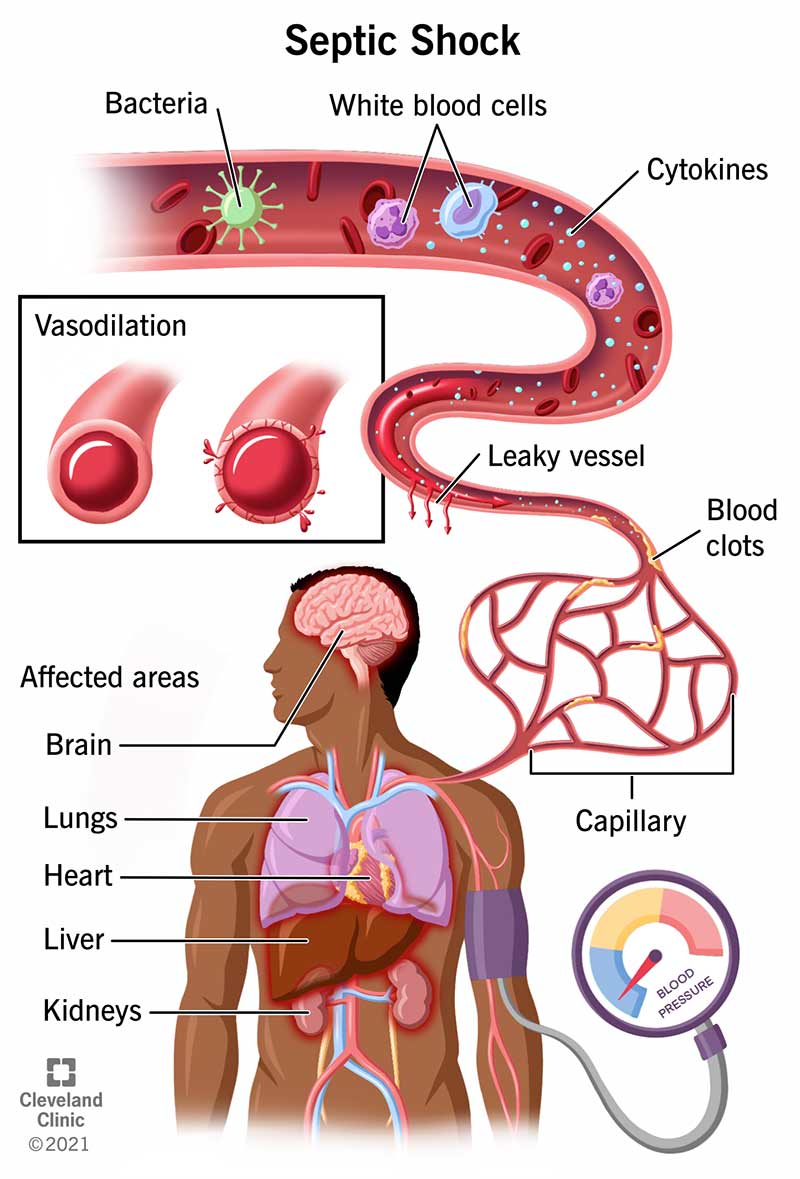
septic shock
Medical conditionWikipedia
44
MENTIONS
8
EPISODES
8
PODCASTS
Search complete. 44 mentions across 8 episodes found for "septic shock".
Oct 15, 2026

Marnie DobakGUEST
It's a Staph bacteria that is, um, resistant to the majority of antibiotics that we have, and it tends to be very aggressive and cause very serious infections sometimes.
Marnie DobakGUEST
And so they knew he was in septic shock from MRSA.
Lauren Bright PachecoHOST
They had finally gotten to the bottom of what was slowly draining the life from Zach, MRSA, that had developed into sepsis.
Lauren Bright PachecoHOST
Here's Dr. Jim O'Brien, the vice president of operations for population health at OhioHealth and a board member of the Sepsis Alliance.
Jim O'BrienSOUNDBITE_SPEAKER
What sepsis is is when those body defense systems actually go haywire, and so instead of having a focused response to the infection, you wind up with widespread response to infection throughout the body.
Jim O'BrienSOUNDBITE_SPEAKER
And so your body functionally suffers friendly fire from your immune system trying to battle the infection.
Jim O'BrienSOUNDBITE_SPEAKER
If you experience septic shock, the risk of dying goes up by about 1% for every five minutes that passes without appropriate antibiotics.
Lauren Bright PachecoHOST
Zach had gone into septic shock because of how rapidly the MRSA had spread throughout his body.

LenaHOST
It comes from intensive care and emergency teams in Australia and New Zealand.
LenaHOST
They took 1,000 adults in the emergency department with septic shock.
LenaHOST
Everyone had already had at least a liter of fluid, and the pressure was still low.
MarcusHOST
So exactly that first page.
15 MINS LATER
MarcusHOST
So three reflexes this week.
MarcusHOST
Fluid for a low pressure.
MarcusHOST
In early septic shock, pressors first did about as well with half the extra fluid.
LenaHOST
Bicarbonate for a low pH.

Scott WhiteHOST
Mm-hmm.
Scott WhiteHOST
So in someone whose observations have started to go off, tell us about septic shock in pregnancy and how that's different from outside pregnancy.
Lucy BowyerGUEST
In pregnancy, um, septic shock is, is often the very last stage before death, and you may not have a gradual decline into septic shock.
Lucy BowyerGUEST
It may be, um, as we were just saying, like compensating, compensating, and then wham, bam, you're in septic shock, and it can be, particularly if it's a group A streptococcus that's causing it, by then you've got such bad end organ damage, it can be really difficult to resuscitate the patient.
Lucy BowyerGUEST
The definition of septic shock itself is unchanged in pregnancy compared with non-pregnant.
Lucy BowyerGUEST
The screening tools that we have before then, so i.e., what blood pressure we'll use, what pulse rate we will use, might be slightly changed according to, as you were saying, pregnancy and which, um, area and territory you are practicing in.
Scott WhiteHOST
And I guess we look at other things rather than just numbers.
Lucy BowyerGUEST
Again, our, our cutoff for lactate might be slightly different in pregnancy compared with the non-pregnant.

Lisa JohnsonHOST
I'm Dr. Lisa Johnson.
Lisa JohnsonHOST
This week we feature new research on transcatheter treatment for tricuspid regurgitation, multi-cancer early detection testing, resuscitation strategies for septic shock, and an experimental approach to restoring vision.
Lisa JohnsonHOST
We review advances in breast cancer treatment, follow a puzzling case of prolonged fever and lymphadenopathy, and report on scientific reproducibility.
Lisa JohnsonHOST
Perspectives discuss outbreak response, obesity trials, and the enduring value of the medical generalist.
6 MINS LATER
Lisa JohnsonHOST
The editorialist writes that it is hard to imagine a trial of this size being conducted in the fragmented US health system.
Lisa JohnsonHOST
All parties should be congratulated for putting an attractive concept to a rigorous test and achieving the unambiguous result that this method of multi-cancer early detection is not yet ready for population-wide cancer screening.
Lisa JohnsonHOST
Vasopressors or fluids in early septic shock.
Lisa JohnsonHOST
By the ARISE fluids investigators, the ANZICS clinical trials group, and the ACIM Clinical Trials Network.

Rushabh DevHOST
What do our listeners need to know about that?
Brycen RatcliffeGUEST
Yeah, so the 2024 Surgical Infection Society guideline recommends source control within 12 hours for lower-risk patients and within six hours for higher-risk patients with septic shock.
Brycen RatcliffeGUEST
These are both Grade 1B recommendation.
Brycen RatcliffeGUEST
The 2026 Surviving Sepsis campaign similarly suggest early source control, ideally within six hours of the diagnosis of sepsis or septic shock when a source control procedure is required, although the certainty there is pretty low.
Rushabh DevHOST
Yeah, so the antibiotic order is not, you know, the completion of sepsis care, right?
Brycen RatcliffeGUEST
Exactly.
Skye ShultzGUEST
Those statements shouldn't carry equal weight when discussing them on rounds.
Skye ShultzGUEST
And modern ICU stewardship includes how we administer therapy.

Courtnee StagnerGUEST
is.
Courtnee StagnerGUEST
Septic is something she's got.
Courtnee StagnerGUEST
She's so septic right now, but I have to have goals of care again with the family because.
Courtnee StagnerGUEST
The decision maker believes very.

Rivka ShotkinGUEST
Um, and for five days it was just sick, fever, not feeling good, throwing up everything I ate.
Rivka ShotkinGUEST
Um, the fifth day after I was home I went into septic shock-
Nachi GordonHOST
Oi
Rivka ShotkinGUEST
... which is an infection-
Rivka ShotkinGUEST
I don't know when they'll let me out, when they'll, you know...
Rivka ShotkinGUEST
But my brother, who's an EMT, was like, "This is not okay," you know? "You gotta take her." So Hatzalah came.
Rivka ShotkinGUEST
At that point I'm already going into septic shock.
Rivka ShotkinGUEST
Um, and they took me away again.