Separation of powers
53
MENTIONS
20
EPISODES
19
PODCASTS
Search complete. 53 mentions across 20 episodes found for "Separation of powers".
Sep 23, 2026

Kevin YearyGUEST
The law should be written by the legislature, not by the courts.
Kevin YearyGUEST
Separation of powers has always meant something important to me.
Kevin YearyGUEST
And I've seen Justice Scalia talking to the United States Supreme Court on video, of course, YouTube, talking about how important the separated powers are to this country's ability to preserve its greatness and our freedom.
Kevin YearyGUEST
And so separation of powers means so much to me.
Kevin YearyGUEST
Yeah, I mean, these are all philosophical principles that guide decision making.
Kevin YearyGUEST
And so when I became a judge, I began to formulate what I called at first the seven principles of judicial restraint.
6 MINS LATER
Kevin YearyGUEST
And that is that you can begin to believe that there were judges that came before us in old England.
Kevin YearyGUEST
and so now we created judges here and so we have the same authorities and and uh we can do the same things that the judges in in grand old england could do and of course the judges of grand old england were appointed by the king they had the authority of the king and when they decided to say something they were saying it in the name of the king and of course that was law in england but when we said in our united states constitution that we were doing something different we said all legislative powers vested in a congress that separates the power that previously maybe was consolidated in judges themselves into different branches, right? Some of the lawmaking powers in the Congress or in this state in the legislature and the judicial power, the power to decide cases is vested in judges.

Mark RoarkHOST
It's about keeping the courts out of a role that belongs to somebody else.
Gwendolyn SavitzHOST
Yeah, that seems to be kind of what it was intended to do, protecting the separation of powers.
Gwendolyn SavitzHOST
Some people get to sue to enforce something and some don't.
Mark RoarkHOST
So let's look at this through an example.

Craig BenzineHOST
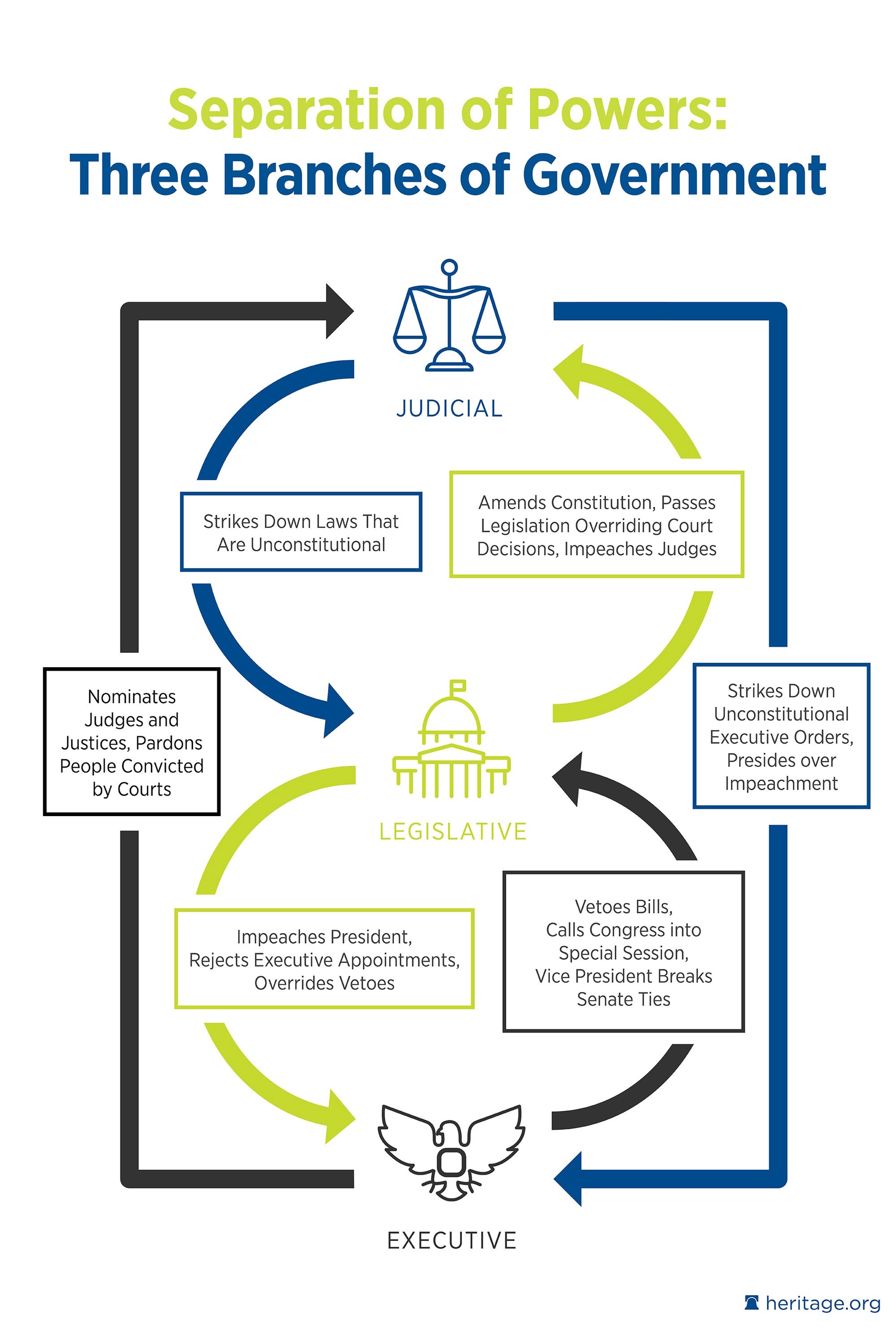
And today I'm going to try to explain two fundamental concepts of American government that students and citizens often confuse, Team Jacob and Team Edward.
Craig BenzineHOST
Separation of powers and checks and balances.
Craig BenzineHOST
Team Jacob.
Craig BenzineHOST
So separation of powers is really simple.
Craig BenzineHOST
The national government is divided into three separate branches.
Craig BenzineHOST
The legislative branch, the executive branch, and the judicial branch.

speaker_4HOST
Let's look at United States v. Texas from twenty twenty-three.
speaker_5HOST
This case is an absolute masterclass in the separation of powers.
speaker_4HOST
Let's lay out the facts.
speaker_5HOST
Under the Biden administration, the Department of Homeland Security issued new immigration enforcement guidelines.
1 HR 3 MINS LATER
speaker_8HOST
They can't just hand out legal advice on abstract questions or propose legislation without a real concrete dispute between adverse parties.
speaker_8HOST
Moving on to Section two, horizontal power, covering Congress and the president.
speaker_8HOST
Okay, now that we've established the judicial boundaries, let's talk about horizontal separation of powers.
speaker_8HOST
The absolute most crucial point here is this: Congress does not possess a general federal police power.
speaker_3HOST
Our roadmap for this journey is going to cover the entire board.
speaker_3HOST
We are going to start with the horizontal separation of powers.
speaker_3HOST
That is the endless tug-of-war between the three branches of the federal government, so the legislature, the executive, and the judiciary.
speaker_2HOST
Okay.
1 HR 2 MINS LATER
speaker_3HOST
If there is no documented history of state constitutional violations, the congressional remedy is disproportionate and structurally void.
speaker_2HOST
So Congress has immense power, mostly through the expansive Commerce Clause and conditional spending, but the court continually invents doctrines like the non-economic limit in Lopez, the Coercion Doctrine in NFIB, and the congruence test in Boerne to keep a leash on the legislature.
speaker_2HOST
But what happens when the President of the United States decides to act unilaterally, especially during a perceived national crisis? Let's transition to the imperial presidency and separation of powers.
speaker_3HOST
When analyzing the structural boundaries of presidential power, you do not start with the text of Article Two, because Article Two is notoriously vague.

Mike RobinsonHOST
Yes.
Mike RobinsonHOST
and if we don't have this oversight and this separation of powers and this limiting ability in an upper chamber we're really heading down some pretty dangerous...
Brian GerrishHOST
By limiting you really mean that the House of Lords has the ability to protect by having a look, a second look at policy that's coming through the Commons and saying no this is not good so it's a protection
Mike RobinsonHOST
It's exactly right.
5 MINS LATER
Mike RobinsonHOST
So what Clegg is attempting to do with all this constitutional reform, whether it be the House of Lords or the new Bill of Rights, is to limit the rights and the protections that people have.
Mike RobinsonHOST
And that's why it's such a dangerous thing that they're doing.
Mike RobinsonHOST
One of the key areas that they're damaging at the moment is this idea of the separation of powers.
Mike RobinsonHOST
How do we describe the separation of powers in a simple way? But basically, there's always some kind of oversight in any particular area of government.

Bill McClayGUEST
of power within the legislature itself.
Dan LevitardADVERTISER
What we call the separation of powers.
Bill McClayGUEST
Not only must we divide power between different branches of government, but we should also divide the legislative power itself.
Bill McClayGUEST
Most of the foregoing reasons apply equally to prove that the legislative power ought to be more complex, to which we may add that if the legislative power is wholly in one assembly, an executive in another, or in a single person, these two powers will oppose and innovate upon each other until the contest shall end in war and the whole power, legislative and executive, be usurped by the strongs.
Bill McClayGUEST
There's some very practical wisdom there.
Bill McClayGUEST
If you make it too difficult, make the separation of powers too stark, the contending powers will not just seek compromise, they will seek one to dominate over the other.
Bill McClayGUEST
Very practical wisdom on Adams' part.
Bill McClayGUEST
Now here he is on the concept of an independent judiciary.

KevinHOST
Yeah
AmandaHOST
... because of separation of powers, right? So, like, essentially what I'm gathering is that the wizarding world does not have separation of powers.
AmandaHOST
[laughs] It's like the Wizengamot, and then they have their lackeys in Magical Law Enforcement running out there being cops.
AmandaHOST
But they're gonna make the laws, and then they're also gonna be the end of the story, because they're gonna be trying the, the cases-

Ben MeiselasHOST
And that's not allowed.
Ben MeiselasHOST
Now, a broader question could even be, does Congress ever have authority under the Constitution to even enact this? You would have a separation of powers fight at that point if Congress passed the law, because let's say Congress passed the law that enabled all of this to happen.
Ben MeiselasHOST
The states would still make the argument.
Ben MeiselasHOST
You're still infringing on states' rights.
Ben MeiselasHOST
All we have to look at is what law is the U.S.
Ben MeiselasHOST
Postal Service claiming this authority? Let's look at that law.
Ben MeiselasHOST
That law doesn't say you get to do all of this and interfere with state elections, right? In the future, if there was a law that says you interfere with state elections, that could still be challenged on the basis of separation of powers.
Ben MeiselasHOST
But we're not even there yet.

Charles CappsGUEST
The law stays the same until it's lawfully changed, otherwise judges would be in the constitutional convention business.
speaker_0SOUNDBITE_SPEAKER
I sometimes wonder if we don't appreciate enough the separation of powers and how important it is to our liberty.
speaker_0SOUNDBITE_SPEAKER
The, the real key to, uh, the distinctiveness of America is the structure of our government.
Chad SquitieriHOST
Welcome back, everyone, to another episode of The Separation of Powers, a podcast brought to you by the Separation of Powers Institute.
Chad SquitieriHOST
I'm your host, Professor Chad Skwiteri, and I am delighted to be joined today by Arizona State University law professor Charlie Capps.
Chad SquitieriHOST
Charlie, welcome to the show.
1 HR LATER
Charles CappsGUEST
It's a hard topic.
Chad SquitieriHOST
Great.
10 more episodes mention Separation of powers.
Create an account to see the whole feed, search across every transcript, and follow the entities you care about.