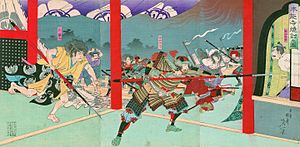
Sengoku period
IncidentWikipedia
38
MENTIONS
15
EPISODES
15
PODCASTS
Search complete. 38 mentions across 15 episodes found for "Sengoku period".
Sep 14, 2026

speaker_2NARRATOR
Sus historias desafían nuestras suposiciones sobre los roles de género en la sociedad samurái y demuestran que el poder, incluso cuando era negado legalmente, podía ser tomado y ejercido por quienes fueran lo suficientemente determinados e inteligentes como para reclamarlo.
speaker_2NARRATOR
La clase samurái alcanzó su apogeo durante el periodo de guerra constante conocido como el periodo Sengoku, la era de los estados en guerra, que duró aproximadamente desde mediados del siglo XV hasta finales del siglo XVI.
speaker_2NARRATOR
Durante esta época, el poder estaba fragmentado entre innumerables daimyo, cada uno controlando territorios y luchando constantemente por la expansión y el dominio.
speaker_2NARRATOR
Las guerras eran frecuentes, brutales e impredecibles.

speaker_2HOST
to claim it.
speaker_2HOST
The samurai class reached its height during the period of constant warfare known as the Sengoku period, the age of warring states, which lasted approximately from the middle of the 15th century until the end of the 16th century.
speaker_2HOST
During this time, power was fragmented among countless daimyo, each controlling territories and constantly fighting for expansion and dominance.
speaker_2HOST
Wars were frequent, brutal and unpredictable.

Steven BellHOST
These two originated in China before traveling across to Japan.
Steven BellHOST
Eventually, though, Japan would go through a little something called the Sengoku Jidai, the Age of War.
Steven BellHOST
And afterwards, in the 1600s, would almost completely cut itself off from the outside world.
Steven BellHOST
So it was then that for more than two centuries of Tokugawa rule, seclusion was the mainstream ideology.

BlakeHOST
... tankōbon.
BlakeHOST
So the main character is Kagome Higurashi, w- who is a 15-year-old girl who follow, falls down her family's magic well from modern-day Tokyo into the Sengoku period, where a bunch of demons are running around.
BlakeHOST
She meets a half-dog, half...
BlakeHOST
Uh, sorry, a half-demon, and the type of demon is dog demon.
SpencerHOST
Yeah
BlakeHOST
... which has supercharged your demon powers abilities, and everybody wants to get it.
BlakeHOST
And through a series of misadventures, the Shikon Jewel gets broken into a bunch of pieces that then scatter themselves across the Sengoku period.
BlakeHOST
And so Kagome and Inuyasha form up to go and get those shards back into a single jewel.

speaker_2HOST
Exactly.
speaker_2HOST
Before a weapon was even swung, let's start in Japan's Sengoku period with a samurai named Honda Tadakatsu.
speaker_3HOST
Ah, yes.
speaker_2HOST
This guy, he fought in over 100 battles during literally one of the most brutal, chaotic eras in Japanese history.
speaker_3HOST
Oh, sure.
speaker_2HOST
You're telling me he fought in a hundred melees and never even, like, tripped and scraped his knee on a stray spear?
speaker_3HOST
Well, to understand Tadakatsu, you really have to understand the physics of a Sengoku battlefield.
speaker_3HOST
It wasn't the romanticized, you know, one-on-one samurai duels you see in movies.

James DesboroughGUEST
That was the initial idea behind it.
James DesboroughGUEST
It's like, why do we only have old school D&D? Why hasn't anyone gone back to a lot of these older games and brought them back? So I was quite a way down developing that, and I realized that the people behind it are still alive, and they still sell Bushido and its semi-sequel Sengoku as well.
James DesboroughGUEST
So I thought, well, damn.
James DesboroughGUEST
I wouldn't feel right doing this now.
Brendan DavisHOST
And, you know, it can it can lead in interesting places.
Brendan DavisHOST
Can you give people the basic gist of the setting, especially if people aren't as familiar with like Japanese history and stuff like that?
James DesboroughGUEST
Okay, so the base setting for the main core book is meant to be historical and set during the Sengoku period in Japan.
James DesboroughGUEST
That is the Warring States period, equivalent to the Three Kingdoms in China.

speaker_0NARRATOR
Because the measure of a successful covert operation is not that it is remembered.
speaker_0NARRATOR
it is that it is not and yet across the long centuries of japan's feudal period certain events broke through the silence moments where the shadow war surfaced into documented history where the involvement of shinobi operatives was acknowledged by the warlords who employed them or pieced together afterward by historians patient enough to read between the lines these events give us our clearest window into what the conflict between samurai and shinobi actually looked like when it moved from philosophy into practice, begin in the 15th century, in the fragmented, ungovernable period that historians call the Sengoku, the warring states era.
speaker_0NARRATOR
Japan had fractured, The authority of the shogunate had collapsed into something nominal, almost ceremonial.
speaker_0NARRATOR
While across the provinces, dozens of daimyo lords competed with ruthless energy for land, resources, and survival.
speaker_0NARRATOR
The attacking force, numerically superior, found itself unable to translate that superiority into decisive action against an enemy that kept striking from directions that couldn't be defended against in any conventional sense.
speaker_0NARRATOR
The lesson was noted by everyone.
speaker_0NARRATOR
But it was in the intelligence war surrounding the great warlords of the High Sengoku period that the shinobi's influence reached its deepest expression.
speaker_0NARRATOR
The campaigns of Takeda Shingen, the formidable lord of Kai Province, whose military genius earned him the title, The Tiger of Kai relied heavily on a network of shinobi operatives known as the Mitsumono, a three-tiered intelligence apparatus that fed Shingen information about enemy positions, political vulnerabilities, and the movements of rival lords with a regularity that his opponents found almost supernaturally accurate.

Kimi KatoHOST
In the Muromachi period, the region fell under the control of the Uesugi.
Kimi KatoHOST
Then came the Sengoku era or Sengoku Jidai, meaning age of warring states.
Kimi KatoHOST
It was a period of near constant civil war in Japan from roughly 1467 to the early 1600s.
Kimi KatoHOST
and Niigata's most famous figure, Uesugi Kenshin.
Kimi KatoHOST
Legend also holds that Kenshin rode alone into Shingen's headquarters for a dramatic duel.
Kimi KatoHOST
Shingen defended himself with a war fan.
Kimi KatoHOST
That scene became one of the Sengoku era's most cinematic images in later stories.
Kimi KatoHOST
Kenshin's spirit of gi, or righteousness, is captured in another celebrated episode.

Chump SlapHOST
All right.
Chump SlapHOST
So this takes place during the Sengoku period.
Chump SlapHOST
We all know this is a period of civil war in Japan between approximately mid to late 1400s to about 1600.
Chump SlapHOST
Just like

Kevin O'SheaHOST
So...
Kevin O'SheaHOST
During the Sengaku, Warring States period, samurai favored the dragonfly almost above all other insects because dragonflies only fly straight forward or hover, never flying backward.
Kevin O'SheaHOST
They came to symbolize courage, relentless forward momentum, and the refusal to retreat in the face of death.
Kevin O'SheaHOST
And samurai frequently adorned their helmets, kabuto, sword guards, tsuba, and armor with dragonfly motifs to grant them bravery in battle.
5 more episodes mention Sengoku period.
Create an account to see the whole feed, search across every transcript, and follow the entities you care about.