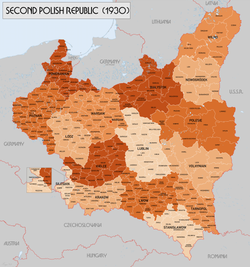
Second Polish Republic
StateWikipedia
9
MENTIONS
8
EPISODES
7
PODCASTS
Search complete. 9 mentions across 8 episodes found for "Second Polish Republic".
Nov 21, 2026

ShirvanHOST
The fatigue of war in European powers, combined with the new geopolitical arrangement, again gave rise to the hope of creating a force in the region that could resist the empires in the East and West.
ShirvanHOST
Józef Klemens Piłsudski, who was the key figure of the newly formed Second Polish Republic, shared that desire.
ShirvanHOST
The Polish Chief of State and later Field Marshal led the Polish Army in the victorious war against Polshevik Russia in 1920, sealed by the victory in the Battle of Warsaw, also known as the Miracle on the Vistula.
ShirvanHOST
The Piłsudski's idea was in nature identical to the plan of Czartoryski and later it began to be known under the name of Intermarium, in Polish Między Morze, which means between the seas.
ShirvanHOST
In pursuit of a regional coalition, Poland's foreign policy from 2007 to 2014 encouraged the expansion of the EU and NATO, especially to Ukraine, Moldova, the South Caucasus and the Balkans.
ShirvanHOST
This modern policy is in fact the Prometheanism doctrine which was envisioned by the leaders of the Second Polish Republic, who, following the establishment of a Polish state in over a century, sought to weaken Moscow's influence by supporting nationalist and ethnic movements within the borders of the Russian Empire and later on the Soviet Union.
ShirvanHOST
The Prometheanism doctrine was partially realized with the breakup of the USSR, but policymakers in Warsaw believe that in order to ensure independence and prevent foreign occupation, the complete breakup of modern-day Russia is necessary.
ShirvanHOST
This is what the national interests of Poland dictate.

Simon WhistlerNARRATOR
With Russia having pulled out of the war after its revolution and German power left in ruins, local Polish councils, militias, and political leaders seized the moment and filled the power vacuum.
Simon WhistlerNARRATOR
On November 11, 1918, the day the armistice ended fighting in Western Europe, Polish leaders in Warsaw proclaimed independence and they formed the Second Polish Republic.
Simon WhistlerNARRATOR
After 123 years of partition, Poland was back on the map.
Simon WhistlerNARRATOR
Sadly, the next few decades would be downhill from here.

Brad MinerNARRATOR
When the shooter was finally stopped several hundred yards later, he was about to cross into the district of Kazimierz, where, within living memory, thousands of Krakow's Jews were huddled into a ghetto before being liquidated by the Gestapo.
Brad MinerNARRATOR
Yesterday, November 11th, Poland celebrated its National Day of Independence, commemorating the emergence of the Polish Second Republic after 123 years of partition and foreign rule.
Brad MinerNARRATOR
Yes, Krakow has known its share of violence and suffering.
Brad MinerNARRATOR
In one sense, the blood, shed so senselessly on Saturday, is a mere drop in the lake of blood spilled in Poland over the centuries.

Molly CrabappleGUEST
There were plenty of you know, men with piggish behavior.
Molly CrabappleGUEST
You're talking about Sofia Dybnova in the book, The Boon's Sex Columnist in Interwar Poland.
Molly CrabappleGUEST
She has a whole thing where she's reproaching a boy for using Marx, for using Marx's idea of like from each according to his ability to each according to his needs to talk about why his ex-girlfriend still has to sleep with him.
Matthew RemskiHOST
Right.
Molly CrabappleGUEST
There are amazing pictures of girls and women who are, you know, who are athletes, right? Who are like javelin throwers, who are, you know, doing like.
Molly CrabappleGUEST
group gymnastics who are like flipping on ring bars.
Molly CrabappleGUEST
I mean, the Bund had a sports club in interwar Poland.
Molly CrabappleGUEST
It was called Morgenstern.

speaker_1HOST
It simply migrates.
speaker_2HOST
The geographic center of gravity for the movement shifts westward, across the new borders into the newly established Second Polish Republic.
speaker_1HOST
Which inaugurates what historians universally refer to as the Boone's Golden Era.
speaker_2HOST
From 1918 until the Nazi invasion in 1939, the Polish Bund doesn't just survive, it thrives in the open light of day.

Joanne JanickiNARRATOR
By February 16, 1919, the Poles controlled the province.
Joanne JanickiNARRATOR
The territory was then included in the reconstituted Second Polish Republic by the Treaty of Versailles, which was ratified in January 1920.
Joanne JanickiNARRATOR
The success of the uprising is still a great source of pride for local inhabitants.
Joanne JanickiNARRATOR
Poznań.

speaker_1NARRATOR
Within six months of his taking charge of the Red Army, its numbers had swelled from 300,000 men to one million troops.
speaker_1NARRATOR
Eventually, this would increase to 3 million men as new fronts opened, particularly in Poland from early 1919 onwards, as Polish separatists undertook the Polish-Soviet War, backed in particular by Britain and France to establish what eventually became the Second Polish Republic.
speaker_1NARRATOR
Trotsky's methods as Commissar for Military and Naval Affairs were brutal.
speaker_1NARRATOR
In order to instill greater discipline in the rank and file, he devised the notorious blocking units, special units which were placed behind the front line of the Red Army troops, charged specifically with gunning down any of their own soldiers suspected of trying to desert or retreat.