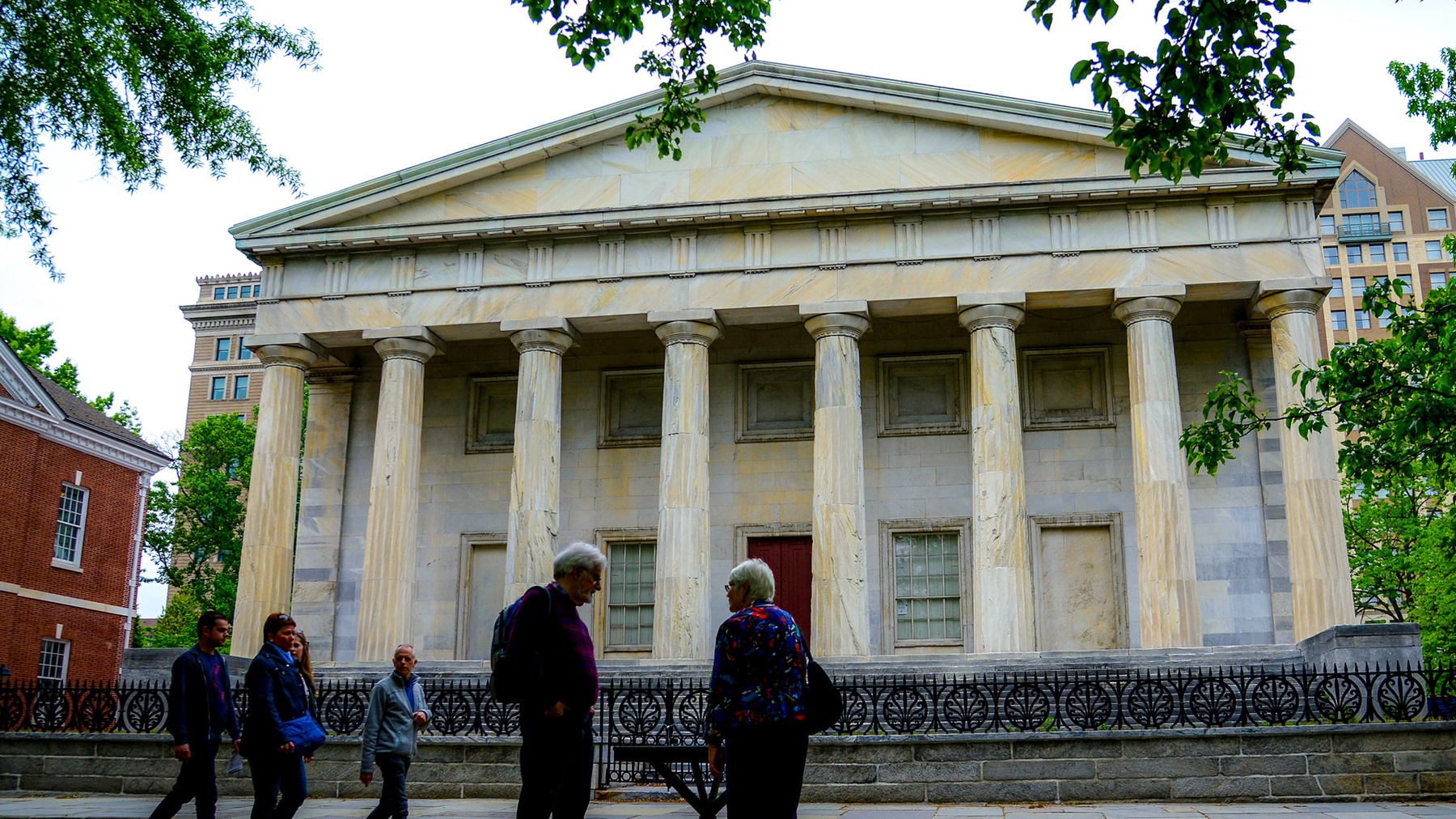
Second Bank of the United States
Art gallery in Philadelphia, PennsylvaniaWikipedia
42
MENTIONS
19
EPISODES
15
PODCASTS
Search complete. 42 mentions across 19 episodes found for "Second Bank of the United States".
Nov 3, 2026

Caroline TurcoHOST
When Jackson entered the White House in 1829, sadly alone, he brought both resentment and a deep suspicion of concentrated financial power.
Caroline TurcoHOST
Specifically, he detested the Second Bank of the United States.
Caroline TurcoHOST
Now, despite the name, it wasn't quite a central bank in the modern sense.
Caroline TurcoHOST
It was a federally chartered institution that held government deposits, issued banknotes, and exercised considerable influence over the nation's credit and banking systems.

Bob CrawfordHOST
So talk about the hoarding of gold that took place in Economy, Pennsylvania.
Joseph SlaughterGUEST
Yeah, and it's not even just the hoarding of gold, but Biddle being connected to the Second Bank of the United States and then the larger story of how Rapp and his adopted son, who's really his chief financial officer, Frederick, they're connected with the banking world in general.
Joseph SlaughterGUEST
And so when the banking crisis happens and they know, for instance, that...
Joseph SlaughterGUEST
when they lived in, you know, there's two different big sort of crisis that they lived through, one around 18, 19, and then the second one that you're talking about you know, banks are failing left and right in this era.

Jake RoqueHOST
walk through that? I think that that's like a really important, and I know about this vaguely, but I think this is an important place to start.
Jake RoqueHOST
So what is that history, that lineage of central banks in America? First bank, second bank, ending the central bank, The Fed.
Jake RoqueHOST
Let's go through that.
Chris SullivanGUEST
So the forefathers who signed the Declaration of Independence, they weren't fighting George III.
Chris SullivanGUEST
Literally like a year before, or two years, the charter expires, and then the war starts.
Chris SullivanGUEST
And it's another war against England for another central bank.
Chris SullivanGUEST
Now, even though America stayed intact and won, there was the second bank of the United States, which was then pushed out by Andrew Jackson.
Chris SullivanGUEST
And that, like, people need to study.

Ashe in AmericaHOST
Early in his political career, he had been a friend of the banking industry and an advocate of easy credit.
Ashe in AmericaHOST
As a member of the Whig political party in the 1830s, before becoming a Republican in his campaign for the presidency, he had been a supporter of Biddle's Second Bank of the United States.
Ashe in AmericaHOST
During his famous debates with Senator Stephen Douglas, one of the points of contention between the two was that Lincoln defended the bank and advocated its reestablishment.
Ashe in AmericaHOST
Furthermore, after becoming president, he took the initiative of requesting Congress to reestablish central banking.
28 MINS LATER
Ashe in AmericaHOST
You want to read these? Sure.
Ashe in AmericaHOST
Do we have time? Okay.
Ashe in AmericaHOST
President Andrew Jackson put his political career on the line in 1832 by vetoing the renewal of the second charter for the second of the charter for the second bank of the United States.
Ashe in AmericaHOST
He called the bank a monster and declared, quote, I am ready with the screws to draw every tooth and then the stumps.

Ilan WurmanHOST
It's actually quite amazing, the historical evidence for this view.
Ilan WurmanHOST
In 1860, Roger Taney, who was Attorney General during Andrew Jackson's presidency, addressed the accusation that Jackson refused to enforce the bank law, the Second Bank of the United States.
Ilan WurmanHOST
And he said, no.
Ilan WurmanHOST
On the contrary, he operated on the assumption that it existed, that he couldn't just ignore the law that created it.

George BagbyGUEST
So he actually recharters the Bank of the United States in eighteen fifteen.
George BagbyGUEST
We get the second Bank of the United States.
George BagbyGUEST
And this is partly because of his, uh, gargantuan financial problems during the war.
George BagbyGUEST
Uh, we have a alarming national debt after the war.
George BagbyGUEST
He's far more invested with the ship owners and the middlemen of New England who know that their commerce bringing over these cheap goods from England is going to suffer with that protective tariff.
George BagbyGUEST
Um, and they are also talking about increased consumer prices in relation to that tariff.
George BagbyGUEST
Nevertheless, the Tariff of eighteen fifteen and the rechartered Second Bank of the United States are both established, and John C. Calhoun of South Carolina advocates for both.
George BagbyGUEST
Now, in Calhoun's defense, he made a special point to say, "This is a temporary protective tariff, and this is in the national interest given our circumstances.

George BagbyGUEST
So he actually recharters the Bank of the United States in 1815.
George BagbyGUEST
We get the second Bank of the United States, [lip smacks] and this is partly because of his, uh, gargantuan financial problems during the war.
George BagbyGUEST
Uh, we have a alarming national debt after the war.
George BagbyGUEST
We financed our war-making, as is the typical case.
George BagbyGUEST
He's far more invested with the ship owners and the middlemen of New England who know that their commerce bringing over these cheap goods from England is going to suffer with that protective tariff.
George BagbyGUEST
Um, and they are also talking about increased consumer prices in relation to that tariff.
George BagbyGUEST
Nevertheless, the tariff of eighteen fifteen and the rechartered Second Bank of the United States are both established, and John C. Calhoun of South Carolina advocates for both.
George BagbyGUEST
Now, in Calhoun's defense, he made a special point to say, "This is a temporary protective tariff, and this is in the national interest given our circumstances.

Kim StaubGUEST
So right now we're in the 1730s portion.
Kim StaubGUEST
And the house was combined by William Strickland, who's famous for the Second Bank of the United States, and he did this house for his friends Reuben and Jane.
Kim StaubGUEST
But one of the really cool things he did was actually install these folding four-way doors, and it's just a way to create flexible floor plans throughout the house 'cause it is a long, large house.
Shara Dae HowardCORRESPONDENT
Yeah, and these doors are huge, and this thoroughway is pretty wide.
Ashe in AmericaHOST
Summary.
Ashe in AmericaHOST
The Second Bank of the United States was dead, but banking was very much alive.
Ashe in AmericaHOST
Many of the old problems continued and new ones arrived.
Ashe in AmericaHOST
The issuance of banknotes had been severely limited, but that was largely offset by the increasing use of checkbook money, which had no limits at all on its issue.

Alan KaplinskyHOST
Although the court didn't decide the ultimate merits, it emphasized that the Federal Reserve may occupy a unique constitutional position.
Alan KaplinskyHOST
Both the majority in Cook and the majority opinion in Slaughter noted that the Federal Reserve has historical antecedents in the First and Second Banks of the United States.
Alan KaplinskyHOST
I'm very puzzled by that, but we'll get to that.
Alan KaplinskyHOST
And suggested that those institutions may represent a category different from executive agencies exercising ordinary executive power.
11 MINS LATER
Alan KaplinskyHOST
Yeah.
Alan KaplinskyHOST
Well, that, that's a good, good segue into Cook.
Alan KaplinskyHOST
I remember my having the conversation with you, uh, after the oral argument where we both sort of scratched our heads [clears throat] with the, uh, the reasoning that had been employed in, in the shadow docket by the court, where they analogize the Federal Reserve to the First and Second Banks of the United States.
Alan KaplinskyHOST
Tell, tell our audience, I think you're gonna tell our audience, why that historical analogy doesn't make any sense.
9 more episodes mention Second Bank of the United States.
Create an account to see the whole feed, search across every transcript, and follow the entities you care about.