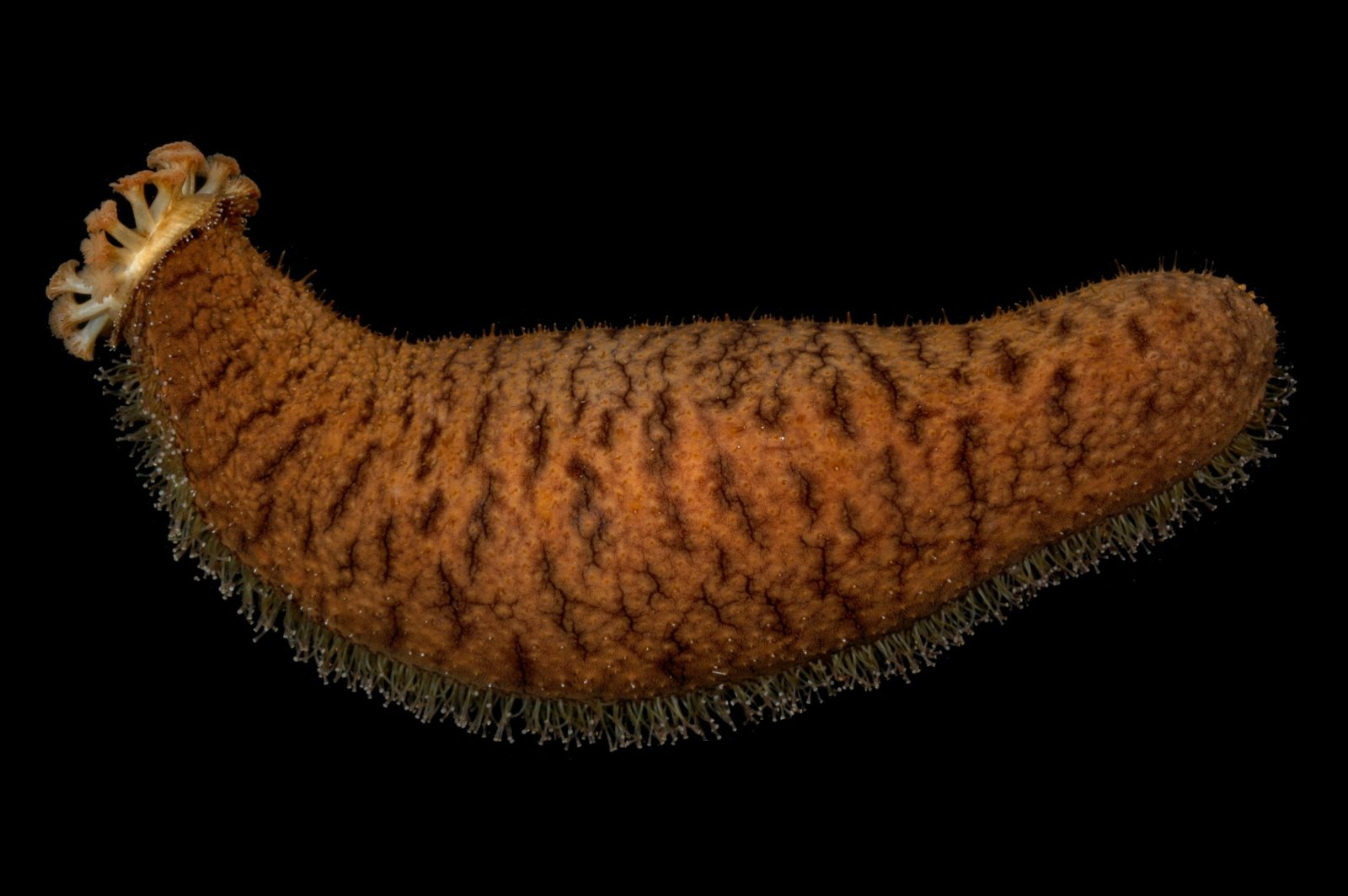
Sea cucumber
AnimalWikipedia
7
MENTIONS
4
EPISODES
2
PODCASTS
Search complete. 7 mentions across 4 episodes found for "Sea cucumber".
Oct 12, 2026

Dave FarinaHOST
Though the echinoderm phylum is still large, diverse, and ecologically significant, there was a time when at least twenty classes existed on Earth, as is evidenced by the fossil record.
Dave FarinaHOST
Today, the five extant echinoderm classes are Crinoidea, Asteroidea, Ophiuroidea, Echinoidea, and Holothuroidea.
Dave FarinaHOST
It's worth mentioning that although there is widespread consensus that these five classes are distinct, the exact number and relationship between orders within a class, and even the total number of orders, is still a subject of ongoing research.
Dave FarinaHOST
In this tutorial, we will cover the least diverse of the echinoderm classes, the crinoids.
Dave FarinaHOST
He knows a lot about the science stuff, Professor Dave explains.
Dave FarinaHOST
As we discussed previously, the five extant echinoderm classes are Crinoidea, Asteroidea, Ophiuroidea, Echinoidea, and Holothuroidea.
Dave FarinaHOST
In the previous tutorial, we covered the crinoids.
Dave FarinaHOST
In this tutorial, we will discuss Asteroidea and Ophiuroidea.

Kim McCallisterHOST
You see its kinda weird little tail? Because of that, they have named it Loki, and Loki is one of 57 new species discovered in the deep sea canyon near Argentina.
Kim McCallisterHOST
Now, this is a sea cucumber, Loki the sea cucumber they call it.
Kim McCallisterHOST
One of m- many newly discovered marine species in the South Atlantic Ocean, these creatures discovered during the expedition of Mar del Plata submarine canyon off the coast of Argentina about a year ago.
Kim McCallisterHOST
This is an area, it's called the Brazil Malvinas Confluence, and it is where the warm subtropical currents collide with cold nutrient rich sub-Antarctic waters.
Kim McCallisterHOST
And what you get is this, they call it a crossroad bustling with biodiversity.
Kim McCallisterHOST
The submarine canyon itself is nearly twice as deep as the Grand Canyon, so more than 11,000 feet.
Kim McCallisterHOST
They said among this new crop of ocean dwellers is here we have pictured Loki the sea cucumber.
Kim McCallisterHOST
Named for its appendages which resemble the Norse god of mischief's horns, Loki was discovered at 8,454 feet deep.
Dave FarinaHOST
Remember, this is just a basic guideline of echinoderm classification, which may change over time.
Dave FarinaHOST
Lastly, we have class Holothuroidea, whose members are often commonly referred to as sea cucumbers.
Dave FarinaHOST
Like most echinoderms, these are found in oceans worldwide.
Dave FarinaHOST
They differ from other echinoderms in that they are elongated and bear gr-