SciPy
Computer programWikipedia
39
MENTIONS
14
EPISODES
11
PODCASTS
Search complete. 39 mentions across 14 episodes found for "SciPy".
Nov 22, 2026

David CloughHOST
So that gives you that.
David CloughHOST
And then we come along and you end up getting like specific manuals for NumPy, Another module we use frequently later on is called SciPy.
David CloughHOST
And then there's a user's guide to Matplotlib.
David CloughHOST
So you can do that.

Philipp HennigGUEST
And you see these kind of work precision diagrams for many different solvers in many different languages actually across language ecosystems.
Philipp HennigGUEST
Here at the top in gray is MATLAB, in green is SciPy, in blue is old Fortran code by Ernst Heyer.
Philipp HennigGUEST
and professional C++ code.
Philipp HennigGUEST
And then down here are the super optimized Julia libraries.

Harrison KinsleyHOST
And then how to resample.
Harrison KinsleyHOST
I'm pretty sure we can use SciPy for resampling information.
Harrison KinsleyHOST
But anyways, that's the question.
Harrison KinsleyHOST
And now how do we get the data actually just in Python? So to do that, it was actually super simple.
6 MINS LATER
Harrison KinsleyHOST
But like I said, I'm pretty sure gamma and beta is going to give us the information that we need, you know, for control.
Harrison KinsleyHOST
Like if we're thinking left, thinking right, I think we're going to need somewhere in these range.
Harrison KinsleyHOST
If I forgot to say it too, I'm pretty sure I can use SciPy for the actual resampling, but it really is going to depend on if this is seamless or not.
Harrison KinsleyHOST
I think it's bursting.
Harrison KinsleyHOST
um basically the crux is greater than two so if you want 60 hertz you need a raw sample sampling that is more than 120 hertz so that makes sense because also on the open bzi gui if you're you know like i'm i'm using 125 hertz it goes to 60 okay so i'll take that as expert validation so So moving on, now that we know those things, what is our objective? Our objective is at least to start, I want to move something on the screen, and as you've already seen, I'm starting to get there, but how do we do it? So we need something, and I want to use deep learning, so we need something to pass through this neural network model that is useful information.
Harrison KinsleyHOST
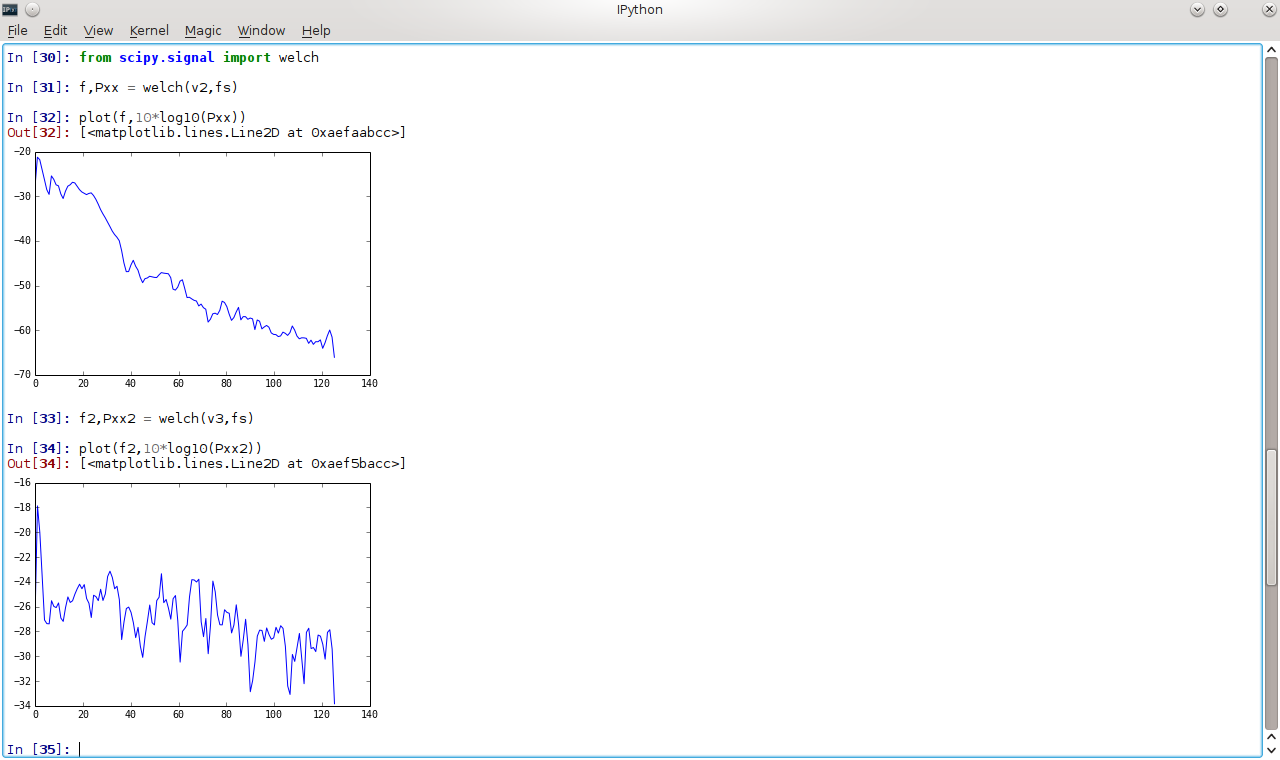
So I did start with PyOpenBCI and I was doing my own signal processing with SciPy.
Harrison KinsleyHOST
This is fairly complex.
Harrison KinsleyHOST
It's not that hard, but you still need to account for any fluctuations in the actual sampling rate.

speaker_0NARRATOR
Data scientists often praise NumPy for its power.
speaker_0NARRATOR
SciPy looks at NumPy and thinks, adorable.
speaker_0NARRATOR
SciPy is not here to perform basic calculations.
speaker_0NARRATOR
It integrates, optimizes, transforms, and solves.
speaker_0NARRATOR
This is a library for those who have mastered simplicity and are prepared to embrace complexity.
speaker_0NARRATOR
Let us explore SciPy, where mathematics meets precision engineering.
speaker_0NARRATOR
Shall we begin? Install SciPy.
speaker_0NARRATOR
SciPy is no ordinary library.

Paul AllenGUEST
So Travis Oliphant, who just moved to Utah after 25 years in Austin, you guys should interview Travis.
Paul AllenGUEST
He invented NumPy and SciPy.
Paul AllenGUEST
He created Anaconda, which is a $1 or $2 billion company to distribute Python into enterprise.
Paul AllenGUEST
Travis is one of the top three or four people in the world in the Python ecosystem.
Paul AllenGUEST
He's the reason Python was the language for AI.
Paul AllenGUEST
Yeah.
Paul AllenGUEST
because he built NumPy and SciPy.
Paul AllenGUEST
So Travis is an investor and we hired some of his AI experts to build custom ML models back in 2020.

RJ HanekeHOST
So why is this an important problem if we can just solve them with tools? I mean, maybe you can't this one specifically, but.
JonasGUEST
Yeah, so we can't, even when we do run these as agent tasks and we provide a bunch of Python libraries for scientific purposes like SciPy and a bunch of image manipulation libraries like OpenCV, the accuracy is significantly better than the VLMs, but it's still under 60%.
JonasGUEST
And so, yeah, like the...
JonasGUEST
It's still nowhere near usable.
Harrison KinsleyHOST
Now let's say you had a lot more plots or something, and you really wanted to make this smooth, right? You don't want this jagged edge, the jagged edge.
Harrison KinsleyHOST
There's a very quick way about doing this, and the quick way that I know of anyways, comes from a download of SciPy.
Harrison KinsleyHOST
So what you'll want to do is come over to your favorite search engine, which is probably Google, and you'll want to do a SciPy download.
Harrison KinsleyHOST
Let me move this over so you can see it.
Harrison KinsleyHOST
Just scipy download.
Harrison KinsleyHOST
And then the first option for you will probably be the sourceforge.net. Click on that and then you'll click on this download for your computer.
Harrison KinsleyHOST
Now, if you're on Mac OS or you don't have Python 2.7 or whatever, first of all, get Python 2.7. And then Windows 32, depending on whatever your operating system is, you might want to pick something else.
Harrison KinsleyHOST
But just make sure you get SciPy.

Grant SandersonNARRATOR
And in this case, it runs it for multiple different iterations, tries to find an average, and it looks like, on this computer at least, it averages at 4.87 seconds.
Grant SandersonNARRATOR
By contrast, if I use a different function from the SciPy library called fftConvolve, which is the same thing, just implemented differently, that only takes 4.3 milliseconds on average, so three orders of magnitude improvement.
Grant SandersonNARRATOR
And again, even though it flies under a different name, it's giving the same output that the other convolve function does, it's just doing something to go about it in a cleverer way.
Grant SandersonNARRATOR
Remember how with the probability example, I said another way you could think about the convolution was to create this table of all the pairwise products, and then add up those pairwise products along the diagonals.

Nathan GoldbaumGUEST
It's not.
Nathan GoldbaumGUEST
OpenBLAST, at one point, when NumPy depended on Atlas, SciPy has a lot of Fortran code, but NumPy has never had any Fortran code.
Nathan GoldbaumGUEST
It's all C.
Nathan GoldbaumGUEST
It talks to CPython directly over the CPython C API.
26 MINS LATER
Nathan GoldbaumGUEST
Yeah, it's interesting that way, yeah.
Nathan GoldbaumGUEST
And often the, like, social part of it, I think, is the most important.
Nathan GoldbaumGUEST
And that's why conferences like the Scientific Python Conference, I gave that talk you're talking about at SciPy 2024 in Tacoma.
Nathan GoldbaumGUEST
And, like...
4 more episodes mention SciPy.
Create an account to see the whole feed, search across every transcript, and follow the entities you care about.