Schwarzschild radius
47
MENTIONS
12
EPISODES
10
PODCASTS
Search complete. 47 mentions across 12 episodes found for "Schwarzschild radius".
Sep 29, 2026

speaker_1HOST
The immense, unprecedented gravitational pressure triggers a macroscopic quantum phase transition.
speaker_1HOST
Instead of continuing to fall inward into a singularity, a microscopic, ultra-hard physical shell forms right at the Schwarzschild radius.
speaker_0HOST
A physical shell.
speaker_1HOST
Mm-hmm.

Jacob HyattHOST
... and special relativity came out, and then you had this physicist called, uh, Schwarzschild come around and play with some of the Einstein equations, and that's where we got the idea of black holes.
Jacob HyattHOST
And you've probably heard the event horizon called the Schwarzschild radius before.
LucasHOST
Yes.
Jacob HyattHOST
So then based on the math that Schwarzschild did, Einstein and another physicist by the last name of Rosen came in and started playing again with these Schwarzschild, uh, ideas behind general relativity, and they found that it is possible to get a situation, kind of the same situation going on with black holes, but instead of just being this infinite density point in space like a black hole-

Jimmy AkinPANELIST
So, and they don't do that, you know, so it comes across as just, they don't know their science.
Jimmy AkinPANELIST
Then later on in the episode, there's all this stuff about entering the black hole and they're conceiving of the Schwarzschild radius as a barrier to, Which it didn't.
Jimmy AkinPANELIST
And even if you did cross the Schwarzschild radius, you would be spaghettified.
Jimmy AkinPANELIST
And there's no acknowledgement of that in this.
Jimmy AkinPANELIST
And it would be an infinite fall because time slows down.

speaker_0NARRATOR
These tests provide confidence that general relativity remains valid across the entire range of gravitational strengths, from weak fields where Newton's laws work well to the extreme environments where black holes dominate space and time.
speaker_0NARRATOR
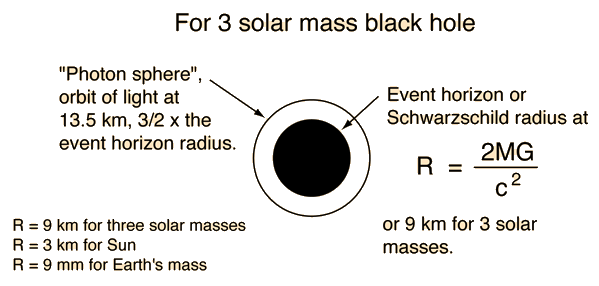
Schwarzschild radius calculations reveal event horizon size for any black hole based solely on its mass.
speaker_0NARRATOR
Karl Schwarzschild discovered this in 1916 by solving Einstein's equations for a perfectly spherical, non-rotating black hole.
speaker_0NARRATOR
The formula is remarkably simple.
speaker_0NARRATOR
Schwarzschild radius equals two times the black hole's mass multiplied by the gravitational constant divided by light speed squared.
speaker_0NARRATOR
For a black hole with 10 solar masses, the radius works out to approximately 30 kilometres.
speaker_0NARRATOR
For a billion solar masses, the radius extends to several billion kilometers, roughly Pluto's distance.
speaker_0NARRATOR
The Schwarzschild radius represents the point of no return, the event horizon.

John GreenHOST
Is a black hole like a town in size?
Katie MackGUEST
So, okay, so the event horizon, the distance from the singularity to the event horizon, that's called the Schwarzschild radius.
Katie MackGUEST
And the Schwarzschild radius for something as massive as the sun is three kilometers.
John GreenHOST
Oh.
Katie MackGUEST
That's small, right? That's pretty little.

Charles BailynHOST
And this is the size something has to be in order for its escape velocity to be equal to the speed of light.
Charles BailynHOST
And a black hole, another definition of a black hole, is something in which the radius of the object is less than the Schwarzschild radius.
Charles BailynHOST
Because if the radius is less, then the escape velocity will be even greater.
Charles BailynHOST
So, as I say, this was worked out in obscurity in the middle of the eighteenth century, and nobody thought anything much about it.
Charles BailynHOST
And so it happened in this case.
Charles BailynHOST
Okay, so one question you can ask is, that's all fine.
Charles BailynHOST
How big is the Schwarzschild radius for some bunch of objects? Let's try the Sun.
Charles BailynHOST
Here, let me start a new piece of paper.
Charles BailynHOST
This is simply something where the escape velocity is faster than the speed of light.
Charles BailynHOST
Or, alternatively, and this amounts to the exact same thing, the radius of the object is less than the Schwarzschild radius, which is defined for an object of any given mass.
Charles BailynHOST
And this isn't particularly extraordinary or interesting, as long as the speed of light isn't particularly extraordinary or interesting.
Charles BailynHOST
And one of the things that happens when you start talking about relativity is that it turns out the speed of light is a very important quantity.
8 MINS LATER
Charles BailynHOST
So, just a couple of examples of the kinds of things that you can deduce from the mathematics about what goes on inside event horizons.
Charles BailynHOST
Here's something.
Charles BailynHOST
all matter with r less than the Schwarzschild radius.
Charles BailynHOST
Oh, this distance here will always be the Schwarzschild radius, by definition, because that's the radius away from an object where the escape velocity is equal to the speed of light.
Charles BailynHOST
Yeah, yes.
Charles BailynHOST
Why is that? Let me, next time I'll write down the Schwarzschild metric and I'll try and answer that question.
Charles BailynHOST
Let me go on here for a minute and point out an important thing about this agreement here, which is, that means the Earth in its motion, for example, in one year, the time coordinate moves one light year, which is 10 to the 16 meters.
Charles BailynHOST
The space coordinate moves 2π times the semi-major axis, which is one astronomical unit.
Charles BailynHOST
And as the gravitational fields get stronger, weird relativistic effects kick in, but that doesn't happen for the Earth.
Charles BailynHOST
So, there's the number is this.
Charles BailynHOST
Schwarzschild radius divided by distance is the measure of how relativistic an orbit is.
Charles BailynHOST
And if this number is small, Then you get correct answers from the Newtonian theory.

speaker_4HOST
Oh, wow.
speaker_5HOST
If they get close enough, the immense energy they carry, packed into the tiny microscopic volume between them, crosses a critical geometric threshold called the Schwarzschild radius.
speaker_5HOST
A
speaker_4HOST
Schwarzschild radius.
speaker_5HOST
Yes.
speaker_5HOST
The Schwarzschild radius is the ultimate point of no return in general relativity.
speaker_5HOST
It is the specific radius at which any given amount of mass or energy, if squeezed tightly enough inside it, has to form an event horizon.
speaker_4HOST
Because the escape velocity exceeds the speed of light.

Matt O'DowdHOST
So our Bekenstein bound hard drive needs to be roughly 4 by 10 to the power of 80 Planck areas corresponding to 40 billion square meters.
Matt O'DowdHOST
That corresponds to a spherical black hole with a radius around 100 kilometers.
Matt O'DowdHOST
So informationally speaking, you could store the entire observable universe of non-radiation particles on the surface area of a black hole m- the size of Switzerland.
Matt O'DowdHOST
The radius I gave is the Schwarzschild radius, the radius of the event horizon of a non-rotating neutral black hole, again, like Switzerland.
Matt O'DowdHOST
It's directly proportional to its mass.
Matt O'DowdHOST
The mass of 100-kilometer radius black hole would be 30 times that of our sun.
Matt O'DowdHOST
It's a hard drive the size of a picturesque European nation with the mass of the heaviest stars in the universe and with the storage capacity to register every atom in the universe.
Matt O'DowdHOST
Not exactly portable, but you'd never need to defrag again.
2 more episodes mention Schwarzschild radius.
Create an account to see the whole feed, search across every transcript, and follow the entities you care about.