SBAR
51
MENTIONS
12
EPISODES
8
PODCASTS
Search complete. 51 mentions across 12 episodes found for "SBAR".
Sep 22, 2026

Alex DorrHOST
And I give some examples of how that's, that's happened for others as well.
Alex DorrHOST
One of the things that I loved at the end of the SBAR is I wrote the tool simultaneously invited deeper reflection on next steps while ensuring that team members didn't feel shut down when offering necessary feedback.
Alex DorrHOST
Once a month when I'm prepping for a client call that loves our stuff, but they're worried about how their team will take when I say venting is not helpful.
Alex DorrHOST
they say that they've had someone experience RBL somewhere online or at a conference or somewhere, and people say their teams took it as, you can't bring up any issues.
Alex DorrHOST
It shuts down all complaints or problems being pointed out, which we've never said ever.
Alex DorrHOST
The SBAR helps you point out more problems without all the drama.
Alex DorrHOST
You bring your SBAR to point out the four things you're most concerned about and ideas to fix it alongside your leaders.
Alex DorrHOST
And so I wanted to put that in the book that this tool is that healthy back and forth of a boundary and not venting where I fix everything as a leader, but you also have endless access to me as long as it's an S bar to flag issues.

Alex DorrHOST
And so the three tools are ones that many of us that have been in reality-based leadership or been following my work for a long time, we know about, but they're just structured in a way that I think channels them even better.
Alex DorrHOST
And the three tools are one for just an overall kind of Swiss Army knife tool to get us ready for next right action called the SBAR.
Alex DorrHOST
And then there's the w- what's a tool for, yes, I'm clear on all that first four steps, but I wanna move forward, but there's circumstances, or there's some annoying constraints, or there's some limitations we have to think about, or there's some barriers.
Alex DorrHOST
Well, that's not why we can't.
Alex DorrHOST
So I hope that clarifies why they're effective on their own, but if we're out of sequence, it can be, come across as a little harsh.
Alex DorrHOST
So with that being said, when to use each of these tools.
Alex DorrHOST
Uh, the SBAR I wrote here is a high-level overview of the unpreferred reality you have been addressing and directs anyone completing it to begin documenting their initial recommendations to start solving the issue.
Alex DorrHOST
And I used to have leaders that say, "Don't come to me with a problem without a solution." And I'm like, "Why would I come to you with a pro-- like, if I had the solution? Sounds like a waste of 10 minutes." So the SBAR is, and to give you the acronym, situation, background, analysis, and then your recommendations.

speaker_1HOST
This pattern recognition, sudden cessation of output plus hemodynamic decline is the dividing line for elite CVICU thinking.
speaker_0HOST
So what's the SBAR recommendation there?
speaker_1HOST
You are calling the surgeon instantly and you tell the panel you are prepping for a bedside re-exploration.
speaker_0HOST
Wait, really? Like opening the chest right there in the ICU bed?
speaker_1HOST
argue.
speaker_0HOST
Right.
speaker_0HOST
You return with specific SBAR data and ask a respectful question.
speaker_1HOST
It centers everything on the data, not ego.

Rebecca McAuleyHOST
in one quarter and again a lack of an associated quality improvement plan to address this finding.
Rebecca McAuleyHOST
There was a general lack of evidence of regular monitoring of compliance with the ISBAR communication tool in one place, limited evidence of regular auditing of compliance with sepsis management protocols and then the result of an audit within an ED in patients where sepsis was suspected there was compliance of only 47.4% with commencing the sepsis form.
Rebecca McAuleyHOST
So taking together these findings that we've run over in the last few slides under this standard 2.8 really pointed to distinct issues that HICWA, you know, find time and again.
Rebecca McAuleyHOST
First, where audits simply weren't being conducted and services were losing the ability to actually monitor and evaluate their own performance.
5 MINS LATER
Rebecca McAuleyHOST
Inspectors found that the national maternity health care record had not been fully adopted in some areas of that hospital.
Rebecca McAuleyHOST
In another, a lack of deteriorating patient risk register.
Rebecca McAuleyHOST
In another, the ISBAR communication tool was not being consistently used in practice.
Rebecca McAuleyHOST
And then finally, in an ED, the emergency medicine EWS hadn't been implemented in practice.
Alex DorrHOST
Like someone says, "Hey, do you have a minute?" And they're venting.
Alex DorrHOST
Boom, hit it with the SBAR.
Alex DorrHOST
It ditches the drama, gets people clean in their thinking.
Alex DorrHOST
They go to next right action.
Alex DorrHOST
Just consistent use of one tool, we call it the SBAR, deals with 95% of the drama.
Alex DorrHOST
Now, I find that fascinating because I know so many groups I work with have had so much leadership training, and the SBAR, which I'll link below if you haven't heard of it, situation, one sentence, background, analysis, recommendations, the tool's also in this book in step five.
Alex DorrHOST
It's such a powerful tool, and I- it's always fascinating to me that they're like, "This tool has transformed everything." I'm like, "Haven't you had like six other leadership programs fully rolled out? There's not a tool like that?" And sometimes they say there is, but nobody uses it, but this one seems like it's easier to use.
Alex DorrHOST
Whatever it is, I'm grateful, but it's, it's like one tool causes so many breakthroughs.

Maureen OsunaHOST
And this was really fun because I would get to go around and talk to my students and get updates on their patients, and I could see so much transformation with my students.
Maureen OsunaHOST
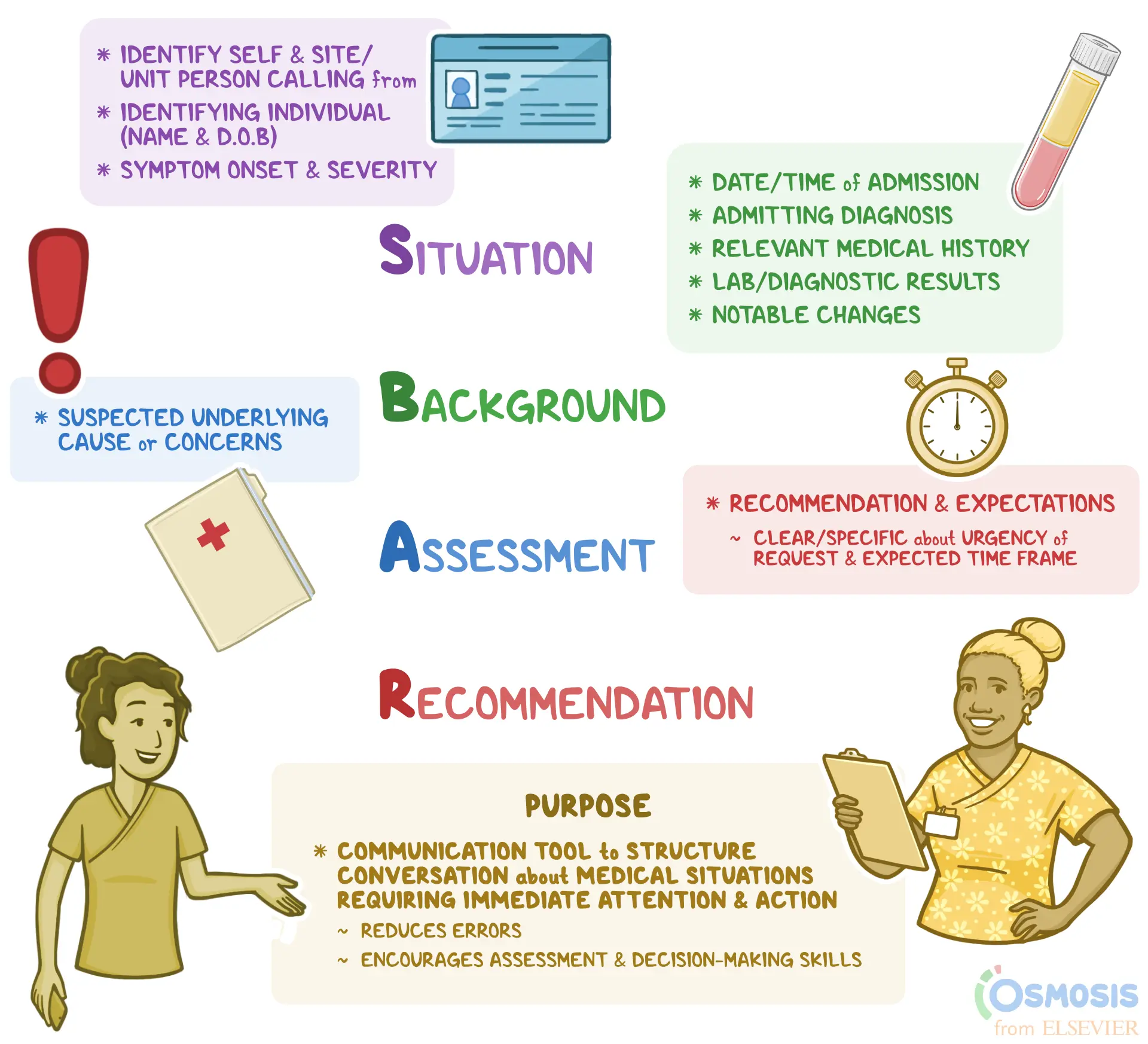
So what I would be doing is I would be getting an SBAR report on their patient, which is situation, background, assessment, and recommendation.
Maureen OsunaHOST
Recommendation is always, like, kind of like the plan, the plan for what's, you know, what we're doing for this patient today.
Maureen OsunaHOST
It does take a lot of coaching, so don't be sad or upset or freaked out or nervous if your instructor has you do that SBAR multiple times.
Maureen OsunaHOST
It's totally fine.
Maureen OsunaHOST
This is the standard way that we communicate in the medical world.
Maureen OsunaHOST
It's, it's concise, it's, um, very effective, it's very to the point, and so that is why we use it.
Maureen OsunaHOST
So students would either, either give me way too much information, stuff that really wasn't super relevant, or they would skip over things that were super relevant, and then I would have to probe deeper.

speaker_1HOST
Here's the strategy.
speaker_1HOST
SBAR stands for Situation, Background, Assessment, and Recommendation, or Request.
speaker_1HOST
It's a communication structure, not a transfer of responsibility.
speaker_1HOST
It works two ways.
speaker_1HOST
Step four, treat whatever answer arrives, yes, no, or silence, as the real outcome.
speaker_1HOST
The collision stays yours to manage until someone else explicitly agrees to take part of it on.
speaker_1HOST
SBAR comes from healthcare communication, where it structures a report from a nurse to a doctor.
speaker_1HOST
But the structure itself isn't restricted to reporting upward.
speaker_1HOST
Completely gone.
speaker_1HOST
But the story about escalating a mental status change using SBAR, that does not.
speaker_1HOST
It acts as a memory hook, and more importantly, it proves active clinical reasoning.
speaker_0HOST
And then the script brings it all home with the future.
8 MINS LATER
speaker_0HOST
You have written everything down.
speaker_0HOST
You've got your present, past, future structure.
speaker_0HOST
You have your SBAR or closed loop handoff micro story.
speaker_0HOST
You have your three triage personality words ready.
speaker_1HOST
Right.
speaker_1HOST
And the heavy hitter, the one you absolutely cannot survive an ICU interview without, is SBAR.
speaker_0HOST
SBAR.
speaker_1HOST
Yes.
speaker_1HOST
That stands for situation, background, assessment, recommendation.
speaker_1HOST
You confirm they have an airway.
speaker_1HOST
You check their oxygen, and you check their pulse and rhythm.
speaker_0HOST
And then the candidate had to actually vocalize the SBAR.

Kristen FergusonGUEST
We all have worked as nurses in different settings in healthcare, and nurses are naturally skilled and good at communication.
Kristen FergusonGUEST
We learn strategies like SBAR, Situation Background Assessment Recommendation.
Kristen FergusonGUEST
Nurses every day are communicating in their places of work, oftentimes with patients who are sick and often need education, or perhaps with new nurses they're teaching or mentoring.
Kristen FergusonGUEST
And they're communicating with non-nurses as well and non-patients, so clinical roles and non-clinical roles.
2 more episodes mention SBAR.
Create an account to see the whole feed, search across every transcript, and follow the entities you care about.