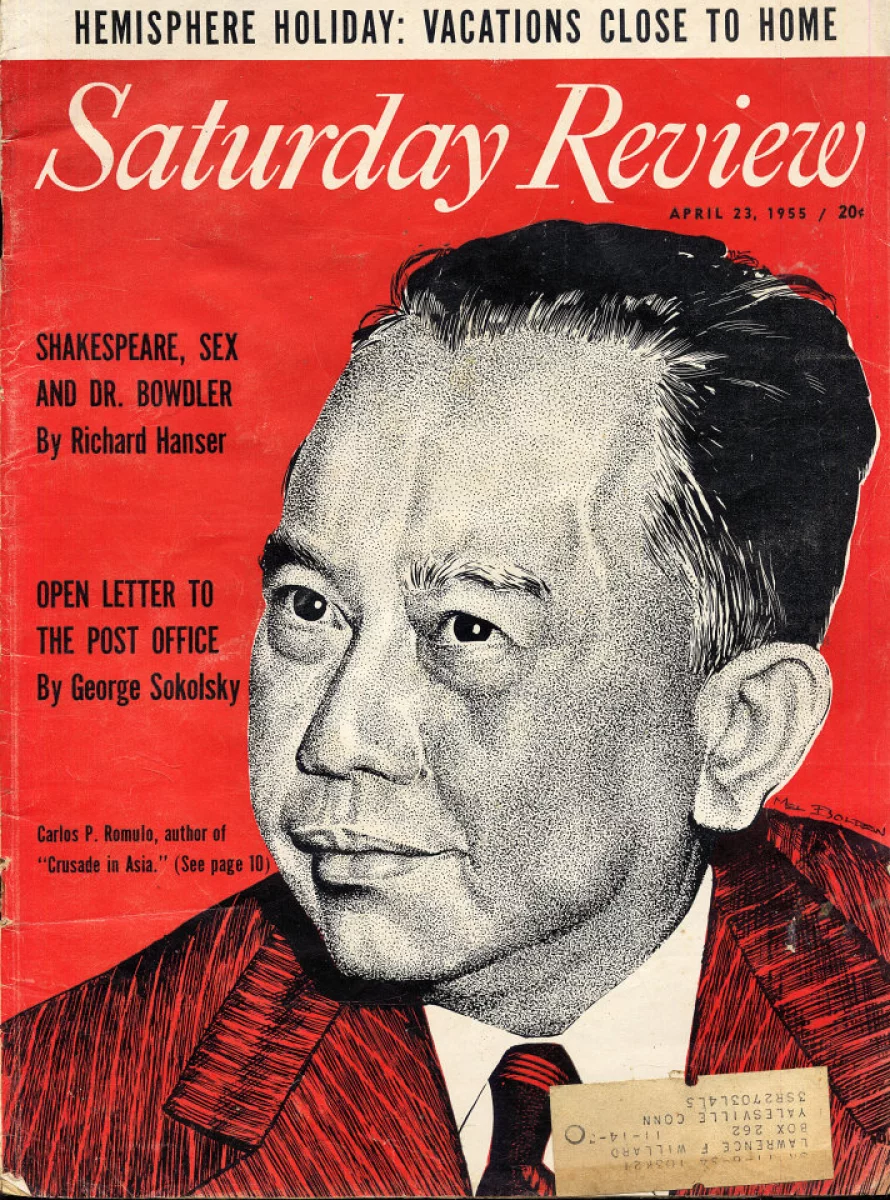
Saturday Review
MagazineWikipedia
9
MENTIONS
9
EPISODES
7
PODCASTS
Search complete. 9 mentions across 9 episodes found for "Saturday Review".
Oct 17, 2026

Darren MarlarHOST
Two weeks later, the Hills filled a four-hundred-seat Unitarian church in Dover.
Darren MarlarHOST
Fuller, who wrote the Trade Winds column for the Saturday Review and had published a book earlier that year about the nineteen sixty-five Exeter sightings a few miles from Portsmouth, took the case next.
Darren MarlarHOST
The interrupted journey came out from Dial Press in nineteen sixty-six at five dollars and ninety-five cents, was serialized in two parts in Look magazine on October fourth and October eighteenth, and became a bestseller.
Darren MarlarHOST
One account puts sales past three hundred thousand copies, a figure no other source confirms.

Peter KuznickGUEST
We have to end the blocs, you know, NATO and, and this, the, uh, Soviet Bloc, uh, and, and figure things out peacefully between us." Uh, and he wrote that to Kennedy, and Kennedy responded slowly.
Peter KuznickGUEST
And, and, you know, but finally Kennedy did respond, and he sent Norman Cousins, who was going to meet with Khrushchev, the publisher of Saturday Review, and in the me- he went there twice.
Peter KuznickGUEST
In the meeting with Khrushchev, Khrushchev says, "Peace is the most important thing." He says, "If the bombs start falling, what difference will it make if we're capitalists or communists, if we're atheists or Christians or Jews or Muslims? Who's gonna be able to tell us apart? You know, in the cemeteries, there are no enemies." My friend Oliver Stone's got a great line in his movie Heaven and Earth, and w- it, from the perspective of a Vietnamese peasant woman.
Peter KuznickGUEST
And, and, uh, the, the, the mother says, you know, "In cemeteries, there are no enemies.

TonyHOST
They were cautious but also interested in public safety.
TonyHOST
An Air Force investigation was quickly set up as the incident drew national media attention from outlets like The Saturday Review.
TonyHOST
John Fuller, the journalist with a keen interest in extraterrestrials, arrived to interview witnesses and write his now famous book.
TonyHOST
He brought a skeptical tone and a willingness to explore multiple explanations.
TonyHOST
This absence of an automated detection forced the subsequent investigations to rely solely on the witnesses' recollection, the timing they could estimate by their clocks, and the physical geography that would later be used to calculate potential flight paths for theoretical aircraft models.
TonyHOST
A few months later, author John Grant Fuller captured the incident in his book Incident at Exeter, which debuted in the Saturday Review before being reprinted in Look and Reader's Digest.
TonyHOST
He turned a terse police report into an evocative narrative about a teenager staring up at impossible lights in the night.
TonyHOST
Fuller's prose amplified every sensory detail, how Muscarello's heart beat faster, how his palms sweated on the passenger seat of a car that was now just a backdrop for a potential alien encounter.
TonyHOST
No black jet or metallic silhouette accompanied the red illumination.
TonyHOST
John G. Fuller, then writing a column for the Saturday Review, happened to be in New Hampshire during that September evening and took it upon himself to investigate what had happened over Kensington's fields.
TonyHOST
His book, Incident at Exeter, popularized the story, presenting detailed interviews with the witnesses as well as background on UFO lore and possible military cover-ups.
TonyHOST
The narrative framed the event as a genuine encounter that could not be fully explained by conventional means.

speaker_2HOST
And he was, um, he was very open about that fact.
speaker_2HOST
He published East of Eden in 1952, but he explicitly told The Saturday Review that everything he had written prior to it was just practice.
speaker_1HOST
Just practice.
speaker_1HOST
That's wild.

Bill Wylie-KellermannGUEST
Dan had reviewed the new Bonhoeffer biography by Eberhard Bethge while he was underground.
Bill Wylie-KellermannGUEST
It appeared in Saturday Review, I think, as a kind of a long prose poem.
Bill Wylie-KellermannGUEST
And coming out of that, Dan was really struck by Finkenwalde and the underground seminary, and they had a conversation about an underground seminary here in the States.
Bill Wylie-KellermannGUEST
Secondly, uh, the Book of Revelation- Which they were both begun to think about when Dan came to Union, when he got out of prison.

Susan ThurlowGUEST
In Little House on the Prairie, in the, the Dr. Tan chapter, Fever and Ague, it has been very interesting for me to find out that in the 1935, and then again in the 1953 edition with illustrations by Garth Williams, that that was a very unusual, if not groundbreaking, chapter in the children's literature world at the time.
Susan ThurlowGUEST
There was a critique done in The Saturday Review in 1965, and it was called The All White World of Children's Books.
Susan ThurlowGUEST
It was written by Nancy Larrick, and she was former president of the International Reading Association, and she found, she wrote in her article, that out of over 5,000 children's books published between 1962 and 1965, less than 1% featured Black characters in contemporary settings, and then only 6%, um, included one or more Black characters in text or illustrations.
Susan ThurlowGUEST
So she goes on to say that she, and I'm quoting her, "Across the country, 6,340,000 non-white children are learning to read and understand the American way of life in books which either omit them entirely or scarcely mention him." So the fascinating part is 30 years before that, Laura Ingalls Wilder features a chapter on a Black prairie doctor, and then again in 1953, he's beautifully illustrated as a Black professional.

JohnHOST
Good point.
Bob AlperGUEST
I think of Norman Cousins, who was the editor of the Saturday Review.
Bob AlperGUEST
He was terminally ill.
Bob AlperGUEST
He checked himself out of the hospital into a hotel room with a slew of Marx Brothers and Candid Camera films.