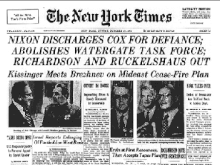
Saturday Night Massacre
22
MENTIONS
20
EPISODES
19
PODCASTS
Search complete. 22 mentions across 20 episodes found for "Saturday Night Massacre".
Oct 17, 2026

Andrew WeissmannGUEST
It's a question of what is the right thing to do.
Andrew WeissmannGUEST
In the same way Elliot Richardson famously, during the Saturday Massacre, was like, "I am not getting rid of Archibald Cox." It's not that the president didn't have the right to get rid of Archibald Cox.
Andrew WeissmannGUEST
It's that the Department of Justice at the time was saying, "That is not the best thing for America.
Andrew WeissmannGUEST
It is not the right policy to have.

Andrew WeissmannGUEST
Um, and there's a reason for that rule, and it is not a question of legality, it's a question of what is the right thing to do.
Andrew WeissmannGUEST
In the same way Elliot Richardson famously, during the Saturday Massacre, was like, "I am not getting rid of Archibald Cox." It's not that the president didn't have the right to get rid of Archibald Cox, it's that the Department of Justice at the time was saying, "That is not the best thing for America.
Andrew WeissmannGUEST
It is not the right policy to have.
Andrew WeissmannGUEST
I am not going to participate in that.

John RothmannHOST
What does it mean to weaponize a Justice Department? Now, I'm gonna contrast this with another time, another place when Richard Nixon was President of the United States, and there was an attempt by Nixon to weaponize the Justice Department.
John RothmannHOST
Remember the Saturday Night Massacre? Remember when he fired Archibald Cox and then Bill Ruckelshaus? Do you remember the outrage of the American people? Where is the outrage? I remember going along the road and having signs, "Honk if you favor impeachment." Well, all I can tell you is I don't see any signs today.
John RothmannHOST
And I'm not talking about impeachment, I'm talking about just disapproval of what Donald Trump is doing.
John RothmannHOST
And I think this needs to be understood clearly.

Simon WhistlerHOST
Before VP Ford had even been confirmed, the wheels were coming off the Nixon administration.
Simon WhistlerHOST
The Saturday Night Massacre on October the 20th, 1973, saw Nixon fire the special prosecutor investigating Watergate, setting off the mother of all storms in DC.
Simon WhistlerHOST
By the summer of 1974, the Supreme Court was ordering him to turn over the tapes he'd recorded of private conversations related to the scandal.
Simon WhistlerHOST
It was closing time on the Nixon presidency.

Leeja MillerHOST
He agreed and fired Archibald Cox that very same evening.
Leeja MillerHOST
The next morning, the world awoke to the news of what was to be called the Saturday Night Massacre.
Leeja MillerHOST
Capitol Hill was slammed with over 50,000 telegrams from across the country calling for Nixon's impeachment.
Leeja MillerHOST
And Nixon's attempt to squash the investigation into him only made the fervor for those tapes that much louder.
Leeja MillerHOST
Impeachment hearings began the following spring, and by early August, less than 10 months after the Saturday Night Massacre, Nixon resigned.
Leeja MillerHOST
Nixon never got the chance to fulfill the promise he made to Bork about the Supreme Court nomination.
Leeja MillerHOST
And when his predecessor, Gerald Ford, was given the chance to nominate a justice, he chose John Paul Stevens over Bork.
Leeja MillerHOST
Bork was, in many ways, the leading architect of those ideals in the first place.

ThomasGUEST
Like under Article 2, you can fire him.
ThomasGUEST
You know, I mean, and again, it's you it'd be like saying like let's say like a court order let's say like you let's say you were like an incorrigible like you know like traffic violator okay if you have a court like ordered you to like hire like a policeman or like a parent and type to like follow you around and you know he should give you citations for speeding well at the same time you pay him a salary and you're within your rights to fire him but like then if you fire him they'll charge you with a crime I mean it's it's like something it's it's like something out of not particularly creative you know like Joseph Heller kind of satire or something it was at this moment you know that like like the firing Cox is this is like breathlessly and and incomprehensibly called the Saturday night massacre kind of all the all this all the hysteria usually associated with the kind of Nixon witch hunt it just just it's just like wanted like absolute like full throttle after this but I want to I want to get back to the issue with with with Haig give me just one second okay Haig was alarmed by Cox's immediate plans to widen the Watergate investigation for a few reasons Haig kind of saw the writing on the wall okay Haig realized that the Watergate like Watergate in and of itself didn't really make sense Haig had been very deeply involved in to what degree is not clear but he'd been very deeply involved in what came to be known as the Houston plan okay the Houston plan was an ongoing effort to surveil people who are believed to be the source of information leaks like the Pentagon papers you know that involved disclosures of critical information of you know of a national security imperative okay between 1969 1971 there'd been about 17 extrajudicial wiretaps of private persons who these private persons were we'll get into in a moment and you'll see that there's a somewhat mischaracterized and Haig was pressure was brought to bear on Haig to disclose what he knew this is when Cox began threatening to bring indictments against those who had conducted and supervised the breaking the break-in of Ellsberg's doctor psychiatrist office you know Dr.
ThomasGUEST
Fielding was the doctor Haig's rebuttal without admitting knowledge of any wrongdoing was that any such disclosures that you know derived from such prosecutions by intent or accident would threaten national security in grave capacities because the White House plumbers were involved in highly classified matters some which were related to these wiretaps which we'll get into in a moment some which were not but Cox then responded by subpoenaing documents relating to the purchase of Nixon's home in San Clemente you know I mean so this became it became it became very clear that this was a witch hunt by this point okay when you're when you're when the scope of your investigation simply widens every time that you're stonewalled with a refusal by act or omission to cooperate with a threatened subpoena when it's not even clear if that subpoena power is constitutionally permitted I mean you're not you're not talking about an investigation into public corruption based on you know facts coming to light that demand it you know you're you're not talking about you're not talking about due process as we think of it you know you really are talking about a witch hunt by this point and I don't I don't see how that can be contested but a man of Give me one second.
ThomasGUEST
Jay Buzhardt, he was named the Special White House Counsel for Watergate matters to the president on May 10th.

Dave RubinHOST
In the presentation, he showed officials internal documents from the Watergate Special Prosecution Force, first led by Archibald Cox.
Dave RubinHOST
Leon Jaworski took over after Nixon ordered Cox's firing in the Saturday Night Massacre.
Dave RubinHOST
Sheppard alleges Cox and Jaworski violated defendants' due process rights by meeting secretly with the judges overseeing the trials and suppressing evidence from the defense.
Dave RubinHOST
Mainstream scholars have long said Watergate was a real constitutional crisis and that Nixon, not the investigators, was guilty of malfeasance that doomed the presidency and produced overhauls that cut executive power.

Jacob SoboroffHOST
So did the deputy attorney general.
Jacob SoboroffHOST
This became known as the Saturday Night Massacre.
Jacob SoboroffHOST
The Supreme Court then ruled eight to nothing that Nixon had to hand over the tapes.
Jacob SoboroffHOST
The House Judiciary Committee approved three articles of impeachment, obstruction of justice, abuse of power, contempt of Congress.
10 more episodes mention Saturday Night Massacre.
Create an account to see the whole feed, search across every transcript, and follow the entities you care about.