Saqsaywaman
Historical place in PeruWikipedia
50
MENTIONS
26
EPISODES
21
PODCASTS
Search complete. 50 mentions across 26 episodes found for "Saqsaywaman".
Sep 25, 2026

Derek OlsonHOST
Basically, it's describing like megalithic engineers from the prehistory.
Derek OlsonHOST
And I call them the earth shapers because not only do you see the colossal megalithic walls like at Sacsayhuaman, 200 plus ton wall blocks, but you will go into the middle of nowhere in the Cusco highlands.
Derek OlsonHOST
You'll go into the caves.
Derek OlsonHOST
One of my favorite sites is known by many as Napa Iglesia.
14 MINS LATER
Ralph Anthony CastaldoGUEST
blow.
Ralph Anthony CastaldoGUEST
600 –
Derek OlsonHOST
Yeah, 600 tons for scale, just so people realize that's twice as big as the biggest stones at Sacsayhuaman in Peru.
Derek OlsonHOST
We're talking mega megaliths.

Tyler EngleGUEST
Um, so, like- If you have a meteorite impact or the, uh, plasma, new plasma physics like the, uh, the plasmoid science that's coming out now, that stuff leaves these in the stone.
Tyler EngleGUEST
So there's traces of plasma interaction in Baalbek, in, uh, Jerusalem, in, uh, Iran, and some at Sacsayhuaman.
Joe RoganHOST
I've seen this on your page.
Tyler EngleGUEST
Yeah.

speaker_5NARRATOR
1-800-CONTACTS.
speaker_4NARRATOR
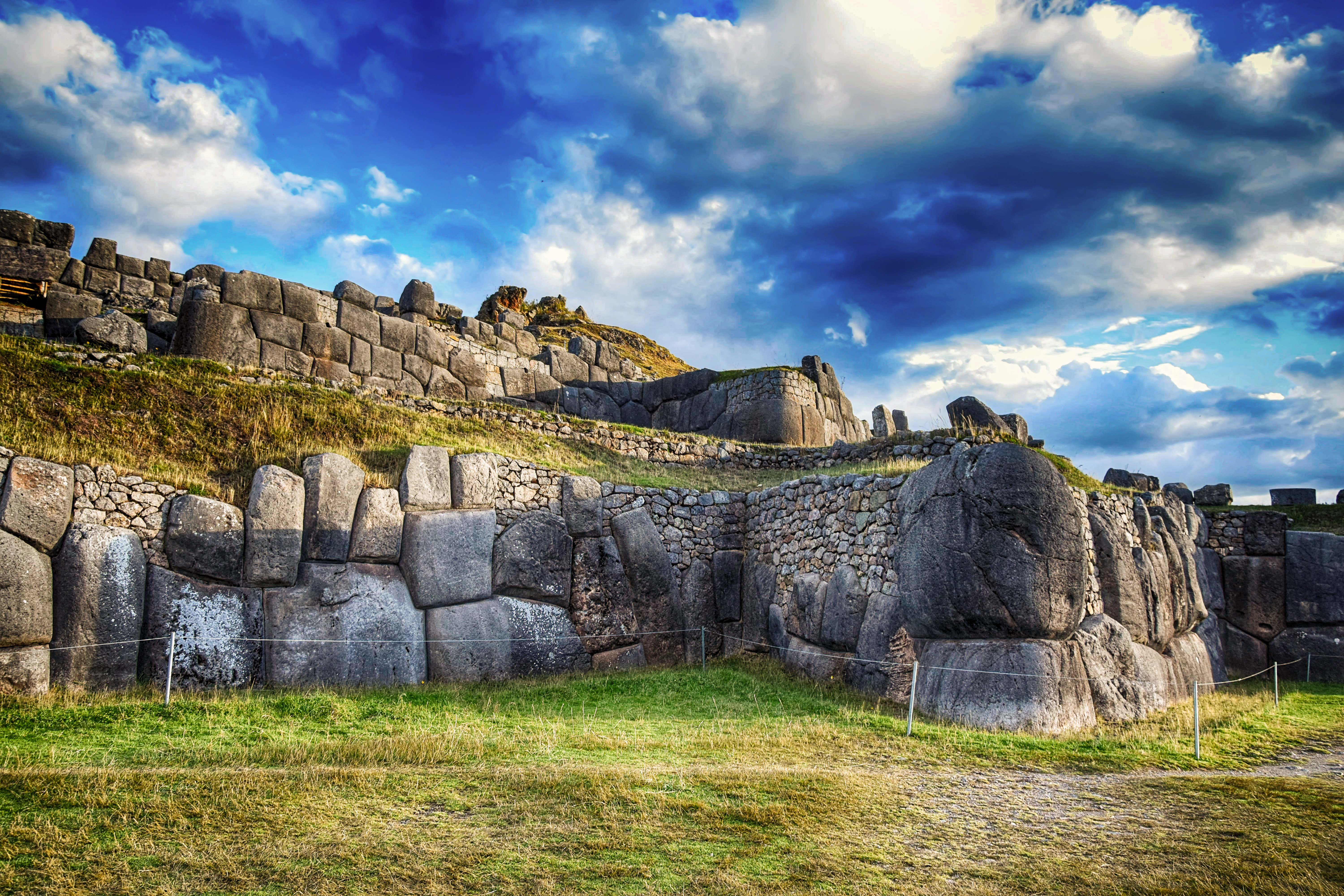
Sacsayhuaman and Inca Stonework On a hillside overlooking Cusco, once the capital of the Inca Empire, high in the Peruvian Andes, stands a complex of massive zig-zagging stone walls known as Sacsayhuaman, built largely under the emperor Pachacuti in the middle of the 15th century and expanded further by his successors in the decades that followed.
speaker_4NARRATOR
Spanish chroniclers, arriving after the conquest, and witnessing it used defensively during a major Inca uprising in 1536, labeled it a fortress, and that description stuck for centuries afterward.
speaker_4NARRATOR
Most archaeologists studying the site today lean toward a different primary reading, that Sacsayhuaman functioned principally as a ceremonial and religious complex tied closely to Inca state ritual and cosmology, part of a broader symbolic layout in which the city of Cusco itself was said to be arranged in the shape of a puma, with this hilltop complex forming the animal's head.
speaker_4NARRATOR
This reading draws support from the sheer scale of ritual activity documented at the site.
speaker_4NARRATOR
Once colonial and archaeological records are read past the fortress label, major state ceremonies including a large annual sun festival tied to the June solstice, are recorded as having been held on the grounds, and excavations have recovered offerings and ceremonial material more consistent with religious observance than with a purely defensive garrison outpost.
speaker_4NARRATOR
none of which rules out its defensive use when the moment actually called for it in 1536.
speaker_4NARRATOR
It simply means the fortress label likely describes an opportunistic later use rather than the site's original governing purpose.

LewisHOST
to actually carry something that big.
LewisHOST
Or even at Sacsayhuaman, unless these things were geopolymer.
LewisHOST
And maybe that is the answer to all this.
LewisHOST
And that would be the more grounded side of this that we're dealing with in the ancient day, ancient polymer.

Mandy MatneyHOST
So arrival day calls for coca tea and zero ambition.
Mandy MatneyHOST
He thought that we would travel up to Sacsayhuaman on day one, but we were blasted with the most intense fatigue I've ever experienced.
Mandy MatneyHOST
It was like a full day of breaking news while running a marathon at the same time.
Mandy MatneyHOST
But rather than climb out that hill, take a stroll through the Plaza de Armas and take a seat to check out the dogs of Cusco.

L.A. MarzulliGUEST
Every site I have ever been to, every site has the same story.
L.A. MarzulliGUEST
whether you're in Gilgal Raphaim, whether you're in Israel, whether you're in Menga Spain, whether you're in Karnak, France, Stonehenge, England, Silbury Hill, Ayersbury in England, I mean, all the way down to Peru, the 5,000-year-old pyramids at Corral, Peru, Sacsayhuaman in Cusco, Teotihuacan in Mexico, Chaco Canyon, the mysterious America's Stonehenge and all the earthworks.
L.A. MarzulliGUEST
So I've been all those places I just mentioned.
L.A. MarzulliGUEST
They all have the same underlying theme.
27 MINS LATER
L.A. MarzulliGUEST
So I'm trying to be patient.
L.A. MarzulliGUEST
Every site I have ever been to, every site has the same story.
L.A. MarzulliGUEST
whether you're in Gilgal Raphaim, whether you're in Israel, whether you're in Mangus, Spain, whether you're in Karnak, France, Stonehenge, England, Silbury Hill, Avesbury in England, I mean, all the way down to Peru, the 5,000-year-old pyramids at Corral, Peru, Sacsayhuaman in Cusco, Teotihuacan in Mexico, Chaco Canyon, the mysterious...
L.A. MarzulliGUEST
America's Stonehenge, and all the earthworks.

Gene DecodeGUEST
Also in Cusco, you can see walls.
Gene DecodeGUEST
You can see it in Sacsayhuaman.
Gene DecodeGUEST
You can see it in Japan, the palace that sits on top of an ancient palace.
Gene DecodeGUEST
work you can see the rocks there in Baalbek you can see it you can see it in Egypt you can see that same rock work of this rocks that are looked like they were almost made like clay and then formed together where you have one stone all fit together where you can't put a you know blade of grass in between them where you'll have a stone that may have six stones touching it and they have little stones and big stones and it's like a jigsaw puzzle so even big huge earthquakes can't take it down and so that's a technology that was lost and that's also how um the pyramids which are The best place to watch is the YouTube universe inside you.

Mondo GonzalezGUEST
So to call it megalithic, another phraseology that archaeologists will use, at least probably 100 years ago, is cyclopean.
Mondo GonzalezGUEST
Because cyclopean archaeology is this massive stones that are put together without mortar, especially there in Sacsayhuaman.
Mondo GonzalezGUEST
at Cusco is they're all, they're, they're polygonal shape.
Mondo GonzalezGUEST
It's these weird things, but they fit beautifully.
Mondo GonzalezGUEST
So to call it megalithic, another phraseology that archaeologists will use, at least probably 100 years ago, is cyclopean.
Mondo GonzalezGUEST
Because cyclopean archaeology is this massive stones that are put together without mortar, especially there in Sacsayhuaman.
Mondo GonzalezGUEST
at Cusco is they're all, they're, they're polygonal shape.
Mondo GonzalezGUEST
It's these weird things, but they fit beautifully.

speaker_0NARRATOR
Sin mortero, sin cemento, simplemente piedra contra piedra.
speaker_0NARRATOR
Una enorme fortaleza llamada Sacsayhuamán fue construida en el siglo XV cerca de Cusco.
speaker_0NARRATOR
Si Cusco está diseñado con la forma de un puma, entonces Sacsayhuamán representa la cabeza del puma.
speaker_0NARRATOR
La fortaleza presenta enormes bloques de piedra, algunos de hasta ocho metros de altura y con un peso de muchas toneladas, todos cortados con precisión y encajados en gigantescos muros en zigzag que parecen desafiar la gravedad.
speaker_0NARRATOR
La precisión es tan extraordinaria que las piedras han permanecido unidas durante quinientos años sin ningún tipo de material aglutinante.
speaker_0NARRATOR
Camina por Sacsayhuamán y verás muros que parecen imposibles, que no deberían existir.
speaker_0NARRATOR
Inclinaciones que deberían haberse derrumbado hace siglos.
speaker_0NARRATOR
Esquinas de piedra que deberían haberse desmoronado bajo su propio peso, pero siguen en pie, perfectamente equilibradas, perfectamente colocadas.
16 more episodes mention Saqsaywaman.
Create an account to see the whole feed, search across every transcript, and follow the entities you care about.