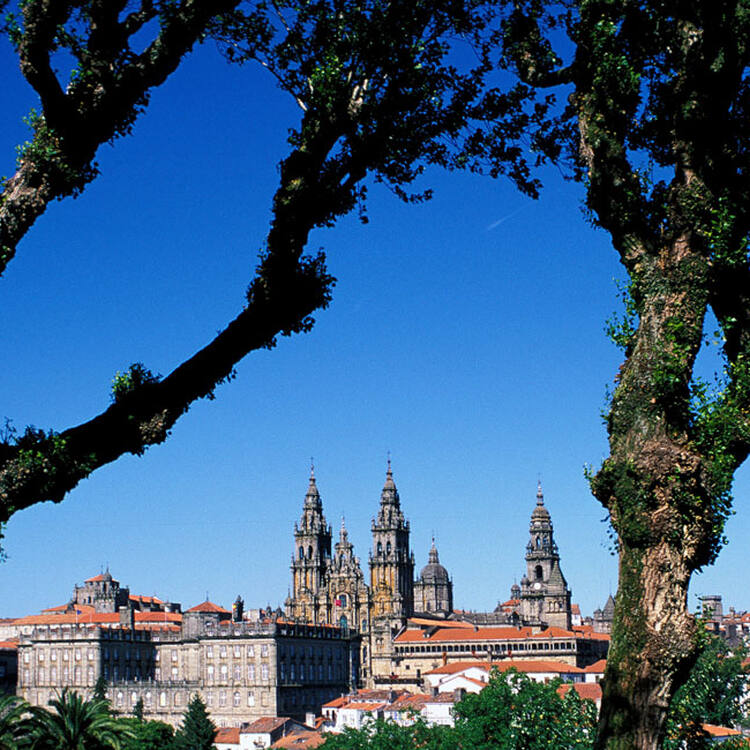
Santiago de Compostela
City in SpainWikipedia
149
MENTIONS
98
EPISODES
84
PODCASTS
Search complete. 149 mentions across 98 episodes found for "Santiago de Compostela".
Oct 29, 2026

Christopher WellsHOST
Sanchez referred to another high-speed railway disaster near Adamus in southern Spain in January, which killed 46 people.
Christopher WellsHOST
That was Spain's deadliest railway accident since 2013, when 80 people died in a derailment near Santiago de Compostela.
Christopher WellsHOST
The latest strategy has raised new questions about the safety of Spain's extensive railway network.
Christopher WellsHOST
Transport Minister Oscar Puente revealed that rail services had resumed despite a technical failure affecting an automatic train control system.

David DayGUEST
Like we're all wearing the same muddy boots.
David DayGUEST
We all have the same backpacks and we're all aiming for the cathedral in Santiago de Compostela.
David DayGUEST
So it's almost like the titles are stripped away and we're all just people.
David DayGUEST
We're all just pilgrims.

Isaiah EdwardsHOST
excuse me, which Spain's health minister, Monica Garcia, uh, Monica, I'm sorry, Monica Garcia said, uh, had injured 80 people, 50, 15 of them very seriously.
Isaiah EdwardsHOST
Um, so yeah, like I said, there's going to be investigations on the way they reference, uh, 2013 derailment in Spain's Santiago de Compostela in which 80 people died.
Isaiah EdwardsHOST
Um, And then follows another fatal accident in January involving high speed trains operated by the same companies on the same.
Isaiah EdwardsHOST
Oh, this is the same line.

Caitríona O'LearyGUEST
That's from the Libres Vernel, which is a medieval manuscript.
Caitríona O'LearyGUEST
It's possibly a pilgrim song for pilgrims on the Camino de Santiago who would have been on their way to Santiago de Compostela.
Caitríona O'LearyGUEST
And there are other words associated with that already.
Caitríona O'LearyGUEST
But I married these words with it.

Gareth DennisHOST
So is this the third ever fatal accident at speed on a high-speed rail line? No, there have been lots of fatal accidents.
Gareth DennisHOST
In Spain, there have been three, Santiago de Compostela, Ademuth, and this, in terms of major fatal derailments.
Gareth DennisHOST
But there have been quite a few high-speed line crashes globally.
Gareth DennisHOST
What does this say about the safety culture when multiple of these crashes can happen in one year on the same line? So I've said this on my Twitter thread, but just because the causes here are both will be different are very obviously different from the information we have now.
14 MINS LATER
Gareth DennisHOST
Clarity on the progress of ETCS Level 2 fitment on the line from Madrid to Sevilla is going to be useful and valuable information as the investigation proceeds and as we try to interpret the information in lieu of that investigation arriving.
Gareth DennisHOST
Talking of that investigation, I brought this up during the Adamov crash, and I'm going to bring it up again because it's relevant now.
Gareth DennisHOST
In 2013, Spain saw its first and, at the time, most significant rail crash and high-speed rail crash, should I say, 2013, Santiago de Compostela, an absolutely horrific incident that had a series of failures.
Gareth DennisHOST
Of course, at the start, all of it was pinned.

Stephanie GeorgieffHOST
By designating Our Lady of Boulogne as in this wonderful designation, the medieval church emphasized that her sanctuary was not merely dedicated to a statue about Mary, but was home to a divinely gifted object sent directly from heaven to the shores of France.
Stephanie GeorgieffHOST
Because of the location of the apparition and the discovery of Our Lady, Bologna-sur-Mer became a staging ground for the Camino de Santiago de Compostela, and a pilgrim destination.
Stephanie GeorgieffHOST
The town sits on a recognized historic northern European feeder route.
Stephanie GeorgieffHOST
It's called the Jacobean Way or Chemin de Saint-Jacques.
Stephanie GeorgieffHOST
During the Middle Ages, pilgrims traveling from England, Flanders, and Scandinavia to Santiago de Compostela often crossed the English Channel or traveled along the northern coast.
Stephanie GeorgieffHOST
Bologna served as one of the primary continental landing ports.
Stephanie GeorgieffHOST
and starting points and staging points for these trans-European journeys.

speaker_1HOST
It is the ultimate pilgrim's badge.
speaker_1HOST
It is physical proof that this man had survived the grueling, thousands of miles long journey across Europe to the shrine of Santiago de Compostela in Spain.
speaker_0HOST
So it means he possessed significant wealth, high social status, and deep religious devotion.
speaker_1HOST
Exactly.

Dan SnowNARRATOR
News of miracles spread, and the church soon became a center for pilgrims.
Dan SnowNARRATOR
One of the four starting points on the road to Santiago de Compostela, Vézelay was a religious destination of huge importance.
Dan SnowNARRATOR
Today, the pilgrimage of Le Père de Famille is taking place.
Dan SnowNARRATOR
This ritual of walking across the landscape to come for spiritual reflection is the same now as it would have been in the Middle Ages.

KarenAUDIENCE
And it
Beebe BahramiGUEST
covers the entire route from Lisbon to Santiago de Compostela, and it includes the extension to Finistán and Muxia, and all the variations, the coastal, the central.
Nancy ReynoldsHOST
Wow.
Beebe BahramiGUEST
That was...

Sean SpanauerHOST
This tradition made Zaragoza one of the most significant pilgrimage destinations in the Spanish-speaking Catholic world.
Sean SpanauerHOST
second in national importance, perhaps only to Santiago de Compostela itself.
Sean SpanauerHOST
The
Sean SpanauerHOST
sick,
88 more episodes mention Santiago de Compostela.
Create an account to see the whole feed, search across every transcript, and follow the entities you care about.