Sandstone
Form of rockWikipedia
12
MENTIONS
5
EPISODES
5
PODCASTS
Search complete. 12 mentions across 5 episodes found for "Sandstone".
Sep 9, 2026

speaker_2NARRATOR
Limestone consists largely of carbonate minerals, commonly calcite.
speaker_2NARRATOR
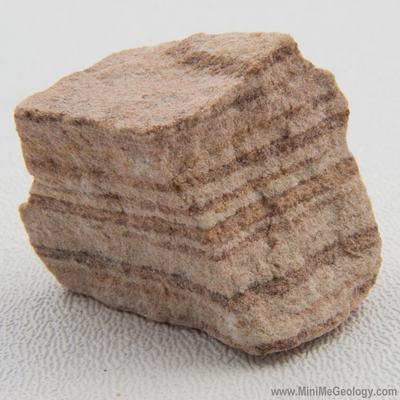
Sandstone consists of sand-sized grains joined into rock.
speaker_2NARRATOR
One name therefore tells us much about composition, while the other draws attention to the size of the particles.
speaker_2NARRATOR
Limestone can contain material made by organisms, including shells and broken shell pieces.
speaker_2NARRATOR
Its texture matters.
speaker_2NARRATOR
A close examination may reveal recognizable remains, fine carbonate material, or crystals that have changed during the rock's history.
speaker_2NARRATOR
Sandstone preserves a different arrangement.
speaker_2NARRATOR
Individual sand grains accumulated before becoming bound together, often by minerals deposited between them.

Gary DeirmendjianGUEST
And then I had a little bolt hole in Ultimo where I'd go and make a mess and then home and suit and tie and face the day, sort of thing.
Julie NicholsonHOST
And was it Sandstone initially that sort of interested you? That was your first sort of foray into creating and making with
Gary DeirmendjianGUEST
Sandstone? I was leading a certain life and the worst...
Gary DeirmendjianGUEST
What was that life? Well, after I...
Gary DeirmendjianGUEST
It's all right.
Gary DeirmendjianGUEST
So, yeah, hacking into it became seriously important.
Gary DeirmendjianGUEST
I
Julie NicholsonHOST
guess your interest and fascination with Sandstone then resulted in a book.

speaker_0NARRATOR
Sediment that was once mud on an ocean floor has been compressed into shale, heated into slate, squeezed further into phyllite, and crushed still further into schist or gneiss.
speaker_0NARRATOR
Sandstone has been metamorphosed into quartzite.
speaker_0NARRATOR
Limestone has been transformed into marble.
speaker_0NARRATOR
The story written in these road cuts is a story of unimaginable force, the force of continents colliding, of an ocean closing, of hundreds of millions of years of tectonic compression squeezing and folding and heating rock until it flows like putty, then raising the whole mass to the sky, and then the equally unimaginable patience of erosion wearing it all back down.

speaker_9NARRATOR
Take a big sandstone block with visible dimensions of 7 metres by 2 metres by 1 metre.
speaker_9NARRATOR
Multiply those and you get 14 cubic metres.
speaker_9NARRATOR
Sandstone in this area averages around 2.2 to 2.4 metric tonnes per cubic metre.
speaker_9NARRATOR
Multiply again and you land somewhere between about 30 and 34 tonnes.
speaker_9NARRATOR
if the same block is actually two meters thick not one your volume doubles and so does the mass now you're in the sixty to seventy ton range change the density a bit and the figure shifts again if one corner is buried or the block is cracked or eroded you're guessing now look at puma punku many of the largest blocks are heavily damaged partially buried or missing chunks Different authors use slightly different measurements and densities.
8 MINS LATER
speaker_9NARRATOR
put them under a microscope and compare grain size mineral mix texture the way crystals grew and interlocked it's like a fingerprint You can go further with geochemistry and isotopes doing elemental analyses that show trace element patterns.
speaker_9NARRATOR
Andesites from one volcanic centre won't be chemically identical to those from another.
speaker_9NARRATOR
Sandstones from different sedimentary basins record different source rocks upstream.

Mitch FortnerHOST
Um, very impressed.
Mitch FortnerHOST
It's better than Sandstone.
Mitch FortnerHOST
Hate to say it, because Sandstone was a big part of my growing up.
Mitch FortnerHOST
Going there as a kid.
Mitch FortnerHOST
Never snuck in.