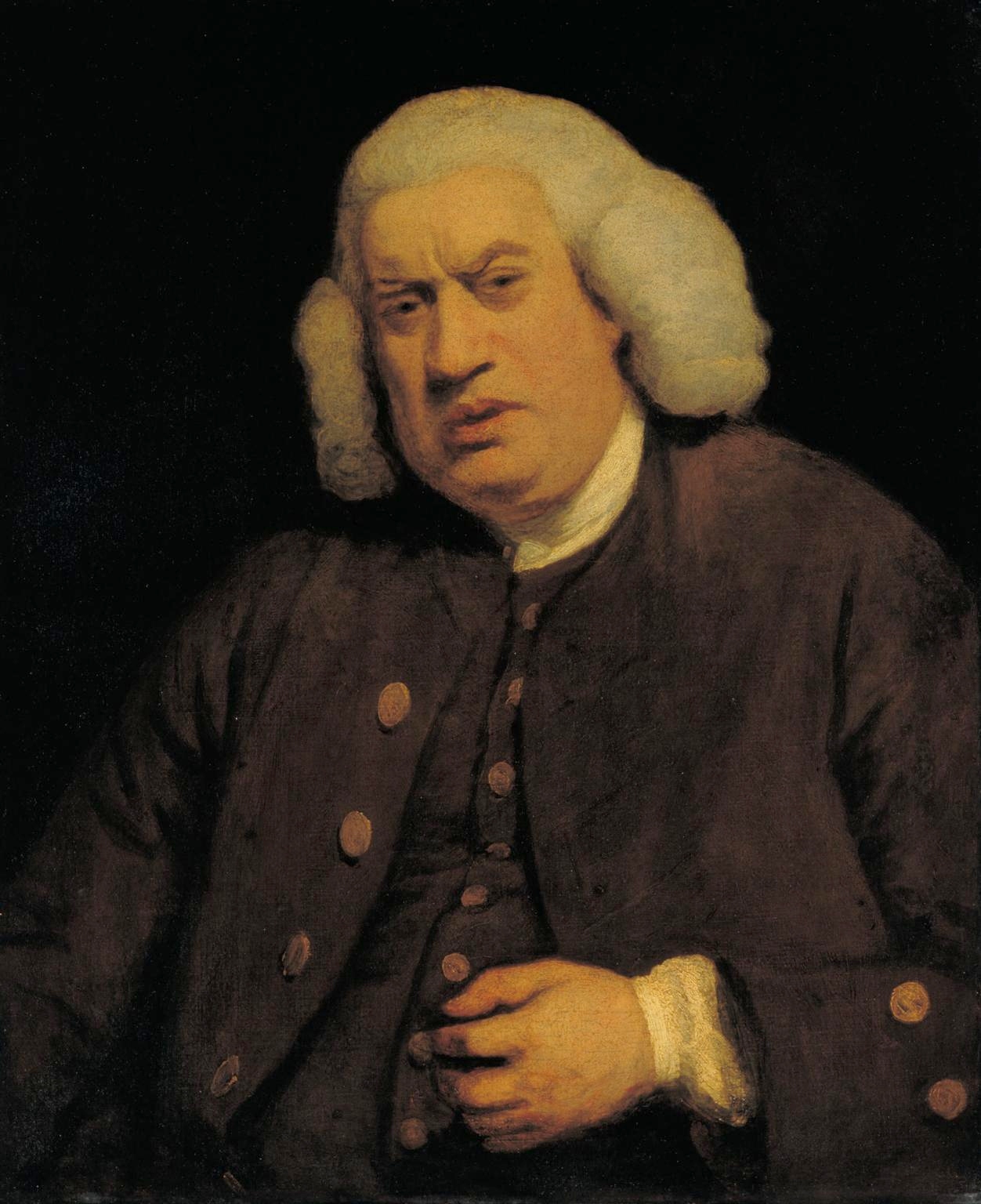
Samuel Johnson

Samuel Johnson

WriterWikipedia

Search complete. 915 mentions across 163 episodes found for "Samuel Johnson".

Sep 11, 2026

Matt LevineHOST
2:45
So we've got to cross it off the list.
Matt LevineHOST
2:47
I sometimes quote Samuel Johnson, who says something like, man is seldom so innocently engaged as in the pursuit of money, as in getting money.
Max AbelsonGUEST
2:55
I know you disagree,
Matt LevineHOST
2:56
but many people disagree.
Matt LevineHOST
2:58
Many people think money is the roots of evils and things like that.
Matt LevineHOST
3:02
But no, I think money is a charming and innocent subject and power is nefarious.
Max AbelsonGUEST
3:06
Well, speaking of charming and innocent, that's not the first time you've quoted Samuel Johnson at me.
Max AbelsonGUEST
3:11
Sure.
Sue AndersonNARRATOR
178:25
Thus he continued to act till the death of his uncle in seventeen seventy-five, when he found himself in possession of three thousand pounds value in money and landed property.
Sue AndersonNARRATOR
178:38
Prior to this event, my father, on a visit to Baltimore, got acquainted with my mother, Elizabeth Johnson.
Sue AndersonNARRATOR
178:46
To her he was introduced by an intimate friend, a Mr. Freeman, whom I may have occasion to mention hereafter.
Sue AndersonNARRATOR
178:54
His uncle, on hearing this, could not bear the idea of a matrimonial connection during his life, and so stood as a grand barrier to the completion of his wishes.

44 MINS LATER

speaker_6ADVERTISER
223:20
Terms at DKNG.co slash offer.
Sue AndersonNARRATOR
223:22
and though her education was not according to the rules laid down by miss hamilton yet she understood in her own way the principles of domestic economy prudence and frugality well has the wise man described a virtuous woman when he says who can find a virtuous woman for her price is far above rubies we have now lived thirty-two years together happy in each other's society and though we have had many trials in the course of that time such as the loss of children bad health and distressed circumstances a murmur never escaped her lips in our pilgrimage here below these little crosses are necessary they teach us to know ourselves were we to pass the little time which is allotted to us in this world without trials and afflictions we should soon forget that we are dependent creatures but a merciful providence has wisely guarded us against these dangers by letting us know our infirmities and how little we can do for ourselves we are assured in the word of god that he never afflicts his creatures but for their good and when these visitations are sanctified by his holy spirit they then become profitable to us they wean us as it were from the world and we become sick of its flimsy joys and imaginary pleasures we learn from them that here we have no abiding city but we seek one to come we have had eleven children six of whom are still alive and with the exception of those diseases which are common to their years they are all healthy and stout it is certainly one of the greatest blessings which parents can enjoy to see a vigorous offspring rise around them and listen to their innocent prattle how often have i been struck with the force and beauty of that passage in holy writ where jesus in order to teach humility unto his disciples called a little child unto him and set him in the midst of them to descend from the divine author of our religion to creatures like ourselves we read in cox's life of that pious reformer melanchthon that he was particularly fond of his children and notwithstanding the multiplicity of his engagements the discharge of which in those perilous times was attended with difficulties and danger yet would he often descend from that lofty station where genius and public opinion had enthroned him to the more endearing scenes of domestic retirement a frenchman one day found him holding a book in one hand and with the other rocking his child's cradle upon his manifesting considerable surprise melanchthon took occasion from this incident to converse with his visitor on the duties of parents and on the regard of heaven for little children in such a pious and affectionate manner that his astonishment was quickly transformed into admiration january eighteen thirty five end of james wilson blind biographer seventeen seventy five eighteen forty five wilson's introduction to the eighteen thirty five edition of his biography of the blind or lives of such as have distinguished themselves as poets philosophers artists etc as well as a few particulars of the life of the author read for librivox by sue anderson
speaker_11NARRATOR
227:17
andersonLetter to Lord Chesterfield by Samuel Johnson.
speaker_11NARRATOR
227:29
This is a LibriVox recording.
Pamela NagamiNARRATOR
190:02
This origin of the scheme made it doubly hateful, and it certainly was very unpopular throughout England.
Pamela NagamiNARRATOR
190:10
Dr. Johnson, who published his dictionary some twenty years after this struggle, gave the following definition of excise.
Pamela NagamiNARRATOR
190:18
A hateful tax levied upon commodities and adjudged, not by the common judges of property, but wretches hired by those to whom excise is paid.
Pamela NagamiNARRATOR
190:29
Every financier who has written upon the subject since has approved of Walpole's scheme.

4 HRS LATER

Pamela NagamiNARRATOR
430:05
He was honorably acquitted, though strong anti-Jacobites maintained that he was not cleared from the charge.
Pamela NagamiNARRATOR
430:11
General Oglethorpe lived forty years longer to an honored old age.
Pamela NagamiNARRATOR
430:16
Dr. Johnson and Goldsmith were amongst his friends and admirers.
Pamela NagamiNARRATOR
430:20
Edmund Burke paid him the remarkable compliment of calling him a more extraordinary person than any he had ever read of, for he had called a province into existence and lived to see it become an independent state.
Pamela NagamiNARRATOR
8:32
John Wesley is an example of this, and he would appear in a far more amiable light in pages written by a kindly man of the world than in a book by a devoted admirer and would-be imitator of his virtues.
Pamela NagamiNARRATOR
8:47
It was, after all, Boswell's many failings which contributed to give us so delightful a portrait as that of his great and good friend Samuel Johnson.
Pamela NagamiNARRATOR
8:57
Now John Wesley was an undoubted saint, and the good he did in England, and his society in America for that matter, is incalculable.
Pamela NagamiNARRATOR
9:06
But I ask his admirers, and any who profess to follow him, to forgive me for using him as a peg on which to hang a few remarks on social England.
Pamela NagamiNARRATOR
11:23
The girls, had they had their brothers' advantages and education, might have been almost equally distinguished.
Pamela NagamiNARRATOR
11:30
As it was, however, Samuel had enough to do to give his sons an education worthy of their abilities.
Pamela NagamiNARRATOR
11:37
The eldest son, Samuel, was a scholar of Westminster and a student of Christ Church, a friend of Bishop Adderbury, and a sound scholar.
Pamela NagamiNARRATOR
11:46
Owing to his Toryism, he was never more than an usher, under master at Westminster, and master of Tiverton School, and he continued to hold the principles of a high churchman to the last.
Stuart BellNARRATOR
13:38
Already in 1711, says the spectator, I would therefore in a particular manner recommend these my speculations to all well-regulated families that set apart an hour every morning for tea, bread, and butter, and would earnestly advise them for their good to order this paper to be punctually served up and to be looked upon as part of the tea equipage.
Stuart BellNARRATOR
14:07
Samuel Johnson draws his own portrait as a hardened and shameless tea drinker who for twenty years diluted his meals with only the infusion of the fascinating plant, who with tea amused the evening, with tea solaced the midnight, and with tea welcomed the morning.
Stuart BellNARRATOR
14:28
Charles Lamb, a professed devotee, sounded the true note of teaism when he wrote that the greatest pleasure he knew was to do the good action by stealth and to have it found out by accident.
Stuart BellNARRATOR
14:44
For teaism it is the art of concealing beauty that you may discover it, of suggesting what you dare not reveal.
Quaker WoodworkerNARRATOR
195:51
And let him who purposes his own happiness reflect that while he forms his purpose the day rolls on, and the night cometh when no man can work.
Quaker WoodworkerNARRATOR
196:06
End of Monitions on the Flight of Time by Samuel Johnson Read by Quaker Woodworker A Mystery of Crowds by Lafcadio Hearn For more information, or to volunteer, please visit LibriVox.org. Who has not at some time leaned over the parapet of a bridge, to watch the wrinklings and dimplings of the current below, to wonder at the trembling permanency of surface shapes that never change? though the substance of them is never for two successive moments the same the mystery of the spectacle fascinates and it is worth thinking about symbols of the riddle of our own being are those shuddering forms in ourselves likewise the substance perpetually changes with the flow of the infinite stream but the shapes though ever agitated by various inter opposing forces remain throughout the years and who has not been fascinated also by the sight of the human stream that pours and pulses through the streets of some great metropolis this too has its currents and counter-currents and eddyings all strengthening or weakening according to the tide-rise or tide-eb of the city's sea of toil but the attraction of the greater spectacle for us is not really the mystery of motion it is rather the mystery of man as outside observers we are interested chiefly by the passing forms and faces by their intimations of personality their suggestions of sympathy or repulsion we soon cease to think about the general flow for the atoms of the human current are visible to our gaze we see them walk and deem their movements sufficiently explained by our own experience of walking and nevertheless the motions of the visible individual are more mysterious than those of the always invisible molecule of water I am not forgetting the truth that all forms of motion are ultimately incomprehensible.
Quaker WoodworkerNARRATOR
198:59
I am referring only to the fact that our common relative knowledge of motions, which are supposed to depend upon will, is even less than our possible relative knowledge of the behavior of the atoms of a water current.
Quaker WoodworkerNARRATOR
199:19
every one who has lived in a great city is aware of certain laws of movement which regulate the flow of population through the more crowded thoroughfares we need not for present purposes concern ourselves about the complex middle currents of the living river with their thunder of hoofs and wheels i shall speak of the side currents only on either footpath the crowd naturally divides itself into an upward and a downward stream all persons going in one direction take the right-hand side all going in the other direction take the left-hand side by moving with either one of these two streams you can proceed even quickly but you cannot walk against it.
DanHOST
35:22
Um.
Jim AllanGUEST
35:22
I would conser- describe myself as the way that David Hume was described by Samuel Johnson.
Jim AllanGUEST
35:30
I'm a Tory by chance.
Jim AllanGUEST
35:32
I mean, I don't think-
Jack ArmstrongHOST
31:56
...
Jack ArmstrongHOST
31:56
this has nothing to do with, this has nothing to do with bagpipes, but it reminded me of this quote I've been trying to work in from Samuel Johnson, who I'm a giant fan of.
Jack ArmstrongHOST
32:04
I love Samuel Johnson.
Jack ArmstrongHOST
32:06
"He is not only dull himself, he is the cause of dullness in others"
Joe GettyHOST
32:10
[laughs]
Joshua KendallSOUNDBITE_SPEAKER
4:03
So he comes home to his father's house, his farm in West Hartford, and says, "Dad, I wanna be a writer." And his father says, "[laughs] Son," he gives him an $8 bill, which is worthless, "Son, you're on your own now." And here's Webster's reaction.
Joshua KendallSOUNDBITE_SPEAKER
4:18
"The subject of this memoir was cast upon the world at the age of 20 without property, without patrons, and in the midst of a war which had disturbed all occupations." For the next couple of days, he locks himself in his room and reads Samuel Johnson's Moral Essays, and then he decides that Samuel Johnson, the author of the great 1755 dictionary, is gonna be his spiritual father.
Joshua KendallSOUNDBITE_SPEAKER
4:45
[upbeat music] Some of you may have seen the Facebook movie, which starts with a rejection.
Joshua KendallSOUNDBITE_SPEAKER
4:51
The fellow, Mark Zuckerberg, is rejected by his girlfriend and then spends 20 hours on computer code and comes up with Facebook.

12 MINS LATER

Joshua KendallSOUNDBITE_SPEAKER
16:34
There's a famous story about some guy in Boston who said, "Maybe we should do what the Israelis did and make ancient Hebrew the national language." But Webster's idea was, you know, American English.
Joshua KendallSOUNDBITE_SPEAKER
16:45
He wanted to get rid of silent Es, you know, changing theater from the French to the E-R, getting rid of the U in color, and he wanted American English because he wanted us to be proud of our country.
Joshua KendallSOUNDBITE_SPEAKER
16:57
Samuel Johnson, the author of the great 1755 dictionary, wrote it for the money.
Joshua KendallSOUNDBITE_SPEAKER
17:02
Johnson once said, "No one but a blockhead ever wrote except for money." And Johnson actually hated Americans.
Lorraine PaquetteNARRATOR
47:38
Recording by Lorraine Paquette Chapter 4 A Friend in Need Friendship, peculiar boon of heaven, the noble mind's delight and pride, to men and angels only given, to all the lower world denied.
Lorraine PaquetteNARRATOR
47:55
Samuel Johnson The experiences of Benny and his sister during the next day were but a repetition of what we recorded in the last chapter, but during the second night they found the shelter of the boat but a poor substitute for a home, and in the morning they were stiff and cramped through lying so long in one position, and when they paid Joe Ragg their third morning visit the old man noticed that all was not right with them.
Lorraine PaquetteNARRATOR
48:21
Nelly especially was gloomy and depressed.
Lorraine PaquetteNARRATOR
48:25
Joe Ragg was generally a silent man and not given to asking many questions, but when he saw great tears in Nelly's round eyes as she sat gazing into the fire he felt that he must know what was troubling the child and help her if he could.

153 more episodes mention Samuel Johnson.

Create an account to see the whole feed, search across every transcript, and follow the entities you care about.

We value your privacy

We use cookies to understand how you use our platform and to improve your experience. Click “Accept All” to consent, or “Decline non-essential” to opt out of non-essential cookies. Read our Privacy Policy.