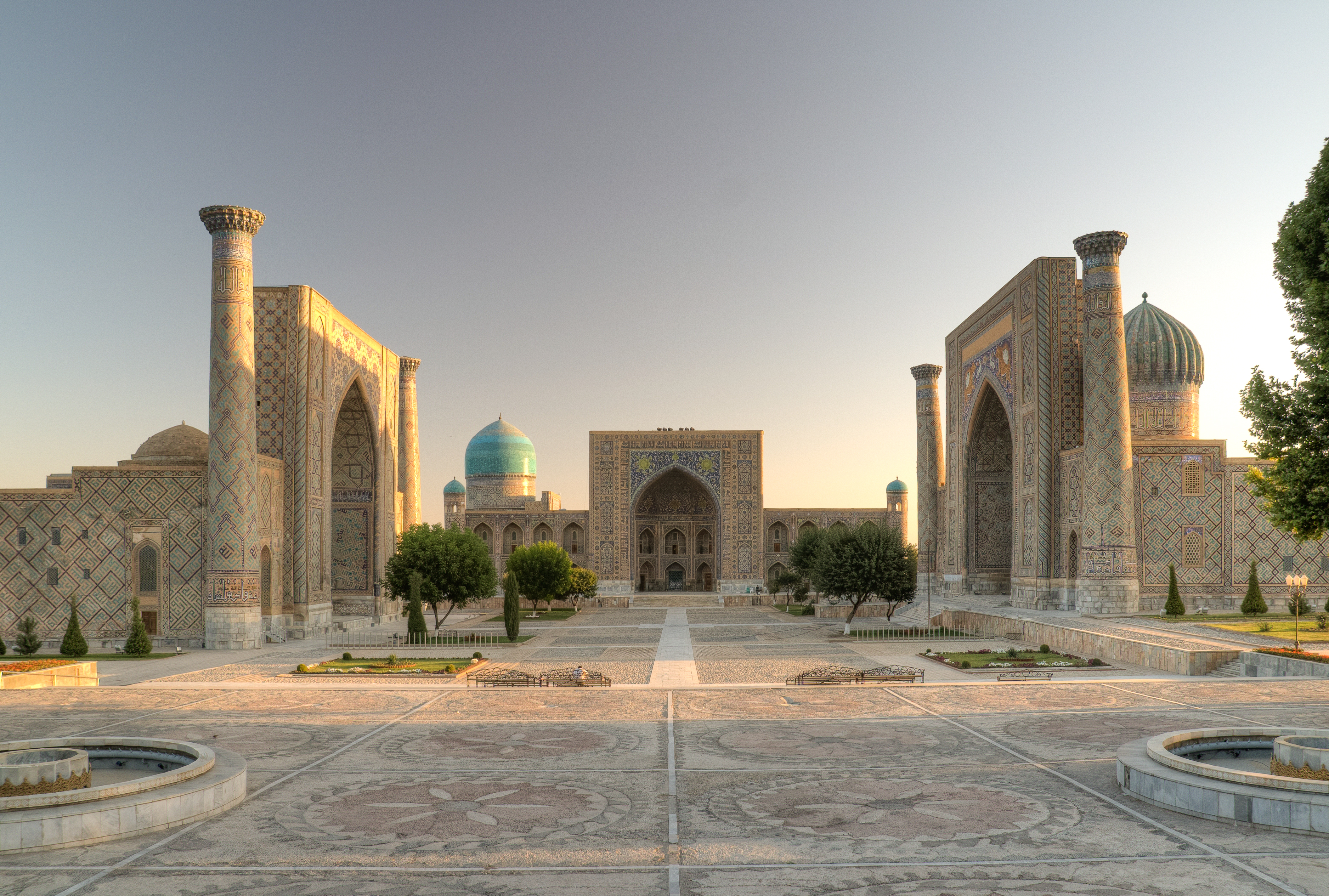
Samarkand
City in UzbekistanWikipedia
259
MENTIONS
92
EPISODES
75
PODCASTS
Search complete. 259 mentions across 92 episodes found for "Samarkand".
Oct 28, 2026

Raoul McLaughlinGUEST
Sogdiana has a famous place in the ancient world because of Alexander's campaigns, but they also had an extraordinary culture and they were perfectly placed to engage in the Silk Routes.
Raoul McLaughlinGUEST
They could deliver from their capital Samarkand, they sent merchants east through the Tarim territories and from there into China.
Raoul McLaughlinGUEST
Dunang on the western edge of the Hershey corridor had a Sogdian community.
Raoul McLaughlinGUEST
And what they did was they transferred One part of their network brought silk goods, predominantly silk, but other Chinese goods from inner China to Dunang.
Raoul McLaughlinGUEST
And then that was one aspect of the business.
Raoul McLaughlinGUEST
And then the letters reveal that from a Samarkand, other Sogdians traveled the entire route around the Tarim Basin, reached Dunhang, and then collected the silks, headed back to their homelands.
Raoul McLaughlinGUEST
So it's almost like there's two stages in the Sogdian network.
Raoul McLaughlinGUEST
But these letters, they're coming from a time of crisis.

speaker_0NARRATOR
In 1870, young naturalist Alexei Fedchenko was working in Turkestan.
speaker_0NARRATOR
While traveling through Samarkand, present-day Uzbekistan, he learned a local doctor was extracting guinea worms from patients, prompting him to abandon his trip.
speaker_0NARRATOR
Fedchenko had studied parasitic worms as a student and was mentored by Rudolf Luhart, who five years prior, in 1865, demonstrated that roundworms infecting fish used tiny water fleas called cyclops as intermediate hosts.
speaker_0NARRATOR
Petchenko was interested in studying the worm and took the opportunity.

Melik KhachiyanGUEST
Well, I think we're very consistent.
Melik KhachiyanGUEST
If you look for our results in the past three Olympics, starting from Chennai, followed by Budapest, followed by Samarkand, I think we're getting very much the same, as we call it, match points.
Melik KhachiyanGUEST
We're getting like 17 match points.
Melik KhachiyanGUEST
And normally, whenever you get such amount of points, you're very much tying for the top five.
16 MINS LATER
Melik KhachiyanGUEST
In India.
Melik KhachiyanGUEST
Yeah.
Melik KhachiyanGUEST
Same thing happening in Samarkand, I think.
Melik KhachiyanGUEST
I had some issues for four or five days, some girls.

Tleghen KondikovHOST
Yes, there was a huge delegation, a lot of business done, and I guess Marco Rubio is the main newsmaker of the last week, so that will require us to dedicate a completely separate talk.
Tleghen KondikovHOST
Once also we will make sense of what actually happened in Samarkand and what it will mean for Uzbekistan and Central Asia.
Peter LeonardHOST
We are going to nevertheless look more broadly outside the region for this episode.
Peter LeonardHOST
We have a couple of topics, first of which is new data about the number of Central Asian nationals being recruited by Russia for its military campaign in Ukraine.

Julie ToméHOST
He spent his childhood moving around the Middle East and India as Timur expanded the empire.
Julie ToméHOST
And after Timur's death, Shahrukh moved the capital of the empire from Samarkand to Herat.
Julie ToméHOST
And Herat is in Afghanistan.
Julie ToméHOST
Uluqbaik became the governor of Samarkand at age 16 in 1409.
Julie ToméHOST
And two years later became the sovereign ruler of Maravanaha.
Julie ToméHOST
Which is made up by modern Eastern Uzbekistan, Western Tajikistan, Southern Kyrgyzstan, and parts of Southern Kazakhstan and Turkmenistan.
Julie ToméHOST
He wanted to make the area an intellectual center for the empire.
Julie ToméHOST
And to do that, he did two things.

speaker_1HOST
Uzbekistan signs $12 billion in U.S. agreements amid growing competition for Central Asia.
speaker_0HOST
Uzbekistan and American companies have signed 54 trade, investment, and technology agreements following U.S. Secretary of State Marco Rubio's visit to Samarkand on the 19th of October.
speaker_0HOST
The agreements carry a prospective value of approximately $12 billion, although the investment has not yet been realized.
speaker_0HOST
They cover critical minerals, energy, transport, technology, and industrial development.

speaker_0NARRATOR
Timur, known to European history as Tamerlane, was one of those figures who appears in the historical record like a force of nature rather than a person.
speaker_0NARRATOR
He had emerged from the region around Samarkand in Central Asia in the 1360s and spent the following decades building an empire through a combination of military genius and systematic, deliberate terror.
speaker_0NARRATOR
He conquered Persia.
speaker_0NARRATOR
He devastated the Golden Horde.

Betzalel MarinovskyGUEST
Right.
Betzalel MarinovskyGUEST
Then my father's family arrived in Samarkand.
Betzalel MarinovskyGUEST
So when they ran, when they escaped the Nazis.
Betzalel MarinovskyGUEST
I'm making it sound so...
Betzalel MarinovskyGUEST
It wasn't so simple.
Betzalel MarinovskyGUEST
Even today...
Betzalel MarinovskyGUEST
They probably didn't even know where Samarkand was before.
Betzalel MarinovskyGUEST
They knew because they had a friend named Simcha Gorodetsky.

speaker_0NARRATOR
When the First World War broke out in the summer of 1914, Moravets was conscripted into the Austro-Hungarian army and sent to the front.
speaker_0NARRATOR
In 1915 he was captured by the Russians and held in a prisoner of war camp in the city of Samarkand .
speaker_0NARRATOR
He volunteered there to fight against the Austro-Hungarian Empire and took command of a machine gun platoon in the 1st Serbian Volunteer Division, a unit raised from Slav prisoners of war to fight on the Russian side.
speaker_0NARRATOR
In September 1916, Moravet saw fierce action against Bulgarian forces on the Dobruja front, where he was injured and later was hospitalized.

Moshe LevinHOST
Achievement keeps on growing and growing, one achievement, another achievement.
Moshe LevinHOST
What's your secret? Rabbi Sudeik said, when I was eight years old, I went to an underground secret school in Samarkand in Soviet Russia.
Moshe LevinHOST
It was a man who was risking his life to teach us Torah, and we learned in a secret place in his basement.
Moshe LevinHOST
And every morning I had to leave to school before dawn.
82 more episodes mention Samarkand.
Create an account to see the whole feed, search across every transcript, and follow the entities you care about.