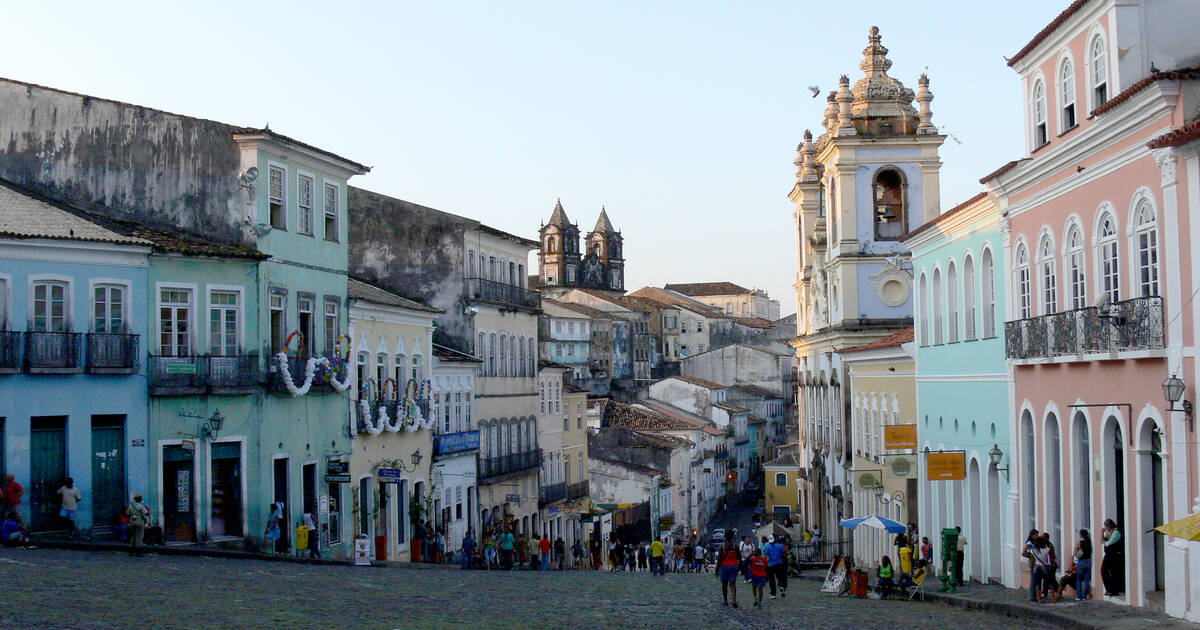
Salvador
Municipality in BrazilWikipedia
21
MENTIONS
10
EPISODES
10
PODCASTS
Search complete. 21 mentions across 10 episodes found for "Salvador".
Sep 9, 2026

RenataVOICE_ACTOR
Sabe de uma coisa? Eu estava pensando.
RenataVOICE_ACTOR
Você é de Salvador, não é? Eu ouço no sotaque às vezes.
RenataVOICE_ACTOR
Quando você fala rápido, aparece um pouquinho.
AlessandroVOICE_ACTOR
Salvador, sim.
AlessandroVOICE_ACTOR
Nasci no Pelourinho, cresci no Cabula.
AlessandroVOICE_ACTOR
Saudade de lá.
AlessandroVOICE_ACTOR
No quinto andar desse prédio, tomando um café excelente, olhando foto de berinjela enquanto chove na cidade grande.
RenataVOICE_ACTOR
A vida leva a gente pra lugares estranhos.

Halu GamashiGUEST
Achava até interessante que o nome dela era dona Aura.
Halu GamashiGUEST
Dona Aura morava num conjunto habitacional extremamente pobre, na periferia de Salvador.
Halu GamashiGUEST
E ela era uma pessoa assim, sempre, ela acordava cantando, ela rezava, a casa dela estava sempre limpa, né, ela trabalhava como faxineira, ela tinha que tá oito horas da manhã na casa da, da pessoa, das pessoas que ela trabalhavam, ficava mais de duas horas de transporte.
Halu GamashiGUEST
Ela pegava um trem e um ônibus pra chegar na casa dessa pessoa.

Shane BiggamHOST
That was Benjamin Horton from City University of Hong Kong.
Shane BiggamHOST
Brazil's northeastern city of Salvador was once a major gateway for the transatlantic slave trade, where hundreds of thousands of enslaved Africans arrived.
Shane BiggamHOST
Now, an archaeological discovery beneath a city-center car park is bringing a long-buried chapter of that history back to light.
Shane BiggamHOST
Archaeologists believe they've found the largest burial ground for enslaved people in Latin America, a site that disappeared from official maps nearly two centuries ago.
Shane BiggamHOST
Lei Shengping has the story.
Lei ShengpingCORRESPONDENT
What looks like an ordinary car park in central Salvador was once one of the city's earliest public cemeteries, known as the Cemetery Poverim, or gunpowder ground.
Lei ShengpingCORRESPONDENT
18th century maps show the cemetery clearly for about 150 years until 1844.
Lei ShengpingCORRESPONDENT
It was used to bury some of the city's most marginalized people, predominantly enslaved Africans.

Mariana MazzucatoGUEST
And that's why also with the work that we're doing on the Public Value of Arts and Culture Project, we're doing it through case studies precisely to also understand where things go wrong.
Mariana MazzucatoGUEST
So in Salvador, one of the Salvador de Bahia in Brazil, the people actually running the carnival, creating the carnival say, well, we also have carnival apartheid.
Mariana MazzucatoGUEST
in terms of even who's allowed in.
Mariana MazzucatoGUEST
They have these corderos.

Paula AparecidaHOST
I need to tell you there is a dispute here in Brazil to recognize where samba was born.
Paula AparecidaHOST
Some people say it was born in Rio de Janeiro, other people say it was born in Salvador, Bahia.
Paula AparecidaHOST
But I need to tell you, I have no opinion about it.
Paula AparecidaHOST
I am focusing on Rio de Janeiro, but Brazil is very huge.
Paula AparecidaHOST
singing organism.
Paula AparecidaHOST
There is a xé music.
Paula AparecidaHOST
A xé is a musical genre specifically created in Bahia, in Salvador.
Paula AparecidaHOST
Salvador is the capital of Bahia.

Tommy Luther HughesGUEST
So they got this amazing acrobat and ballerina, dancer.
Tommy Luther HughesGUEST
from Salvador de Bahia from Brazil and they didn't realize at the audition so he just turned up and everyone was going okay so why don't you say a little bit about your your name where you come from you know your background and so everyone was doing that and he just got up with this massive beautiful smile and he said Jackson and then he sat down and they were like ah Jackson great thank you why don't you tell us where you're from and he's just like Jackson And they're like, oh, okay.
Tommy Luther HughesGUEST
So he doesn't speak any English.
Tommy Luther HughesGUEST
They got me involved.

Randall BockHOST
So if they had been listened to, people paid attention to these experts from the WHO, There would be zero children under the age of nine in the country and the schools are empty.
Randall BockHOST
So I was reading an article about Salvador, the Bahia, state of Bahia in North Brazil, which is, again, kind of for our listeners, a little bit upside down from the United States.
Randall BockHOST
The north of Brazil is poor, darker skinned, hotter.
Randall BockHOST
And whatnot.
Randall BockHOST
Anyway, in Salvador, they're saying that, you know, people have left the city because of Zika microcephaly, because of worries about Zika, which is more of the Zika belt up in the north.
Randall BockHOST
And they have fewer kids in the school.
Randall BockHOST
People are sadder and whatnot.

Shari BayerHOST
The special dinner series brought together top chefs and sommeliers from across Latin America to celebrate the continent's diverse ingredients, cultures, and contemporary cooking traditions.
Shari BayerHOST
The participants included hosts Tasia Magalhaes and Daniel Steinle, along with German Sitz of Nino Gordo in Buenos Aires, Argentina, Juan Pablo and Ricardo Rodex of Casa Las Cujas in Santiago, Chile, Marcia Taja of Arami in La Paz, Bolivia, and Fabricio Lemos and Lucian Arruca of Restaurante Origen in Salvador, Brazil.
Shari BayerHOST
So why did I go? Well, I was invited
Shari BayerHOST
and it was quite a Latin American lineup.

Christina NaulaHOST
I think I'm probably gonna call him Otto Wucherer because, um, that's a bit easier.
Christina NaulaHOST
I don't really have any information about his early life, but I learned that as a young child, he spent a year or so in Salvador, um, which is the capital city of the Brazilian state Bahia, I think, where his father was manager of a commercial business, and we'll return to Bahia later.
Christina NaulaHOST
So the family then lived in Hamburg, where Otto went to school until he was 15, and actually after the death of his father, he'd worked in a pharmacy and, um, he kind of earned the resources to fund his own university studies, so he didn't have a, a wealthy family back-background.
Christina NaulaHOST
But he went on to study medicine at Tübingen in Germany, and he graduated with a doctorate in 1841, and from there he went to practice first in London, then in Lisbon, and I assume that having spent his early childhood in Portugal and Brazil, he was probably fluent in Portuguese.
Christina NaulaHOST
So, and at the age of 23, he moved to Brazil, where he settled eventually in Salvador, uh, which at that time was still a main port for the then still legal slave trade.
Christina NaulaHOST
And the Atlantic slave trade was, kind of diverting into history, I guess, um, was banned in Brazil in 1850, but domestic enslavement really continued until slavery was abolished in all of Brazil in 1888.
Christina NaulaHOST
And I think that was probably the final country in the Western world to end slavery, um, so I just wanted to mention that as well.
Christina NaulaHOST
But I am a parasitologist, so, um, hopefully, um, if I made some mistakes there, you can forgive me.

Solomon SmithHOST
The Dutch West India Company, which would be founded in 1620, was given a monopoly over Dutch trade and settlement in West Africa and throughout the Americas.
Solomon SmithHOST
A powerful Dutch squadron captured the rich Brazilian capital of San Salvador in 1624, forcing the Spanish to divert resources to its reconquest and allowing the Dutch, English, and French intruders the opportunity to establish colonies in Eastern Caribbean.
Solomon SmithHOST
The most spectacular and unique Dutch maritime success was the capture of an entire Spanish treasure fleet, including the flotilla and galleons that nearly 200,000 pounds of silver.
Solomon SmithHOST
It was all taken off the coast of Cuba in 1628.