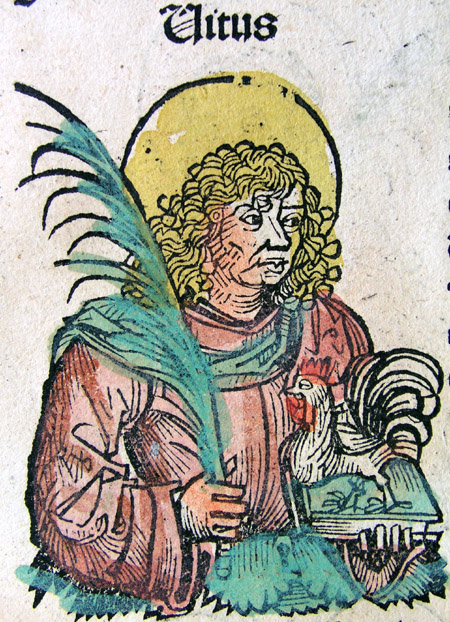
Saint Vitus
MartyrWikipedia
10
MENTIONS
3
EPISODES
3
PODCASTS
Search complete. 10 mentions across 3 episodes found for "Saint Vitus".
Oct 2, 2026

Eva DavisNARRATOR
This may possibly be denied by the authorized expounders of the doctrine of the Church of Rome, but it is nevertheless certain that it is the view taken by the uneducated classes, with whom the saints are much more present and definite deities than even the Almighty himself.
Eva DavisNARRATOR
It is worth noting that during the dancing mania of 1418, not God or Christ or the Virgin Mary, but Saint Vitus was prayed to by the populace to stop the epidemic that was afterwards known by his name.
Eva DavisNARRATOR
There was a temple to Saint Michael on Mount St. Angelo, and Augustine thought it necessary to declare that angel worshipers were heretics.
Eva DavisNARRATOR
Even Protestantism, though a much younger growth than Catholicism, shows a slight tendency toward polytheism.

Martin GeesonNARRATOR
They now indeed endeavored to hasten their reconciliation with the irritated and at that time very degenerate people by exorcisms, which with some procured them greater respect than ever because they thus visibly restored thousands of those who were affected.
Martin GeesonNARRATOR
In general, however, there prevailed a want of confidence in their efficacy, and then the sacred rites had as little power in arresting the progress of this deeply rooted malady as the prayers and holy services subsequently had at the altars of the greatly revered martyr Saint Vitus.
Martin GeesonNARRATOR
We may therefore ascribe it to accident merely and to a certain aversion to this demoniacal disease, which seemed to lie beyond the reach of human skill, that we meet with but few and imperfect notices of the Saint Vitus's dance in the second half of the fifteenth century.
Martin GeesonNARRATOR
The highly colored descriptions of the sixteenth century contradict the notion that this mental plague had in any degree diminished in its severity, and not a single fact is to be found which supports the opinion that any one of the essential symptoms of the disease, not even excepting the tympany, had disappeared, or that the disorder itself had become milder in its attacks.
Martin GeesonNARRATOR
The physicians never, as it seems, throughout the whole of the fifteenth century undertook the treatment of the dancing mania, which according to the prevailing notions appertained exclusively to the servants of the church.
Martin GeesonNARRATOR
Chapter one, section five.
Martin GeesonNARRATOR
Physicians.
Martin GeesonNARRATOR
It was not until the beginning of the sixteenth century that the Saint Vitus's dance was made the subject of medical research and stripped of its unhallowed character as a work of demons.

Michael KentHOST
Instead, depending on the place and the period, outbreaks could be understood through things like religion and medicine, supernatural punishment of these people, or some combination of all three.
Michael KentHOST
And one saint in particular became connected to the phenomenon, Saint Vitus.
Michael KentHOST
Vitus was an early Christian martyr whose cult became popular in certain parts of Europe.
Michael KentHOST
And over time, he became associated with people suffering from involuntary movement and compulsive dancing.
Michael KentHOST
People experiencing these symptoms might travel to a shrine dedicated to Vitus and pray for relief.
Michael KentHOST
So if you lived in the region around Strasbourg in early 1500s, the idea that Saint Vitus could have something to do with an uncontrollable dancing was already part of the cultural vocabulary around you.
Michael KentHOST
So this brings us to Strasbourg.
Michael KentHOST
Today, Strasbourg is in France, right on the border with Germany.