Saint-Domingue
86
MENTIONS
26
EPISODES
26
PODCASTS
Search complete. 86 mentions across 26 episodes found for "Saint-Domingue".
Sep 11, 2026

Patrick GriffinGUEST
I had tried to stay up to speed on the literature of the French Revolution.
Patrick GriffinGUEST
And, of course, being an Atlanticist, there's so much now that's being done in Saint-Domingue or Haiti.
Patrick GriffinGUEST
And so I was tended to be pretty current on that as well.
Patrick GriffinGUEST
Other things I had to learn, really... from scratch, which was really exciting but daunting at the same time.
31 MINS LATER
David GellmanHOST
And...
David GellmanHOST
So maybe you could talk a little bit about what you learn, you know, comparatively about the ways in which the enslaved shape struggle over sovereignty and endings.
David GellmanHOST
And like, is it the same across places or are there, there's always variations of themes, but are there distinctions between how we think about the, you know, Saint-Domingue versus North America versus Brazil versus various parts of the Spanish empire versus West Africa?
Patrick GriffinGUEST
There's more commonalities than not.

Michael LeggiereGUEST
The idea was to turn the Louisiana territory into the breadbasket of France's Caribbean islands.
Michael LeggiereGUEST
Because even though the Caribbean islands were fabulously wealthy, for France it would be Haiti in particular, or Saint-Domingue in particular, but they couldn't be self-sufficient because they didn't have a food supply.
Michael LeggiereGUEST
They could turn out tons and tons of sugar
John ViscardoHOST
cane,
Michael LeggiereGUEST
So Napoleon forced the Spanish to give Louisiana territory back to him, back to France.
Michael LeggiereGUEST
And then the idea was to create Louisiana territory, use it to be the breadbasket of the Caribbean.
Michael LeggiereGUEST
But then you had the revolt in Saint-Domingue, Haiti.
Michael LeggiereGUEST
And as you astutely pointed out, Napoleon lost tens of thousands of troops, throwing good money after bad money.

Patrick GriffinGUEST
I had tried to stay up to speed on the literature of the French Revolution.
Patrick GriffinGUEST
And, of course, being an Atlanticist, there's so much now that's being done in Saint-Domingue or Haiti.
Patrick GriffinGUEST
And so I was tended to be pretty current on that as well.
Patrick GriffinGUEST
Other things I had to learn, really... from scratch, which was really exciting but daunting at the same time.
31 MINS LATER
David GellmanHOST
And...
David GellmanHOST
So maybe you could talk a little bit about what you learn, you know, comparatively about the ways in which the enslaved shape struggle over sovereignty and endings.
David GellmanHOST
And like, is it the same across places or are there, there's always variations of themes, but are there distinctions between how we think about the, you know, Saint-Domingue versus North America versus Brazil versus various parts of the Spanish empire versus West Africa?
Patrick GriffinGUEST
There's more commonalities than not.

Patrick GriffinGUEST
I had tried to stay up to speed on the literature of the French Revolution.
Patrick GriffinGUEST
And, of course, being an Atlanticist, there's so much now that's being done in Saint-Domingue or Haiti.
Patrick GriffinGUEST
And so I was tended to be pretty current on that as well.
Patrick GriffinGUEST
Other things I had to learn, really... from scratch, which was really exciting but daunting at the same time.
31 MINS LATER
David GellmanHOST
And...
David GellmanHOST
So maybe you could talk a little bit about what you learn, you know, comparatively about the ways in which the enslaved shape struggle over sovereignty and endings.
David GellmanHOST
And like, is it the same across places or are there, there's always variations of themes, but are there distinctions between how we think about the, you know, Saint-Domingue versus North America versus Brazil versus various parts of the Spanish empire versus West Africa?
Patrick GriffinGUEST
There's more commonalities than not.

James EarlyHOST
Remember, I'm sure we've mentioned this, but it bears repeating that the Caribbean to both Britain and France was much more important than the North American colonies because for Britain, their sugar producing colonies in the Caribbean produced way more money than the colonies in North America.
James EarlyHOST
So, and of course, France had several colonies there as well, such as Saint-Domingue, the island, half island, which later became Haiti.
James EarlyHOST
And so France and Britain are going to, in addition to fighting on, North America proper on the mainland, they're going to be constantly battling it out in the Caribbean, trying to steal each other's colonies if possible.
James EarlyHOST
Anyway, on April 13th, the Stang, along with 11 ships of the line, one 50-gun ship and four frigates, plus 9,600 crew members, including Marines, Semper Fi, and 1,000 soldiers sailed for North America.

Nathan Pearl RosenthalGUEST
And what that means is that the economy is growing massively, but the returns from this massive growth are actually going, by and large, to the wealthiest, people who are already on top of society.
Nathan Pearl RosenthalGUEST
The most famous example of this is Saint-Domingue, what becomes Haiti, which is a colony of France in the period.
Nathan Pearl RosenthalGUEST
On the eve of the French Revolution, Saint-Domingue is an island where 90% of the population is enslaved.
Nathan Pearl RosenthalGUEST
And the other 10% of the population owns everything, including all of the enslaved people.
Nathan Pearl RosenthalGUEST
Thomas Piketty, the French economist, describes this as the most extreme case of inequality in world history.

Nathan Perl-RosenthalGUEST
And what that means is that the economy is growing massively, but the returns from this massive growth are actually going, by and large, to the wealthiest, people who are already on top of society.
Nathan Perl-RosenthalGUEST
The most famous example of this is Saint-Domingue, what becomes Haiti, which is a colony of France in the period.
Nathan Perl-RosenthalGUEST
On the eve of the French Revolution, Saint-Domingue is an island where 90% of the population is enslaved.
Nathan Perl-RosenthalGUEST
And the other 10% of the population owns everything, including all of the enslaved people.
Nathan Perl-RosenthalGUEST
Thomas Piketty, the French economist, describes this as the most extreme case of inequality in world history.

Addison AndersonNARRATOR
There are few surviving written records about Christophe's life immediately after the war.
Addison AndersonNARRATOR
Over the next decade, we know he worked as a mason and a waiter at a hotel in the French colony of Saint-Domingue, as Haiti was then known.
Addison AndersonNARRATOR
In 1791, when the colony's slaves rose up in rebellion, Christophe got another opportunity to fight for freedom.
Addison AndersonNARRATOR
Led by Toussaint Louverture, the rebels fought against plantation owners, as well as British and Spanish forces seeking control of the island.
Addison AndersonNARRATOR
Christophe quickly rose through the ranks, proving himself the equal of more experienced generals.
Addison AndersonNARRATOR
By 1793, Louverture had successfully liberated all of Saint-Domingue's enslaved people, and by 1801 he'd established the island as a semi-autonomous colony.
Addison AndersonNARRATOR
But during this time, Napoleon Bonaparte had assumed power in France and made it his mission to restore slavery and French authority throughout the empire.
Addison AndersonNARRATOR
French attempts to reinstate slavery met fierce resistance, with General Christophe even burning the capital city to prevent military occupation.

Gary ArndtHOST
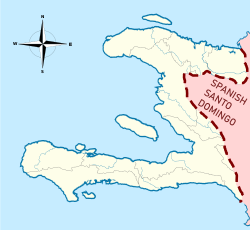
In a unique arrangement outlined in the sixteen ninety-seven Treaty of Ryswick at the end of the Nine Years' War, Spain ceded control of roughly one-third of the western side of the island to France.
Gary ArndtHOST
Under this new arrangement, the western third was dubbed Saint-Domingue, while the eastern two-thirds remained the Spanish colony of Santo Domingo.
Gary ArndtHOST
It was at this point the two sides of the island began to evolve very different personalities.
Gary ArndtHOST
In French Saint-Domingue, the island focused on sugar production, becoming a plantation state fueled by slave labor.
Gary ArndtHOST
By the close of the eighteenth century, Saint-Domingue had grown into what was likely the world's most prosperous colony, leading global sugar production.
Gary ArndtHOST
However, it had become a hellscape for the enslaved people who worked its fields.
Gary ArndtHOST
The population of Saint-Domingue was more than ninety percent slaves, governed by a small minority of white landowners who oversaw a reign of terror that saw a life expectancy of only seven years for the enslaved people upon arrival.
Gary ArndtHOST
While the French side of the island received significant colonial attention because of its profitability, Santo Domingo on the eastern side was a totally different world.

MireilleHOST
They exist in community with each other.
MireilleHOST
Vodou's roots trace to the Fon and Iwe peoples of the old kingdom of Dahomey in what's now Benin and Togo, blended with Congo and Yoruba traditions carried by hundreds of thousands of enslaved people trafficked into the French colony of Saint-Domingue.
MireilleHOST
The word itself comes from the Fon language and simply means spirit.
MireilleHOST
At the center of Vodou is Bondier, a distant supreme creator, who doesn't intervene directly in daily life, a concept that echoes across nearly every West African tradition on this list.
16 more episodes mention Saint-Domingue.
Create an account to see the whole feed, search across every transcript, and follow the entities you care about.