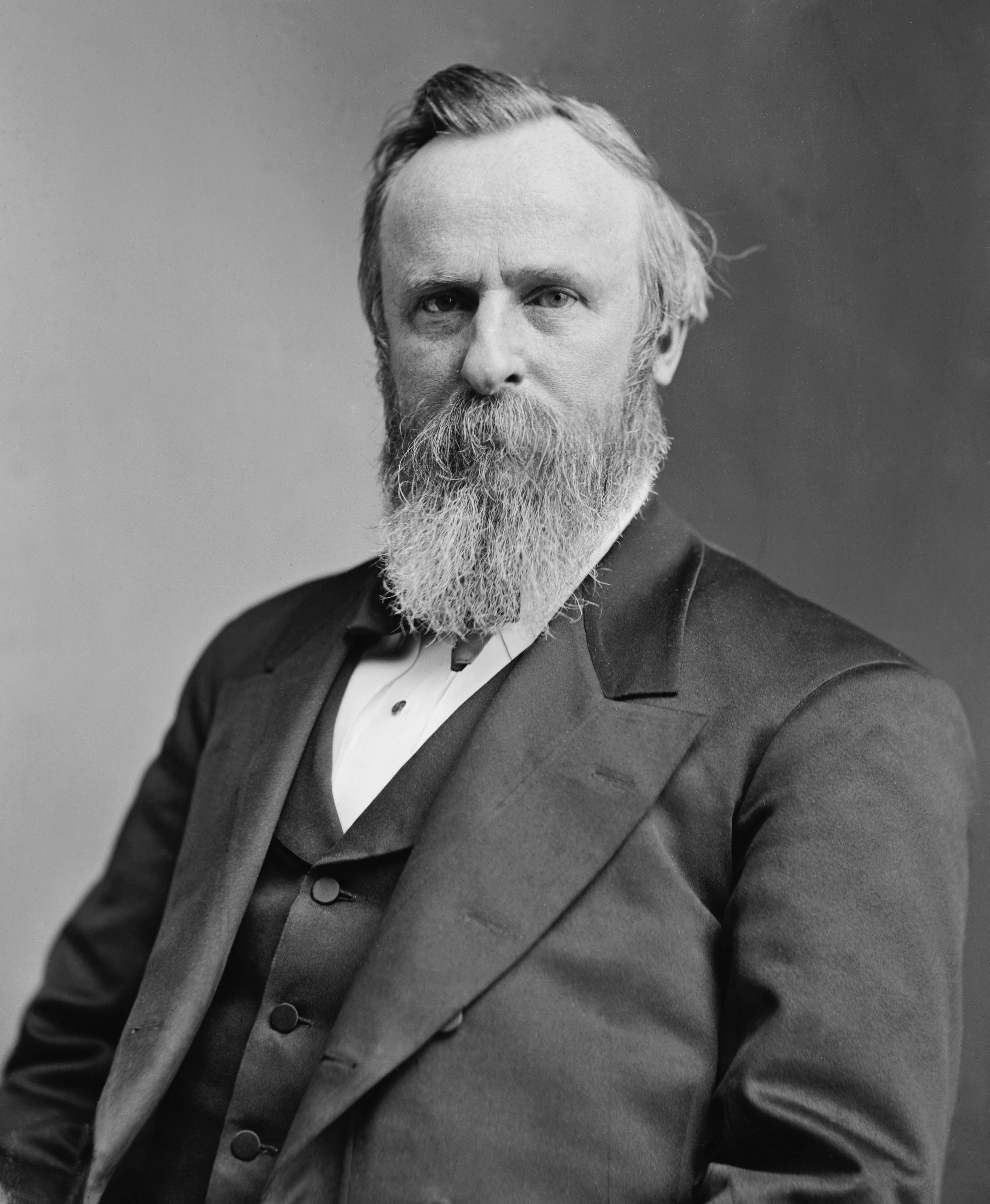
Rutherford B. Hayes
19th U.S. PresidentWikipedia
121
MENTIONS
50
EPISODES
48
PODCASTS
Search complete. 121 mentions across 50 episodes found for "Rutherford B. Hayes".
Sep 22, 2026

David BlightHOST
No more jokes about Ohio.
David BlightHOST
And they found Rutherford B. Hayes.
David BlightHOST
Now Hayes had many things going for him.
David BlightHOST
He had indeed been a Civil War veteran.
14 MINS LATER
David BlightHOST
Just don't come here and try to Here was the deal.
David BlightHOST
And by the way, one of the chief brokers, there were several chief brokers.
David BlightHOST
One was James Garfield of Ohio, close personal friend and associate of Rutherford B. Hayes, later succeeded him as President of the United States and to be assassinated.
David BlightHOST
But the other great broker at was Tom Scott, the President of the Texas Pacific Railroad.
Joanne FreemanHOST
There's nothing holding him back," and that's really useful in politics.
David BlightHOST
They used to say that later in the 19th century about some Republicans bec- a- as it was said of Rutherford B. Hayes, "He was obnoxious to no one."
Joanne FreemanHOST
[laughs]
David BlightHOST
And that was a compliment.

Rachel Goldstein ShabazzVOICE_ACTOR
The Waterloo Bridge was
speaker_16SOUNDBITE_SPEAKER
built during the Rutherford B. Hayes administration.
speaker_16SOUNDBITE_SPEAKER
It's 139 years old, but as of three years ago, too rickety for travel.
speaker_16SOUNDBITE_SPEAKER
Timber planks, iron trusses, stone piers.

EliseHOST
Garfield had been shot by an assassin just four months into his presidency.
EliseHOST
Arthur became the third president to serve in 1881, following Rutherford B. Hayes and Garfield, marking only the second time in American history that three presidents held office in the same year.
EliseHOST
Surprising fact, Garfield's assassin, Charles Guiteau, even wrote to President Arthur from jail, claiming credit for helping him reach the White House.
EliseHOST
Also on this day in history, in 1519 Magellan set sail to find a western route to Asia.

John GreenHOST
And this set up one of the most contentious elections in American history.
John GreenHOST
The Democrats nominated New York Governor and NYU Law School graduate Samuel Tilden, the Republicans chose Ohio Governor and Kenyon College alumnus Rutherford B. Hayes.
John GreenHOST
One man who'd gone to Crash Course writer Raoul Meyer's law school, and another who'd gone to my college, Kenyon.
John GreenHOST
Now if this election had been based on facial hair, as elections should be, there would have been no controversy.
John GreenHOST
Now you might remember that in these situations, there is a constitutional provision that says Congress should decide the winner, but Congress, shockingly, proved unable to accomplish something.
John GreenHOST
So they appointed a 15-man electoral commission, a super committee if you will, and there were eight Republicans on that committee and seven Democrats, so you will never guess who won.
John GreenHOST
Kenyon College's own Rutherford B. Hayes! Go lords and ladies! And yes, that is our mascot.
John GreenHOST
Shut up.

RoxannaPANELIST
He used his position to distribute thousands of government jobs to allies of his political boss, which was Senator Roscoe Conkling.
RoxannaPANELIST
In fact, he was so fiercely dedicated to this partisan machine that President Hayes actually fired him in 1878 for over-dispensing these jobs.
RoxannaPANELIST
But when he was selected as vice president running mate in 1880, it was a backroom political compromise.
RoxannaPANELIST
But let's just move forward what he did.

Ben WilfordNARRATOR
A deadlock ensued, and Congress adjourned without making provision for the Army.
Ben WilfordNARRATOR
Satisfied with the technical victory, the Democrats let the Army bill pass the next session, but kept up their fight on the force laws until they wrung from President Hayes a measure forbidding the use of United States troops in supervising elections.
Ben WilfordNARRATOR
the following year they again had recourse to a writer on the army bill and carried it through putting an end to the use of money for military control of elections the reconstruction programs were clearly going to pieces and the supreme court helped along the process of dissolution by declaring parts of the laws invalid in eighteen seventy eight the democrats even won a majority in the senate and returned to power a large number of men once prominent in the confederate cause the passions of the war by this time were evidently cooling a new generation of men were coming on the scene the supremacy of the whites in the south if not yet complete was at least assured federal marshals their deputies and supervisors of elections still possessed authority over the polls but their strength had been shorn by the withdrawal of united states troops the war on the remaining remnants of the force bill lapsed into desultory skirmishing when in eighteen ninety four the last fragment was swept away the country took little note of the fact the only task that lay before the southern leaders was to write in the constitutions of their respective states the provisions of law which would clinch the gains so far secured and establish white supremacy beyond the reach of outside intervention white supremacy sealed by new state constitutions the impetus to this final step was given by the rise of the populist movement in the south which sharply divided the whites and in many communities threw the balance of power into the hands of the few colored voters who survived the process of intimidation southern leaders now devised new constitutions so constructed as to deprive negroes of the ballot by law mississippi took the lead in eighteen ninety south carolina followed five years later louisiana in eighteen ninety eight north carolina in nineteen hundred alabama and maryland in nineteen o one and virginia in nineteen o two the author of these measures made no attempt to conceal their purposes the intelligent white men of the south said governor tillman intend to govern here the fifteenth amendment to the federal constitution however forbade them to deprive any citizen of the right to vote on account of race color or previous condition of servitude this made necessary the devices of indirection they were few simple and effective the first and most easily administered was the ingenious provision requiring each prospective voter to read a section of the state constitution or understand and explain it when read to him by the election officers
Anthony WilsonNARRATOR
as an alternative the payment of taxes or the ownership
1 HR 4 MINS LATER
speaker_17NARRATOR
though the democrats especially in the north resented this policy and dubbed it with the expressive but inelegant phrase waving the bloody shirt the republicans refused to surrender a slogan which made such a ready popular appeal as late as eighteen eighty four a leader expressed the hope that they might ring one more president from the bloody shirt they refused to let the country forget that the democratic candidate grover cleveland had escaped military service by hiring a substitute and they made political capital out of the fact that he had insulted the veterans of the Grand Army of the Republic by going fishing on Decoration Day.
speaker_17NARRATOR
Fortified by all these elements of strength, the Republican held the presidency from 1869 to 1885.
speaker_17NARRATOR
The three presidents elected in this period, Grant, Hayes, and Garfield, had certain striking characteristics in common.
speaker_17NARRATOR
They were all of humble origin, enough to please the most exacting Jacksonian Democrat.
John GreenHOST
But anyway, shortly after the election of 1800, the 12th Amendment was passed, making the electoral college simpler, but not as simple as, say, you know, one person's vote counting as one vote.
John GreenHOST
Anyway, complain about the electoral college all you want, but without it, we would never have had President Rutherford B. Hayes, and just look at that beard.
John GreenHOST
So Jefferson became president, and his election showed that Americans wanted a more democratic politics, where common people were more free to express their opinions.
John GreenHOST
The Federalists were never really a threat again in presidential politics, and arguably the best thing that John Adams ever did was transfer power in an orderly and honorable way to his rival, Jefferson.

JaredHOST
like, 1812 and then, like, 1970.
JaredHOST
Fuck Jimmy Carter's wife and then go back and Rutherford B. Hayes.
JaredHOST
Get her real
JordanHOST
quick.

Chad StoeckerNARRATOR
God demands daily decisions.
Chad StoeckerNARRATOR
In July of 1864, 21-year-old Second Lieutenant William McKinley found himself on Lieutenant Colonel Rutherford B. Hayes' staff, currently in the Virginia Valley near Kernstown.
Chad StoeckerNARRATOR
The Confederates began firing.
Chad StoeckerNARRATOR
The Union army, having underestimated the South's strength, retreated.
40 more episodes mention Rutherford B. Hayes.
Create an account to see the whole feed, search across every transcript, and follow the entities you care about.