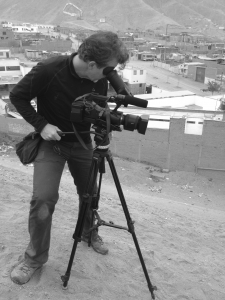
Rustin Thompson
Filmmaker
8
APPEARANCES
8
PODCASTS
Sep 3, 2026


Rustin ThompsonGUEST
So I came to this idea because as I said, I live in Seattle and we have lost seven to 10 of our art house theaters in the last 15 years, 10 years.
Rustin ThompsonGUEST
This is where I got my movie going, Education, where all these theaters, many of them clustered around the University of Washington, where I went to college.
9 MINS LATER

Rustin ThompsonGUEST
Well, you know, I'll go back to when I was a kid because I so mentioned I had an older brother.
8 MINS LATER

Megan BraunHOST
So speaking of going to these theaters through your documentary, but also just in life, what is your ideal movie theater going experience? Like what kind of snacks? What kind of theater? Do you have a preferred seat?


Rustin ThompsonGUEST
Sort of rewinding back to when I started making the film, I'm from Seattle.
Rustin ThompsonGUEST
And we've lost 10 of our art house theaters in the last 10, 15 years, all gone.
21 MINS LATER

Rustin ThompsonGUEST
It runs about 78 minutes, and I describe it as an elegy for small-town cinemas of the American West.
Rustin ThompsonGUEST
I grew up mainly in a little town outside of Seattle called Puyallup, but I also spent time in Reno and Colorado Springs and Vail and Ontario, Oregon.
Rustin ThompsonGUEST
And when I thought about making this film, I really wanted to go to the so-called cinema deserts, which are the small towns that still has a theater, yet there's 50 to 100 miles, sometimes less, sometimes more, between the next theater that's open.
15 MINS LATER
Jan PriceHOST
I wish that somebody would open an IMAX theater or change their screen to become an IMAX, you know, because more and more films are coming out that way.

Adam SchartoffHOST
... seem to be showing many, uh, any studio films, first-run studio films for two weeks.
Rustin ThompsonGUEST
The, so there's a theater in my film that we meet the owners early on, uh, and it's in Susanville, California, and it's the Sierra Theater.
Rustin ThompsonGUEST
Just, uh, just classically beautiful, uh, marquee, and a huge interior, and they have a balcony.


Mike KasparHOST
So tell me a little bit about what inspired you to go out on the road and track down some of these great movie houses.
Rustin ThompsonGUEST
Yeah, well, I know your audience can't see it, but yes, I'm surrounded by film posters, foreign language film posters, and my DVDs and Blu-rays, so clearly I'm a bit of a film head, a cinephile.
Rustin ThompsonGUEST
And I was at a very early age, probably when I was seven or eight is when my love of film really took off.
Rustin ThompsonGUEST
And the way that I've learned about life and love and death and relationships and how to live.
Mike KasparHOST
There's a lot really that drives this film emotionally as well because getting to know the theater owners, inevitably they will say to you, we love doing this we love being a part of showcasing presenting film

Rustin ThompsonGUEST
And there's that one that I didn't name that's in Elma, Washington, that looks like it could... blow over in the wind.

Libby DenkmannHOST
I mean, what did you hear from community members about what having these single and double screen theaters on their main streets means?


Rustin ThompsonGUEST
I, I, I call it an elegy for small town cinemas of the American West, and I, um, I wanted to explore these, these cinema deserts, these spaces that were a small town, it might have the only existing operating theater in a span of 100 to 150 miles.
Rustin ThompsonGUEST
And in between those small towns are all these other small towns that are dotted with theaters that are closed, uh, and have been long closed, some for 50 years, some for 30 years.
21 MINS LATER
