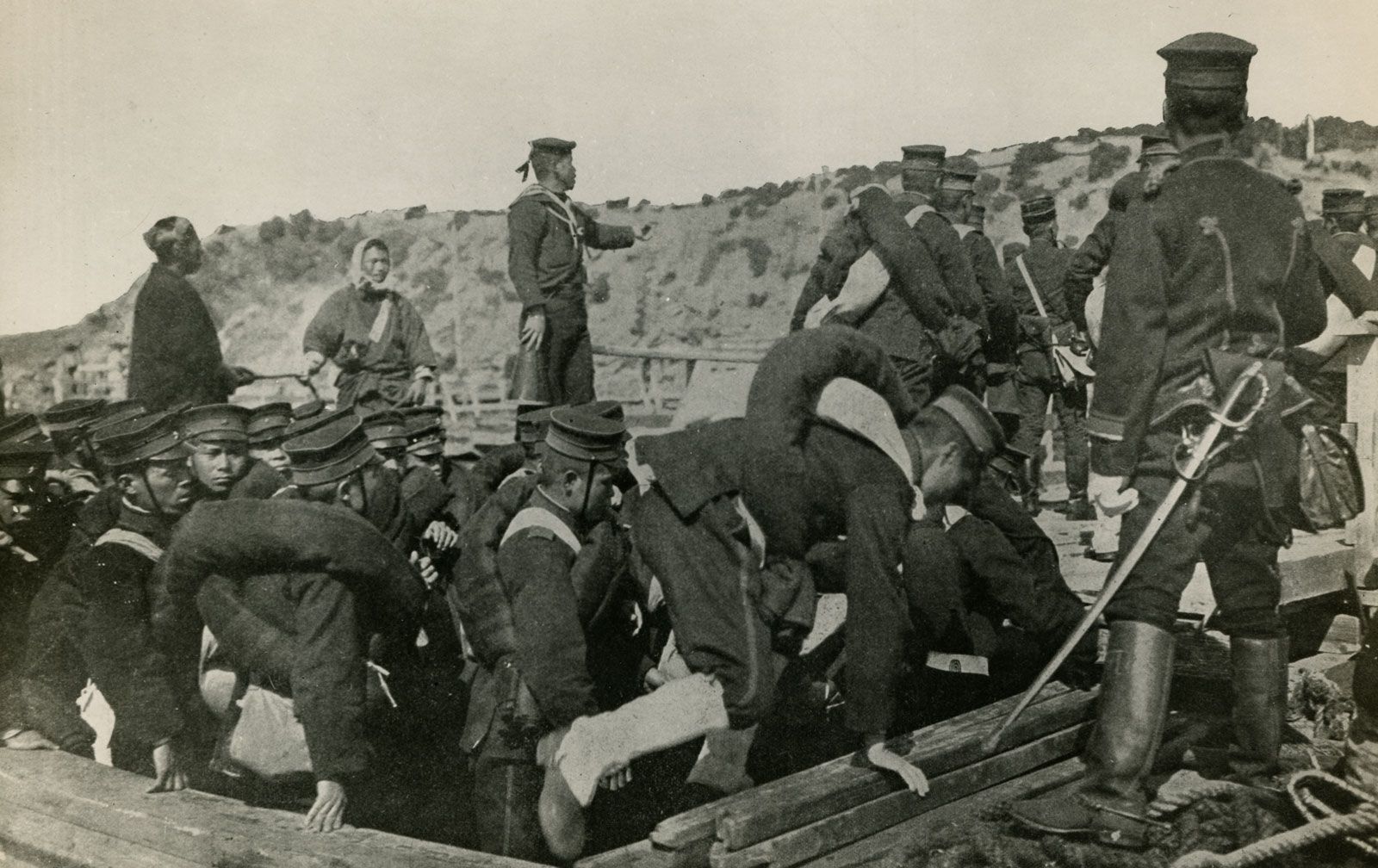
Russo-Japanese War

Russo-Japanese War

BattleWikipedia

Search complete. 507 mentions across 180 episodes found for "Russo-Japanese War".

Sep 11, 2026

Francis FukuyamaGUEST
3:20
My father was also born in the United States.
Francis FukuyamaGUEST
3:22
His father came over around the time of the Russo-Japanese War early in the 20th century to escape impressment there.
Francis FukuyamaGUEST
3:31
Uh, but, um, you know, I grew up in New York City.
Francis FukuyamaGUEST
3:34
There was never a Japanese American community there, so I really never felt, you know, particularly rooted in that particular ethnic group.
AlistairNARRATOR
132:44
Chapter 14b, The Battle of Concessions in the Far East, Part 2.
AlistairNARRATOR
132:51
Subtitle, The Russo-Japanese War.
AlistairNARRATOR
132:56
While a few of the great powers, notably Great Britain, Germany, and the United States, declared that the Boxer War should not be made a pretext for dismembering China, Russia endeavored so to use it.
AlistairNARRATOR
133:09
Russian troops sent into Manchuria during the war remained there.

10 MINS LATER

AlistairNARRATOR
143:28
Year by year Japan tightened her grasp, and finally in 1910 the annexation of Korea was announced.
AlistairNARRATOR
143:39
Subtitle Revolution in China On China the lesson of imperialism had been more and more strongly impressed.
AlistairNARRATOR
143:48
If the Boxer War had shown the futility of attempting to shut out the Western world, the Russo-Japanese War had quite as emphatically demonstrated the advantage of borrowing from the West the governmental, economic, and military methods which had enabled Japan within a few decades to become more than a match for Russia.
AlistairNARRATOR
144:08
The lesson was more deeply impressed because the Russo-Japanese War was fought largely on Chinese soil and for the Chinese provinces of Manchuria, while China's government looked on helpless and aghast.
Isaac MeyerHOST
3:02
His other famous series is about a high school youth hockey team in Tomakomai, to give you an idea.
Isaac MeyerHOST
3:09
Golden Kamui is set over a century ago in the late Meiji era and is all about Russo-Japanese war vet Sugimoto Saichi, his adoptive daughter-slash-best friend Ashripa, and their adventure together to look for long-lost Ainu gold.
Isaac MeyerHOST
3:22
It's a lot of fun, it's also very violent and over-the-top, so if you're a kid, definitely skip it.
Isaac MeyerHOST
3:28
But for our purposes, the series matters because one of the side characters, Tanigaki Genjiro, is Matagi.
Isaac MeyerHOST
3:35
He's described as having grown up in a hunting community before being conscripted to fight in the Russo-Japanese War, and because of it, being one of the only people who can rival the Ainu characters in the story in his mastery of the woodlands and how to survive inside them.
Isaac MeyerHOST
3:52
And because Golden Kamui has been crazy popular, especially in the last few years, the last chapter came out in 2022, the anime adaptation wrapped up about half a year or so ago, there's been a growing interest in the subjects it touches on.
Isaac MeyerHOST
4:05
That includes, for example, Ainu history and culture.
Jeremiah JacquesCORRESPONDENT
55:28
The tragic history of World War II shows us that most clearly.
Jeremiah JacquesCORRESPONDENT
55:32
But we can also see glimpses of it looking back at the Russo-Japanese War, the invasion of Taiwan and other conflicts.
Jeremiah JacquesCORRESPONDENT
55:40
And it was because of those dark chapters of history that the Allied powers at the end of World War II forced Japan to renounce war and to become a pacifist nation.
Jeremiah JacquesCORRESPONDENT
55:52
So with that history in mind, it's very sobering today to see Japan moving away from pacifism and rapidly remilitarizing, even with some of the most advanced and deadly warships on Earth.
AlistairNARRATOR
125:43
Chapter Fourteen B, The Battle of Concessions in the Far East, Part Two.
AlistairNARRATOR
125:50
Subtitle, The Russo-Japanese War.
AlistairNARRATOR
125:55
While a few of the great powers, notably Great Britain, Germany, and the United States, declared that the Boxer War should not be made a pretext for dismembering China, Russia endeavored so to use it.
AlistairNARRATOR
126:08
Russian troops sent into Manchuria during the war remained there.

9 MINS LATER

AlistairNARRATOR
135:07
Subtitle, Revolution in China.
AlistairNARRATOR
135:12
On China, the lesson of imperialism had been more and more strongly impressed.
AlistairNARRATOR
135:16
If the Boxer War had shown the futility of attempting to shut out the Western world, the Russo-Japanese War had quite as emphatically demonstrated the advantage of borrowing from the West the governmental, economic, and military methods which had enabled Japan within a few decades to become more than a match for Russia.
AlistairNARRATOR
135:37
The lesson was more deeply impressed because the Russo-Japanese War was fought largely on Chinese soil and for the Chinese provinces of Manchuria, while China's government looked on helpless and aghast.
Jonathan SchwabHOST
20:05
Hmm.
Henry AbramsonGUEST
20:06
A lot of Jews have already been in the region, particularly when you get to the Russo-Japanese War.
Jonathan SchwabHOST
20:12
Mm-hmm.
Henry AbramsonGUEST
20:12
They're already there sometimes as conscripts, and they see lots of opportunity there.
Eva EastonNARRATOR
83:53
It is a walled city and contains a couple of hundred thousand people.
Eva EastonNARRATOR
83:58
During the Russian-Japanese War, a portion of it is said to have been eight different times in the hands of the Russians and Japanese.
Eva EastonNARRATOR
84:08
The streets are unpaved.
Eva EastonNARRATOR
84:10
Dirt and filth abounds.
Eva EastonNARRATOR
88:49
For years it was about the worst city to be found, there being at least one murder committed almost every day.
Eva EastonNARRATOR
88:58
After changing trains at midnight and rambling around a few hours I would say that it is not filled with saints yet.
Eva EastonNARRATOR
89:06
During the Russian-Japanese war it was one of the great gateways, more than a million soldiers passing through it.
Eva EastonNARRATOR
89:15
From Harbin west one passes through the Kweigan Mountains.
Dave KangGUEST
26:16
About, you know, 1850, the arrival of Perry's, uh, Black Ships, you know, the Japanese realized, "Okay, the world is changing." And yes, they were the first, they were the first non-Western country to industrialize.
Dave KangGUEST
26:28
They're also the first non-Western country to beat a Western country in a war, 1904, the Russo-Japanese War.
Dave KangGUEST
26:34
So in many ways, Japan was one of the first to do all of these things, and they could have stopped.
Dave KangGUEST
26:39
My sense is, and much of the discussion about like the late 19th, early 20th century is, that there was this mad scramble, and it wasn't clear at all what was gonna happen in China, what was gonna happen in Korea.
AlistairNARRATOR
135:12
Chapter 14b, The Battle of Concessions in the Far East, Part 2.
AlistairNARRATOR
135:19
Subtitle, The Russo-Japanese War.
AlistairNARRATOR
135:24
While a few of the great powers, notably Great Britain, Germany, and the United States, declared that the Boxer War should not be made a pretext for dismembering China, Russia endeavored so to use it.
AlistairNARRATOR
135:37
Russian troops sent into Manchuria during the war remained there.

11 MINS LATER

AlistairNARRATOR
146:37
Subtitle: Revolution in China.
AlistairNARRATOR
146:42
On China, the lesson of imperialism had been more and more strongly impressed.
AlistairNARRATOR
146:46
If the Boxer War had shown the futility of attempting to shut out the Western world, the Russo-Japanese War had quite as emphatically demonstrated the advantage of borrowing from the West the governmental, economic, and military methods which had enabled Japan within a few decades to become more than a match for Russia.
AlistairNARRATOR
147:06
The lesson was more deeply impressed because the Russo-Japanese War was fought largely on Chinese soil and for the Chinese provinces of Manchuria, while China's government looked on helpless and aghast.
AlistairNARRATOR
126:44
The Battle of Concessions in the Far East, Part Two.
AlistairNARRATOR
126:50
Subtitle: The Russo-Japanese War.
AlistairNARRATOR
126:55
While a few of the Great Powers, notably Great Britain, Germany, and the United States, declared that the Boxer War should not be made a pretext for dismembering China, Russia endeavored so to use it.
AlistairNARRATOR
127:08
Russian troops sent into Manchuria during the war remained there.

9 MINS LATER

AlistairNARRATOR
135:57
Year by year, Japan tightened her grasp, and finally, in 1910, the annexation of Korea was announced.
AlistairNARRATOR
136:07
Subtitle Revolution in China On China, the lesson of imperialism had been more and more strongly impressed.
AlistairNARRATOR
136:17
If the Boxer War had shown the futility of attempting to shut out the Western world, the Russo-Japanese War had quite as emphatically demonstrated the advantage of borrowing from the West the governmental, economic, and military methods which had enabled Japan within a few decades to become more than a match for Russia.
AlistairNARRATOR
136:37
The lesson was more deeply impressed because the Russo-Japanese War was fought largely on Chinese soil and for the Chinese provinces of Manchuria, while China's government looked on helpless and aghast.

170 more episodes mention Russo-Japanese War.

Create an account to see the whole feed, search across every transcript, and follow the entities you care about.

We value your privacy

We use cookies to understand how you use our platform and to improve your experience. Click “Accept All” to consent, or “Decline non-essential” to opt out of non-essential cookies. Read our Privacy Policy.