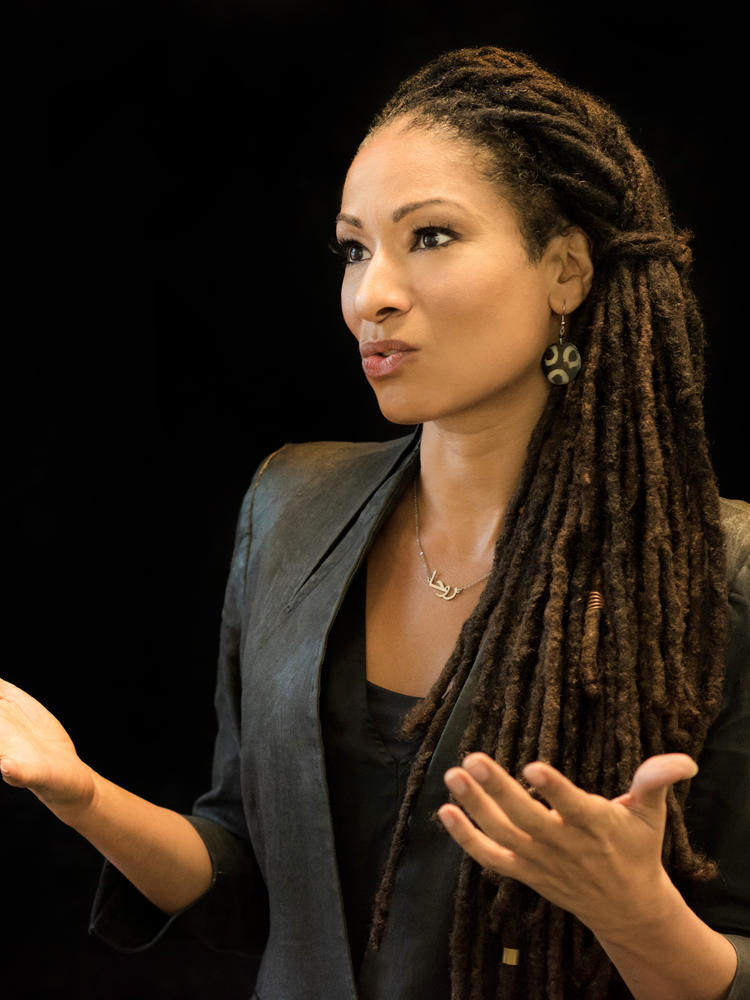
Ruha Benjamin
Sociologist and professorWikipedia
8
MENTIONS
7
EPISODES
7
PODCASTS
Search complete. 8 mentions across 7 episodes found for "Ruha Benjamin".
Nov 10, 2026

Mar Osma de ForestGUEST
It's just trying to dream up what is possible other than what we have.
Mar Osma de ForestGUEST
I really appreciate all of the prison abolitionists, Mariam Kaba, Ruha Benjamin, all of these people who have done so much work because It really is just a different way of thinking about how you live in the world rather than an end result.
Jennifer Diane GostinHOST
I love that answer.
Jennifer Diane GostinHOST
And I would agree for me, being in the community has really helped me learn more about myself.

Damian HarmonyHOST
Yeah.
Isaac SandersGUEST
One of my favorite books, favorite academic authors, author in general, but I don't know if y'all have heard of Ruha Benjamin.
Isaac SandersGUEST
She wrote the book Race After Technology.
Isaac SandersGUEST
And so it's this book that kind of goes through very similarly that... as we are building more technology, people are saying it's unbiased, but when you're creating things, and she uses so many different examples, but the one that's coming to mind is this beauty tracker that was made in China.

Alix DunnHOST
Also, this idea that superintelligence, whatever, is going to save us all or it's going to kill us all.
Alix DunnHOST
I don't know if you all heard the expression from Ruha Benjamin that there are two sides of the same Bitcoin, which is one of my favorites.
Alix DunnHOST
Yeah, no.
Alix DunnHOST
So I hear you.

Gabriella BennettGUEST
It makes so much sense to gather data on us and be able to preempt our needs, therefore, by knowing where I'm going to be and what my patterns are and how I use the city.
Gabriella BennettGUEST
And then I went to see a sociologist called Ruha Benjamin, and she gave the most amazing keynote at this urbanism conference.
Gabriella BennettGUEST
And it was a really bold thing for this conference to put her on because she is like so anti tech and AI and really just wheeled through this incredible argument talking about this idea of you know all these things that are coded what are these coded ideas when we talk about intelligence when we talk about cities like whose intelligence are we talking about and she made such an amazing persuasive case that actually things like the robo dog it's like an agent of racism you know in border camps and the US border when you've got a robo dog patrolling it's not a neutral thing and actually technology can't ever be considered neutral when the people creating technology and maintaining technology are are humans and we in ourselves are like absolutely impossible and incapable of impartiality.
Gabriella BennettGUEST
Like it's just not a human thing.

Catarina DoriaHOST
I'm an AI ethicist, and this is Bots Don't Cry, the podcast where every Tuesday I'll teach you critical AI literacy with other critical AI experts.
Catarina DoriaHOST
And today, we are super duper lucky to learn from Dr. Ruha Benjamin.
Catarina DoriaHOST
Dr. Ruha Benjamin is a writer, scholar, and cultural worker.
Catarina DoriaHOST
She's a professor in the Department of African American Studies at Princeton University, founding director of the IWL's Just Data Lab, and is the author of four books, Imagination and Manifesto, Viral Justice, Race After Technology, and People's Science.
Catarina DoriaHOST
She's also the editor of Captivating Technology, Truly, Thank you so much for being here.

Marcus HazelwoodHOST
What conversation at NOMA changed the way you think?
Graeme MiracleGUEST
One, the keynote speaker, Dr. Ruha Benjamin.
Graeme MiracleGUEST
She talked about innovation.
Graeme MiracleGUEST
and really about the way we look at innovation and trying to twist, you know, is innovation really going to Mars or innovation creating the next sustainable house solution? And so that really like changed my idea of like, I love technology, I love STEM, but it really changed my idea of like, okay, how do I use this technology into really creating a more positive and better future? Especially with like here, where this year I'm listening to more about the vernacular of architecture and really trying to like understand how maybe technology can play into vernacular, how maybe where can we boost and create a more positive future, really.

Jared VanGUEST
When we talk about AI completely generating text, we have to be very careful with that.
Jared VanGUEST
And one of the reasons why I think we need to be very careful with that, I'm gonna share my screen real quick if that's okay with you, 'cause, uh, there's this thing called Jim Code by Ruha Benjamin in her book Race After Technology, and Jim Code is a specific manifestation of discriminatory design in which racist values and assumptions are built into our technological systems.
Jared VanGUEST
So we see this when there's, uh, studies that fi- that find potential risk with self-driving cars, that they also notice darker-skinned pedestrians because they didn't train the data on dark-skinned people.
Jared VanGUEST
Then AI algorithms are making decisions about healthcare, which may only worsen medical racism, choosing to not provide, uh, resources to people that are Black.