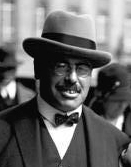
Rudolf Hilferding
Austrian economistWikipedia
15
MENTIONS
4
EPISODES
4
PODCASTS
Search complete. 15 mentions across 4 episodes found for "Rudolf Hilferding".
Oct 9, 2026

Radhika DesaiGUEST
Though I had read volume three, somehow I had sc- uh, not fully appreciated this.
Radhika DesaiGUEST
But, uh, I was asked to write an essay on Hilferding, and I decided to take up the challenge, and I read all of his Finance Capital, and he refers to this.
Radhika DesaiGUEST
And then I suddenly realized that Marx actually also proposes a completely different outcome for capitalism, which people don't discuss, and that is the arrival of monopoly.
Radhika DesaiGUEST
Marx basically says that monopoly is the organic result of competition.
Radhika DesaiGUEST
But once you eliminate competition, uh, once, uh, uh, monopolies are able to essentially be price setters, then there is no need for them to develop the forces of production.
Radhika DesaiGUEST
So Marx had said that, and in fact, if you...
Radhika DesaiGUEST
Not only does Hilferding develop these insights, but so does Lenin.
Radhika DesaiGUEST
You know, P- that pamphlet that Lenin wrote in 1916, which I already alluded to earlier, he talks about imperialism as the highest stage of capitalism.

Vivek ChibberHOST
Marxism is the theory that tries to help socialists understand the world around them so that they might be able to more effectively intervene in the world.
Vivek ChibberHOST
That means that, as Hilferding, Rudolf Hilferding, the German Marxist, once said, technically you could say that y- the theory you think is best and most illuminating is Marxism without being a socialist, because they're different things.
Melissa NaschekHOST
Yeah.
Vivek ChibberHOST
Technically, yes, that's right.
16 MINS LATER
Vivek ChibberHOST
He held the view that capitalism entered a stage of what's called monopoly capital.
Vivek ChibberHOST
Now, if you hold to the view that competition is over, and firms can monopolize sectors and effectively deter entrants, you also hold the view that capital cannot move in and out of sectors pursuing the highest rate of profit, which means, technically speaking, that the law of value is very hard to sustain.
Vivek ChibberHOST
Okay, so then if you think the law of value is central to the labor theory of value, then you're saying someone like Sweezy or someone like Hilferding or someone like Lenin is no longer a Marxist.
Vivek ChibberHOST
Would you wanna say that, right? It, it just makes no sense.

Vivek ChibberHOST
Marxism is the theory that tries to help socialists understand the world around them so that they might be able to more effectively intervene in the world.
Vivek ChibberHOST
That means that as Hilferding, Rudolf Hilferding, the German Marxist once said, technically you could say that the theory you think is best and most illuminating is Marxism without being a socialist because they're different things.
Melissa NaschekHOST
Yeah.
Vivek ChibberHOST
Technically, yes, that's right.
16 MINS LATER
Vivek ChibberHOST
He held to the view that capitalism entered a stage of what's called monopoly capital.
Vivek ChibberHOST
Now, if you hold to the view that competition is over and firms can monopolize sectors and effectively deter entrants, you also hold to the view that capital cannot move in and out of sectors pursuing the highest rate of profit, which means technically speaking that the law of value is very hard to sustain.
Vivek ChibberHOST
Okay, so then if you think the law of value is central to the labor theory of value, then you're saying someone like Sweezy or someone like Hilferding or someone like Lenin is no longer a Marxist.
Vivek ChibberHOST
Would you want to say that? It just makes no sense.

Warwick PowellGUEST
There was a view, I guess, back in, say, 110 years or so ago.
Warwick PowellGUEST
And if you look at Hilferding, for example, he talked about what was essentially the merger of industrial and finance capital.
Warwick PowellGUEST
where they shared common interests.
Warwick PowellGUEST
And of course, their common interest ultimately was the pursuit of monopoly.
6 MINS LATER
Warwick PowellGUEST
And it is that-
Radhika DesaiHOST
Can I add a corollary to that very quickly, if I may, because this is very important.
Radhika DesaiHOST
You mentioned Hilferding and how he had a certain conception of what finance capital was, which he said existed in its paradigmatic form in his time in Germany.
Radhika DesaiHOST
And he explicitly contrasted the German financial system with the British financial system, which was the opposite in many respects.