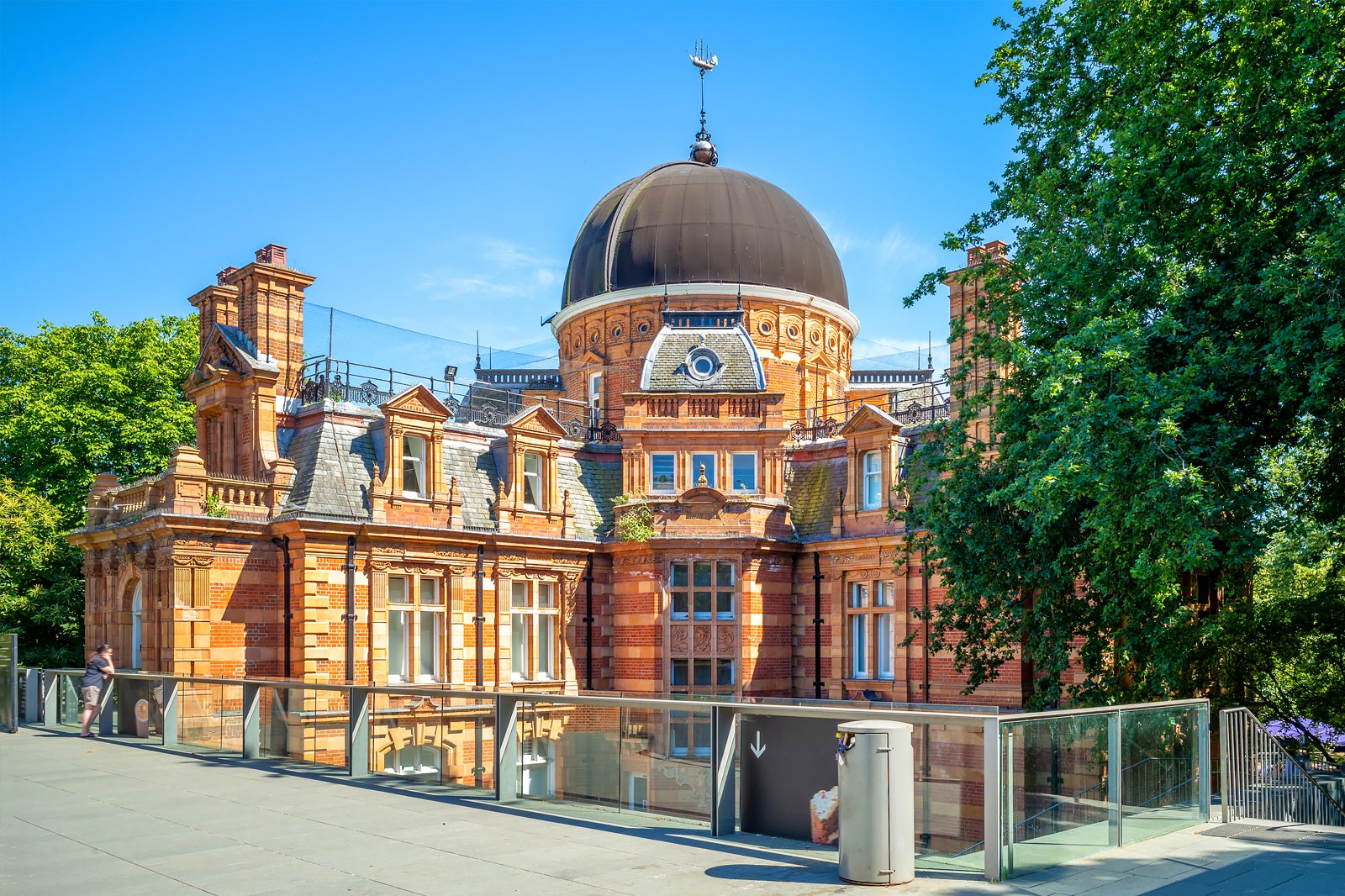
Royal Observatory
Observatory in London, EnglandWikipedia
40
MENTIONS
23
EPISODES
21
PODCASTS
Search complete. 40 mentions across 23 episodes found for "Royal Observatory".
Nov 23, 2026

Melissa JeanNARRATOR
In fact, our whole system of weights and measures is found on the apparent diurnal motion of the sidereal system, that is, on the real diurnal rotation of the earth.
Melissa JeanNARRATOR
We may look on the meridian plane, in which the great transit telescope of the Greenwich Observatory is made to swing, as the gigantic hand of a mighty dial, a hand which, extending outwards among the stars, traces out for us by its motion among them the exact progress of time, and so gives us the means of weighing, measuring, and valuing terrestrial objects with an exactitude which is at present beyond our wants.
Melissa JeanNARRATOR
The earth, then, is our chief timepiece, and it is of the correctness of this giant clock that I am now to speak.
Melissa JeanNARRATOR
But how can we test a timepiece whose motions we select to regulate every other timepiece? If a man sets his watch every morning by the clock at Westminster, it is clearly impossible for him to test the accuracy of that clock by the motions of his watch.
54 MINS LATER
Joanne CrosbyNARRATOR
It is to the peculiarity we are now to consider that the quasi-failure of the observations made in seventeen sixty-nine may be attributed.
Joanne CrosbyNARRATOR
It is true that Mr.
Joanne CrosbyNARRATOR
Stone, the first assistant of the Greenwich Observatory, has managed to remove the greatest part of the doubt which clouded the results of those observations.
Joanne CrosbyNARRATOR
But not even his skill and patience can serve to remove the blot which a century of doubt has seemed to throw upon the most exact of sciences.

Genevieve ManionHOST
This is the only auroral event ever recorded above Britain, by the way.
Genevieve ManionHOST
As this happened, the Royal Observatory at Greenwich observed an extraordinarily unusual luminous formation traveling across the sky.
Genevieve ManionHOST
It was seen by many people, but they described it as, quote, like a long, luminous, nebulous cigar ship moving across the moon.
Genevieve ManionHOST
I love these descriptions.

speaker_0NARRATOR
Arthur Eddington went to the island of Príncipe, off West Africa.
speaker_0NARRATOR
Charles Davidson and Andrew Cromlin, from the Royal Observatory at Greenwich, went to Sobral in Brazil.
speaker_0NARRATOR
Frank Dyson, the Astronomer Royal, coordinated it all from England.
speaker_0NARRATOR
Clouds caused trouble, and only two of the seven plates from Príncipe were good enough to use.

Dan SnowNARRATOR
Knight realized there was a fundamental problem with the longitude.
Dan SnowNARRATOR
The modern maps Knight examined used the international zero meridian passing through the Royal Observatory at Greenwich, London.
Dan SnowNARRATOR
But then he realized charts in Captain Kidd's time referenced other zero meridians.
Dan SnowNARRATOR
The French favored Paris.

speaker_1NARRATOR
we have been told to make every preparation for a journey of exploration in south africa and that being done to come here to the falls of morgada and wait for my colleague colonel everest of the cambridge observatory well here are the falls of morgada we are at the place appointed and we are waiting what more do you want my worthy bushman the hunter doubtless did want more for his fingers played feverishly with the lock of his rifle an excellent manton a weapon of precision with conical shot and which could bring down a wild cat or an antelope at a distance of eight or nine hundred yards thus it may be seen that the bushman had put aside the quiver of aloes and the poisoned darts of his fellow-countrymen for the use of european weapons but you are not mistaken mr emery replied Is it really at the falls of Morgada and towards the end of this month of January that they have appointed to meet you? Yes, my friend, quietly answered William Emery, and here is the letter from Mr.
speaker_1NARRATOR
Airy, the director of the Greenwich Observatory, which will show you that I am not mistaken.
speaker_1NARRATOR
The bushman took the letter that his companion gave him.
speaker_1NARRATOR
He turned it over and over, like a man not very familiar with the mysteries of penmanship.
7 MINS LATER
speaker_1NARRATOR
He was waiting for Europeans, fellow countrymen, who had left their homes to run the risks of a distant expedition.
speaker_1NARRATOR
But what was the expedition for? What scientific problem could it want to solve in the deserts of South Africa? What observation could it be trying to take in latitude 30 degrees south? That was just what Mr.
speaker_1NARRATOR
Airy, the director of the Greenwich Observatory, did not tell in his letter.
speaker_1NARRATOR
As for Emery himself, they asked for his cooperation as for that of a scientific man who was familiar with the climate of those southern latitudes, and as he was openly engaged in scientific labours, he was quite at the disposal of his colleagues in the United Kingdom.

James KitchenHOST
That's 16 billion miles it blasted off into space back in 1977.
James KitchenHOST
Carys Herbert is an astronomer at the Royal Observatory Greenwich.
Carys HerbertSOUNDBITE_SPEAKER
I'm actually feeling quite emotional about it.
Carys HerbertSOUNDBITE_SPEAKER
This is such a huge milestone that I think really appeals to us on a very human level.

OxhornHOST
West.
OxhornHOST
Royal Observatory? Oh my God, there's so much in this game.
OxhornHOST
I mean, I'll probably be back there.
OxhornHOST
Oh.

speaker_19NARRATOR
He rediscovered the inequality called variation by observing the moon in all phases, a thing which had not been attended to.
speaker_19NARRATOR
It is remarkable that in the 19th century Sir George Airy established an altazimuth at Greenwich Observatory with this special object to get observations of the moon in all phases.
speaker_19NARRATOR
He also discovered other lunar equalities and wanted to add another epicycle to the moon's orbit, but he feared that these would soon become unmanageable if further observations showed more new inequalities.
speaker_19NARRATOR
But, as it turned out, the most fruitful work of Tycho Brahe was on the motions of the planets, and especially on the planet Mars, for it was by an examination of these results that Kepler was led to the discovery of his immortal laws.
1 HR 1 MIN LATER
speaker_21NARRATOR
and also it added a new member to the solar system, and gave a prospect of adding many more.
speaker_21NARRATOR
When Halley's Comet reappeared in 1835, Pontecolon's computations for the date of perihelion passage were very exact, and afterwards he showed that with more exact values of the masses of Jupiter and Saturn, his prediction was correct within two days, after an invisible voyage of 75 years.
speaker_21NARRATOR
Hind, afterwards, searched out many old appearances of this comet going back to 11 B.C., and most of these have been identified as being, really, Halley's Comet, by the calculations of Cowell and Cromelon of Greenwich Observatory, who have also predicted its next perihelion passage for April 8-16, 1910, and have traced back its history still farther to 240 B.C., Already in November 1907, the Astronomer Royal was trying to catch it by the aid of photography.
speaker_21NARRATOR
History of Astronomy by George Forbes Chapter 9 Discovery of New Planets Herschel, Piazzi, Adams, and Le Verrier It would be very interesting, but quite impossible in these pages, to discuss all the exquisite researches of the mathematical astronomers, and to inspire a reverence for the names connected with these researches, which for two hundred years have been establishing the universality of Newton's law.

Melissa JeanNARRATOR
the interval namely between the successive passages by the same star of the celestial meridian of any fixed place this interval is assumed to be constant and it has indeed been described as the one constant element known to astronomers we find then that there is a connection and a very important connection between the motion of the stars and our measures not merely of value but of weight length volume and time In fact, our whole system of weights and measures is found on the apparent diurnal motion of the sidereal system, that is, on the real diurnal rotation of the Earth.
Melissa JeanNARRATOR
We may look on the meridian plane, in which the great transit telescope of the Greenwich Observatory is made to swing, as the gigantic hand of a mighty dial, a hand which, extending outwards among the stars, traces out for us, by its motion among them, the exact progress of time, and so gives us the means of weighing, measuring, and valuing terrestrial objects, with an exactitude which is at present beyond our wants.
Melissa JeanNARRATOR
the earth then is our chief timepiece and it is of the correctness of this giant clock that i am now to speak but how can we test a timepiece whose motions we select to regulate every other timepiece if a man sets his watch every morning by the clock at westminster it is clearly impossible for him to test the accuracy of that clock by the motions of his watch it would indeed be possible to detect any gross change of rate but for the purpose of illustration i assume what is indeed the case that the clock is very accurate and therefore that minute errors only are to be looked for even in the long intervals of time and just as the watch set by a clock cannot be made use of to test the clock for small errors so our best timepieces cannot be employed to detect slow variations if any such exist in the earth's rotation period sir william herschel who early saw the importance of the subject suggested another method some of the planets rotate in such manner and bear such distinct marks upon their surface that it is possible by a series of observations extending over a long interval of time to determine the length of their rotation period within a second or two supposing their rotation uniform we obtain at once an accurate measure of time supposing their rotation not uniform we obtain one a hint of the kind of change we are looking for and two by the comparison of two or more planets the means of guessing how the variation is to be distributed between the observed planets and our earth Unfortunately, it turned out that Jupiter, one of the planets from which Herschel expected most, does not afford us exact information, his real surface being always veiled by his dense and vapor-laden atmosphere.
Melissa JeanNARRATOR
Saturn, Venus, and Mercury are similarly constructed, and are in other respects unfavorable objects for this sort of observation.
52 MINS LATER
Joanne CrosbyNARRATOR
It is to the peculiarity we are now to consider that the quasi-failure of the observations made in 1769 may be attributed.
Joanne CrosbyNARRATOR
It is true that Mr.
Joanne CrosbyNARRATOR
Stone, the first assistant of the Greenwich Observatory, has managed to remove the greatest part of the doubt which clouded the results of those observations.
Joanne CrosbyNARRATOR
But not even his skill and patience can serve to remove the blot which a century of doubt has seemed to throw upon the most exact of sciences.

Patricia McGuireHOST
I do hope you're going to find it as fascinating as I do.
Patricia McGuireHOST
So to find some contemporary ideas, I turned to the Greenwich Observatory, which gives a list of moon names for the Northern Hemisphere.
Patricia McGuireHOST
Link in the show notes.
Patricia McGuireHOST
I will have a go at looking at some Southern Hemisphere moon ideas in this series.
13 more episodes mention Royal Observatory.
Create an account to see the whole feed, search across every transcript, and follow the entities you care about.