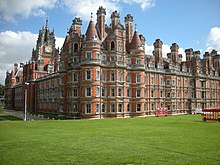
Royal Holloway, University of London
University in Egham, EnglandWikipedia
24
MENTIONS
23
EPISODES
23
PODCASTS
Search complete. 24 mentions across 23 episodes found for "Royal Holloway, University of London".
Sep 24, 2026

Hannah MathersGUEST
Um, and so it looked like I wasn't going to get onto a masters.
Hannah MathersGUEST
I couldn't find something that was going to work, but eventually right at the end of the summer, there were places at a masters at Royal Holloway, um, about quaternary science, which is like the last two and a half million years of geological times, all about the ice ages.
Hannah MathersGUEST
So this was a great opportunity to have a real focus, but it was a very intense year.
Hannah MathersGUEST
Um, It was a very intense year, so it nearly killed me, I think, but it did give me the opportunity to get my PhD scholarship off the back of that.

Ruth LassNARRATOR
It was her job to bring Stanko's ideas into land.
Ruth LassNARRATOR
Before she began advising the police and the Home Office, Stanko had a distinguished academic career, holding research posts at University College London, Royal Holloway University of London, and Brunel.
Ruth LassNARRATOR
In 1996, she received a Lifetime Achievement Award from the American Society of Criminology.
Ruth LassNARRATOR
She flew around the world, giving two keynote speeches a week on the costs and causes of domestic violence.

Sam LeithHOST
Hello and welcome to the Spectator's Book Club podcast.
Sam LeithHOST
I'm Sam Leith, the literary editor of the Spectator, and this week I'm joined by John Sellers, who's a professor of the history of philosophy in the University of London, Royal Holloway, and whose new book touches on a subject that's very much in the news, despite being a couple of thousand years old, Stoicism.
Sam LeithHOST
Your book's called Stoicism is Not What You Think.
Sam LeithHOST
What do people think Stoicism is and how do they get that wrong?

Zain Al-MahawisGUEST
Um, I'm Dr. Zain Al-Mahawis.
Zain Al-MahawisGUEST
I'm a research assistant at Royal Holloway.
Zain Al-MahawisGUEST
I just graduated from my PhD at the University of Glasgow.
Zain Al-MahawisGUEST
I was diagnosed with retinitis pigmentosa between the ages of, uh, four and six, and I'm now based in Scotland, and I am accompanied by my fluffy companion, Mitch, who is my guide dog.

speaker_0HOST
So yourself, the Honorary Professor Johnny Cortez, MBE.
speaker_0HOST
You're a graduate of the Royal Holloway College, University of London, Doctor of Philosophy at the Maldine College and the Animal Ecological Research Group, Oxford.
speaker_0HOST
You're a Beacon Professor of the University of Gibraltar and hold an honorary doctorate from the University of Kingston.
speaker_0HOST
In 2003, you were awarded an MBE for your services to ecology.

AnnaHOST
That's this work.
AnnaHOST
Celsa Pardo-Araujo and Nanda Rea at the Institute of Space Sciences in Barcelona with Michele Ronchi at Astron in the Netherlands and Vanessa Graber at Royal Holloway in London published this week in Nature Astronomy.
AnnaHOST
It's a population synthesis.
AnnaHOST
Assume a distribution of magnetic fields and spins at birth, then evolve the whole simulated population forward.

AnnaHOST
That's this work.
AnnaHOST
Celsa Pardo-Araujo and Nanda Rea at the Institute of Space Sciences in Barcelona with Michele Rahme at ASTRON in the Netherlands and Vanessa Graber at Royal Holloway in London published this week in Nature Astronomy.
AnnaHOST
It's a population synthesis.
AnnaHOST
Assume a distribution of magnetic fields and spins at birth, then evolve the whole simulated population forward.

Anna Niia VarfolomeevaHOST
She is Associate Professor of Geography at the University of Washington and founder and editor of the blog Cryopolitics, which I highly recommend to everyone.
Anna Niia VarfolomeevaHOST
Klaus Dotz is professor of geopolitics at Royal Holloway, University of London.
Anna Niia VarfolomeevaHOST
His research spans geopolitics and security, ice studies, and international governance of the Arctic and Antarctic.
Anna Niia VarfolomeevaHOST
He is the author and editor of numerous books, including Ice, Nature, and Culture, and Border Wars.

Kevin EnglandHOST
And for the record, yes, I said 2018, and in a moment you'll understand why.
Kevin EnglandHOST
That study, which was conducted by a team at Royal Holloway University of London, indicated that Bombus terrestris, the European bumblebee, was observed in the field to not be performing within norms following exposures to the insecticide sulfoxaflor.
Kevin EnglandHOST
The product is spelled S-U-L-F-O-X-A-F-L-O-R, in case you were wondering.
Kevin EnglandHOST
The researchers observed and measured fewer queens being produced, reduced colony growth, and lower reproductive success overall.

Paul McGannHOST
He's a member of what's known as the equestrians, the strata of middle class, which is rising in influence within Roman society, named after their one-time proliferation within the Roman cavalry, pointedly obliged to provide their own horses.
Paul McGannHOST
David Quinn is a reader in ancient and late antique history at Royal Holloway, University of London.
David GwynnGUEST
[instrumental music] This is a class that emerged originally in the second century BC in the Roman Republic.
David GwynnGUEST
They're socially below the level of the Senate, but they become marked out as a separate block of society because they're generating wealth, above all particularly actually through trade, through industry, and successful equestrians can begin to reach the senatorial order.
13 more episodes mention Royal Holloway, University of London.
Create an account to see the whole feed, search across every transcript, and follow the entities you care about.