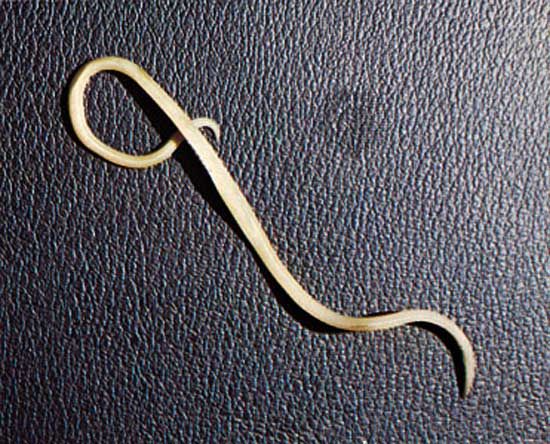
Roundworm
AnimalWikipedia
98
MENTIONS
28
EPISODES
27
PODCASTS
Search complete. 98 mentions across 28 episodes found for "Roundworm".
Sep 17, 2026

Mysha KaziGUEST
And then senior year, someone mentioned like there possibly being a link between Alzheimer's and type 2 diabetes.
Mysha KaziGUEST
So I kind of looked into that, but it was really hard with C. elegans and stuff.
Mysha KaziGUEST
And it's like kind of like a really broad idea.
Mysha KaziGUEST
So I would like to still focus on it because it's definitely crazy.

Masud HusainGUEST
Now, maybe centuries from now, we might be able to.
Masud HusainGUEST
And of course, we are closer to doing that in simpler animals like the fruit fly, Drosophila, or in the worm, C. elegans.
Masud HusainGUEST
We can kind of pinpoint neurons which are involved in a particular process.
Masud HusainGUEST
But in humans, you

Stephen PhinneyGUEST
Well, what importance is that clinically? Well, a number of subsequent papers show that upper airway inflammation and asthma are caused by down-regulating these enzymes.
Stephen PhinneyGUEST
That if you take a little nematode called C. elegans and you grow that nematode in regular culture medium, it lives typically for 20 days.
Stephen PhinneyGUEST
If you grow it in a culture medium that contains enough beta-hydroxybutyrate, it lives 26% longer.
Stephen PhinneyGUEST
Now this nematode is a darling of the longevity research community because it only lives 20 days.

JeanNARRATOR
Because the genes of C. elegans often have counterparts in humans, the implications for human aging were hard to ignore.
JeanNARRATOR
Still, worms are one thing, mammals another.
JeanNARRATOR
The first key discovery about human aging wouldn't come for another decade.
JeanNARRATOR
In 2005, Shinya Yamanaka, then a medical researcher at Kyoto University, was trying to solve a supply problem.

speaker_0HOST
So let's go ahead and jump into things.
speaker_0HOST
If anyone has ever used the Google machine before, may have ended up looking up C. elegans and found nematodes, right? Caenorhabditis elegans, for whatever reason, um, claims the, the search engine results for C.
speaker_0HOST
elegans, unless you're spelling out the whole name of Sericostmus or you type in tarantula or spider afterwards.
speaker_0HOST
So I just thought that was a funny little Easter egg looking up.

Andrea ZangaraGUEST
And independent researchers at the University of Valencia, and there is a research center really specific for AHR research, they studied whether pomanops could affect this pathway.
Andrea ZangaraGUEST
In C. elegans, which is a tiny worm that is also a common aging model, Pominox helps support lifespan and movement through AHR-related effects.
Andrea ZangaraGUEST
And similarly, in aged mice, it's also supported antioxidant activity, cellular balance, mitochondrial protection, and movement.
Andrea ZangaraGUEST
So in simple terms, maybe we can say that Pomonops protects the body, natural cell resilience linked to healthier aging rather than forcing an artificial pathway.

Oded RechaviGUEST
We can't do this to humans, the things that we do to these animals, and we can change their genes, do all kinds of things to them.
Andrew HubermanHOST
The community of people that study C. elegans has literally numbered and named each neuron so that two laboratories on opposite sides of the world can publish papers on the same neuron knowing that it's the same neuron-
Oded RechaviGUEST
Absolutely
Andrew HubermanHOST
...
Andrew HubermanHOST
in the two different laboratories, something that is, uh, extremely hard to do in any mammalian model-
Oded RechaviGUEST
Right
Andrew HubermanHOST
... a mouse, or, uh, certainly in humans, and has posed huge challenges that, uh, give great advantages to studies of things like C. elegans.
Oded RechaviGUEST
A C. elegans nematode always has nine hundred and fifty-nine cells, out of which three hundred and two are neurons.

Onder AlbayramGUEST
I'm originally from Turkey, but starting as an undergrad research scholar at the MRCLMB, the University of Cambridge, the UK, back to 2004.
Onder AlbayramGUEST
And I participated in a study of the sensory ability of the nematode C. elegans, where I joined and learned about the neuron and neuroscience that time and what we discovered that the mechanism of how this animal, small animal, microscopic warmth.
Onder AlbayramGUEST
integrates the signal from food to hypoxic stress to regulate its adaptive behavior.
Onder AlbayramGUEST
That was fascinating.
Onder AlbayramGUEST
Um, I was very lucky and they respected me, which is another point.
Onder AlbayramGUEST
And those respect, I think it deserved because I was also respectful.
Onder AlbayramGUEST
Um, but again, the other thing is the, the lab, which they initially discovered the C. elegans got the Nobel prize.
Onder AlbayramGUEST
I was working the, in the Nobel prize lab.

Andrew HubermanHOST
But Dr. Oded Rakavi's lab is asking whether RNA can sometimes carry more than just temporary instructions.
Andrew HubermanHOST
They use C. elegans, these tiny, transparent worms, to study inheritance with unusual
Oded RechaviGUEST
precision.
Oded RechaviGUEST
And the strongest evidence comes from small RNAs.

Yuan ZhaoHOST
Insulin-slash-IGF-1 signaling is one of the best-established molecular pathways regulating longevity across animal species.
Yuan ZhaoHOST
In C. elegans, the gene DAF2 encodes an insulin-slash-IGF1 receptor, and reducing its activity can substantially extend lifespan.
Yuan ZhaoHOST
However, most previous aging studies in this model have focused on hermaphrodites, leaving considerably less known about how males respond to interventions targeting the same pathway.
Yuan ZhaoHOST
To investigate these sex-specific effects, the researchers used an auxin-inducible Degren system to selectively degrade the DAF2 receptor throughout the body or within particular tissues.
Yuan ZhaoHOST
Median lifespan increased by 446%, compared with a 109% increase in hermaphrodites exposed to the same intervention.
Yuan ZhaoHOST
The age at which 10% of the population remained alive reached 106 days in treated males, compared with 15 days in controls.
Yuan ZhaoHOST
The authors described this as one of the largest lifespan extensions reported in C. elegans, or any animal, from a single intervention.
Yuan ZhaoHOST
The effects also depended strongly on which tissue was targeted.
18 more episodes mention Roundworm.
Create an account to see the whole feed, search across every transcript, and follow the entities you care about.