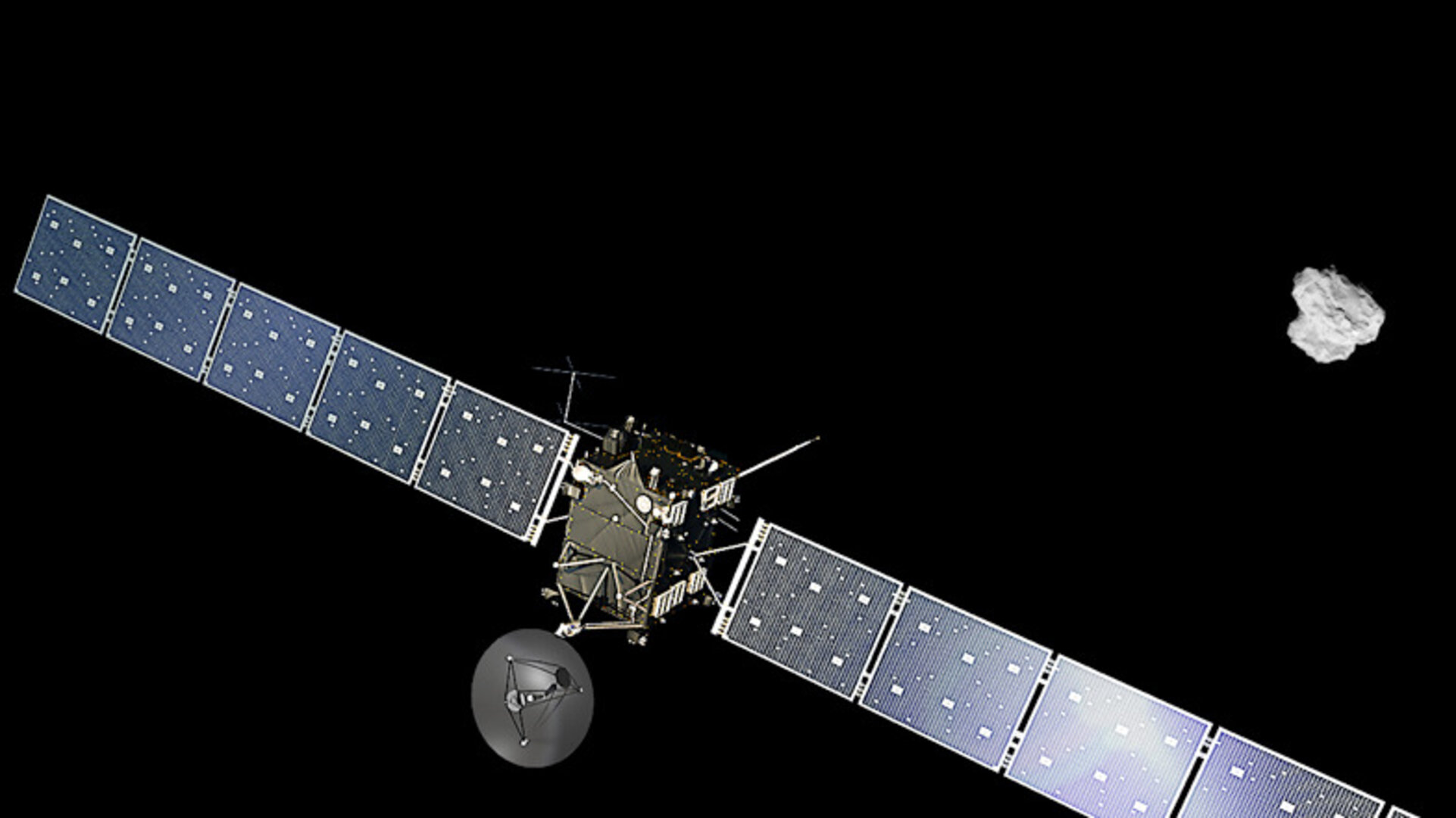
Rosetta
Space probeWikipedia
8
MENTIONS
5
EPISODES
5
PODCASTS
Search complete. 8 mentions across 5 episodes found for "Rosetta".
Oct 11, 2026

John FolmarGUEST
He was introduced to us earlier in the first king's reading.
John FolmarGUEST
In 2014, the Rosetta space mission soft-landed a probe onto a shooting comet traveling at 50 kilometers per second.
John FolmarGUEST
That's because humans want to know things.
John FolmarGUEST
We want to explore the world.

Brian CoxGUEST
Well, that's one of the questions, actually.
Brian CoxGUEST
One of the things the Rosetta probe is trying to do is trying to look at the water on that comet to see if it has the same characteristics, the same mixture of isotopes, if you know that language, so the same composition that the water on Earth has.
Brian CoxGUEST
Because probably the most widely accepted theory is that the Earth was very hot when it was formed about 4.54 billion years ago, and so the water would have been driven off So you wouldn't have much water in the inner solar system.
Brian CoxGUEST
You find lots of water in the outer solar system.
Brian CoxGUEST
Could these
Alice RobertsGUEST
comets even have brought life as well? I mean, that's a...
Brian CoxGUEST
I mean, this is another thing that the Rosetta mission and the Thule lander is trying to look for organic molecules, see how complex they are.
Brian CoxGUEST
You know, we find amino acids certainly out there in space.

Cecilia TubianaGUEST
So the, the water production rate is pretty large.
Cecilia TubianaGUEST
Uh, larger than, uh, other, uh, comets, for instance, of the 67P which was a target of the Rosetta mission, which show a much, uh, smaller production rate.
Cecilia TubianaGUEST
But it is not, like, extraordinary large.
Cecilia TubianaGUEST
There are other comets which, uh, like the Comet Halley which has shown a production rate which is-
Cecilia TubianaGUEST
In general, the, the production rate has a connection with the size of the, of the nucleus, of the active part, or the active fraction on the nucleus.
Cecilia TubianaGUEST
Uh, even though this is not always the case.
Cecilia TubianaGUEST
I mean, a good counter example is, uh, coming, Comet Churyumov, which was actually the, the original target of the Rosetta mission, which is a pretty small comet, but its activity is very high.
Cecilia TubianaGUEST
And, uh, and so this is called a, uh, hyper, um, hyperactive comet.

speaker_2HOST
Right.
speaker_2HOST
In several high-profile missions like the Galileo probe in 1990, the NEAR Shoemaker probe in 1998, and the Rosetta spacecraft in 2005, the telemetry data showed something impossible.
speaker_0HOST
What did it show?
speaker_2HOST
After swinging past the Earth, the spacecraft came out of the maneuver with a tiny bit more speed than our physics models predicted.

speaker_1HOST
But to prove that, the water on those comets must match the isotopic signature of the water in Earth's oceans.
speaker_1HOST
The ESA's Rosetta mission, which rendezvous with Comet 67P in 2014, found that 67P's water had a very different D-H ratio than Earth's water, which sort of complicated the theory.
speaker_5HOST
Oh, interesting.
speaker_1HOST
But Halley's Comet belongs to a different class, a different family of cometary bodies.